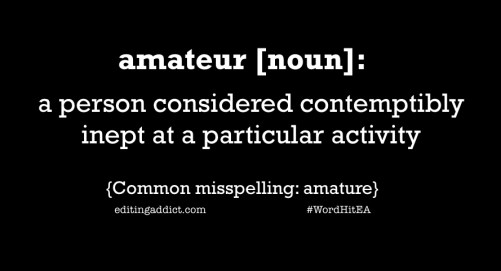
amateur [noun]: a person considered contemptibly inept at a particular activity
{Common misspelling: amature}
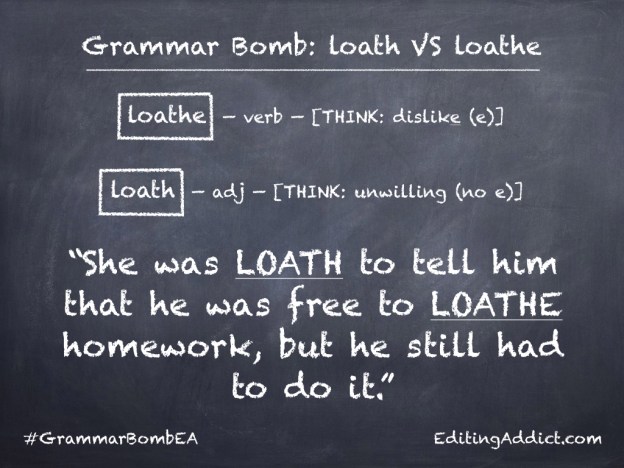
“She was loath to tell him that he was free
to loathe homework, but he still had to do it.”
loathe verb [THINK: dislike (e)]
loath adj [THINK: unwilling (no e)]


“In English, proper nouns (nouns which signify a particular person, place, or thing) are capitalized.
Following this rule, when Earth is discussed as a specific planet or celestial body, it is capitalized…When Earth is a proper noun, the is usually omitted.”
“When you are talking about the ground or soil as a surface or stratum, then you must lowercase the word…It is acceptable to leave earth lowercase and use the with earth if you are talking about it as the planet we live on: The earth rotates on its axis.”
[read more about it on blog.dictionary.com]


“In formal American English, that is used in restrictive clauses, and which in used in nonrestrictive clauses.”
“A restrictive clause contains information that limits the meaning of the thing being talked about….Note that in restrictive clauses, sometimes that can be omitted.”
A nonrestrictive clause…is used to supply additional information that is not essential to understanding the main point of the sentence…it adds extra information, almost like an aside. You could delete the details…and the sentence would still make sense.”
[read more about it on blog.dictionary.com]
Glimpse inside the mind of a contemporary philosopher...
reciprocity
The Life of a Teenage-Traveler
Plus ça change, plus c'est la même chose / The more things change, the more they stay the same
writer & mother, feeding my dream and my family
AWAKENING THE SLEEPING READERS
A blog full of humorous and poignant observations.
The only thing worse than being 'blind' is having a Sight but no Vision
A contrast between elegance and grunge.
The strings of my life’s soulfulness in the beauty of eternity.
Adult & YA Romantic Fantasy Author
A topnotch WordPress.com site
Think upon your thoughts and it will take you higher
Words of Wonder, Worry and Whimsy
Finding the Light in the Darkness and the Darkness in the Light
A vacant mind and lost thoughts


 Editing Addict, LLC