
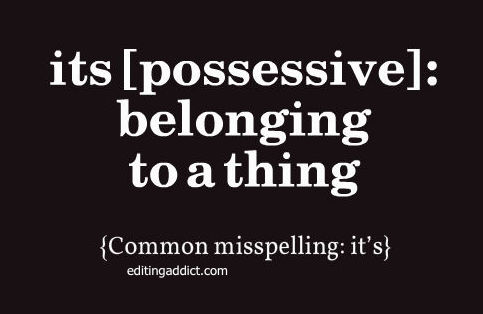
wholly [adverb]: entirely
{Common misspelling: holy / wholey}
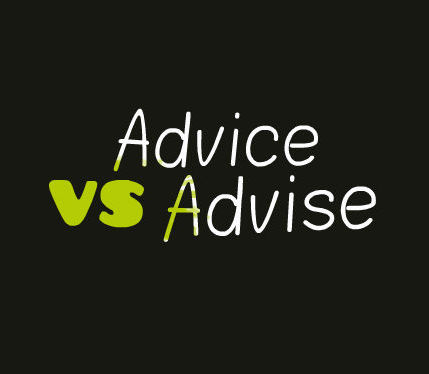
“Advise is a verb meaning “to give counsel to; offer an opinion or suggestion as worth following.””
“…Advice is a noun meaning “an opinion or recommendation offered as a guide to action, conduct, etc.””
[read more about it on blog.dictionary.com]

“The particular sense of desert that appears in just deserts ultimately derives from the Old French verb deservir meaning “to deserve,” and has been around in English since the late 1200s. Dictionary.com defines desert as “reward or punishment that is deserved.” The idiom get/receive one’s just deserts means “to be punished or rewarded in a manner appropriate to one’s actions or behavior.”
“…Dessert with the double s ultimately derives from the French desservir meaning “to clear the table.” Dictionary.com defines dessert as “cake, pie, fruit, pudding, ice cream, etc., served as the final course of meal.” While it is certainly true that a meal of cake, and cake alone, could be called “just desserts,” this is not the spelling or meaning of the phrase that has been around in English since the late 1300s.”
[read more about it on blog.dictionary.com]
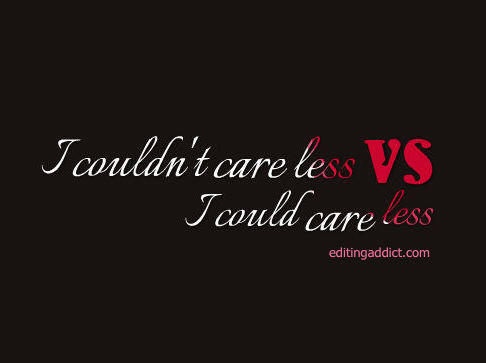
“When you want to colloquially express that you don’t care at all about something you might say “I couldn’t care less.” This phrase first popped up in British English at the turn of the 20th century and is still popular today. In the 1960s, a controversial American variant of this phase entered popular usage: “I could care less.””
“…“I could care less” emerged as a sarcastic variant employing Yiddish humor...mirrors the intonation of the sarcastic Yiddish-English phrase “I should be so lucky!” where the verb is stressed.”
“…In English, along with other languages, idioms are not required to follow logic, and to point out the lack of logic in one idiom and not all idioms is…illogical. …not everyone you encounter will be a lexicographer, so be aware that [some]…will cringe if you use “I could care less” in conversation.”
[read more about it on blog.dictionary.com]

“Who is a subjective-case pronoun, meaning it functions as a subject in a sentence…”
“Who, like I, he, she, and they, performs actions, as in Who rescued the dog? (who is doing the rescuing in this sentence).”
“…whom is an objective-case pronoun, meaning it functions as an object in a sentence.”
Whom, like me, him, her, and them, is acted on, as in Whom did you see? (whom is being seen here, not doing the seeing). Whom more commonly appears when it follows a preposition, as in the salutation To Whom it may concern (Does it concern he? No. Does it concern him? Yes.) or in the title of Ernest Hemingway’s 1940 novel For Whom the Bell Tolls.”
[read more about it on blog.dictionary.com]

“The two-word expression a while is a noun phrase, consisting of the article a and the noun while, defined as “a period or interval of time.”
“…The noun phrase a while can and often does follow a preposition, such as for or in: “He said he would be home in a while.”
“The one-word awhile is an adverb that means “for a short time or period.””
“The adverb awhile cannot follow a preposition, a rule that makes sense if you revisit the definition of the term and drop it into a sentence…“He said he would be home in for a short time or period.””
[read more about it on blog.dictionary.com]
Glimpse inside the mind of a contemporary philosopher...
reciprocity
The Life of a Teenage-Traveler
Plus ça change, plus c'est la même chose / The more things change, the more they stay the same
writer & mother, feeding my dream and my family
AWAKENING THE SLEEPING READERS
A blog full of humorous and poignant observations.
The only thing worse than being 'blind' is having a Sight but no Vision
A contrast between elegance and grunge.
The strings of my life’s soulfulness in the beauty of eternity.
Adult & YA Romantic Fantasy Author
A topnotch WordPress.com site
Think upon your thoughts and it will take you higher
Words of Wonder, Worry and Whimsy
Finding the Light in the Darkness and the Darkness in the Light
A vacant mind and lost thoughts




 Editing Addict, LLC