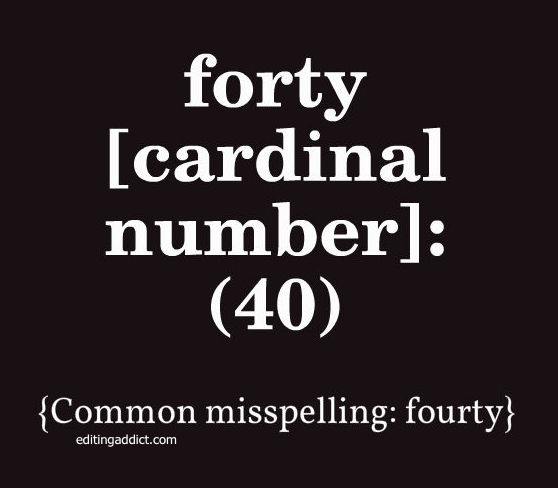
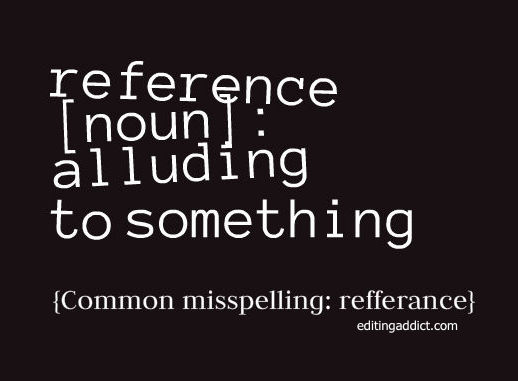
forty [cardinal number]: number (40)
{Commom misspelling: fourty}
“The form alright is a one-word spelling of the phrase all right. Alright is commonly used in written dialogue and informal writing, but all right is the only acceptable form in edited writing. Basically, it is not all right to use alright in place of all right in standard English.“
[read more about it on blog.dictionary.com]
“Many think that the difference between judgement and judgment is that the longer version is the British spelling, whereas the shorter one is the convention in the US. While some claim that Noah Webster first recorded the spelling of judgment in his 1828 American Dictionary of the English Language, judgment has been the prevailing spelling on both sides of the pond since the late 1600s.”
[read more about it on blog.dictionary.com]

“Complement with an e…meaning “something that completes.” If something complements something else, it completes it, enhances it, or makes it perfect.
The noun compliment means “an expression of praise, commendation, or admiration,” and the verb means, “to praise or express admiration for someone.”
[read more about it on blog.dictionary.com]

Grammar Girl has an amazing article describing the history, use, and suggestions regarding contractions: “Use contractions in formal writing if it will sound stranger to avoid them than to use them.”
The Chicago Manual of Style says, “Most types of writing benefit from the use of contractions. If used thoughtfully, contractions in prose sound natural and relaxed and make reading more enjoyable.”
Do you remember the character Data from Star Trek? He could not use any form of contraction. Ever. And it set him apart as a non-human. Don’t do that to your writing. Make sure your reader knows there is a human behind the words. Don’t overdo it. There ain’t no reason to sound uneducated in your struggle of pen and paper.

“Stationary with an a…means “fixed in one place and not moving,” like a stationary bicycle at the gym.
Stationery with an e stems from the term stationer, which refers to “a person who sells the materials used in writing, such as paper, pens, pencils, and ink.””
[read more about it on blog.dictionary.com]
Glimpse inside the mind of a contemporary philosopher...
reciprocity
The Life of a Teenage-Traveler
Plus ça change, plus c'est la même chose / The more things change, the more they stay the same
writer & mother, feeding my dream and my family
AWAKENING THE SLEEPING READERS
A blog full of humorous and poignant observations.
The only thing worse than being 'blind' is having a Sight but no Vision
A contrast between elegance and grunge.
The strings of my life’s soulfulness in the beauty of eternity.
Adult & YA Romantic Fantasy Author
A topnotch WordPress.com site
Think upon your thoughts and it will take you higher
Words of Wonder, Worry and Whimsy
Finding the Light in the Darkness and the Darkness in the Light
A vacant mind and lost thoughts


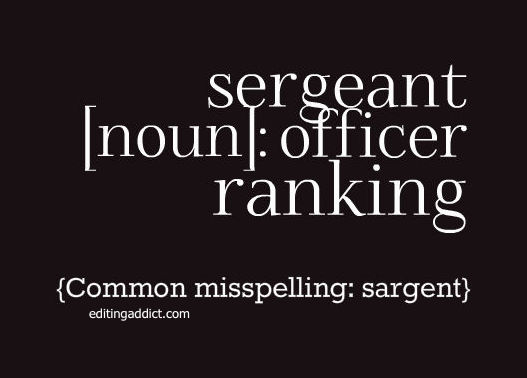







 Editing Addict, LLC