Grammar Bomb: Pore VS Pour

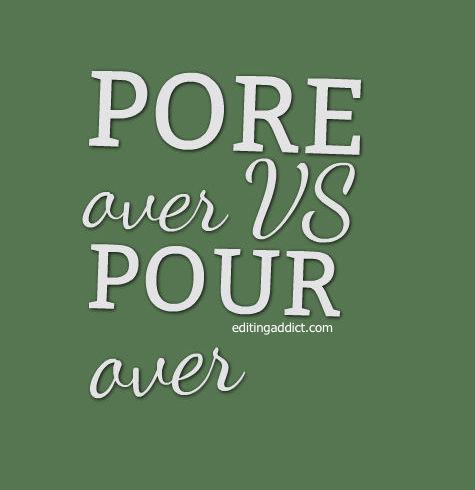
You PORE over books, and you POUR words from your mouth.

#GrammarBombEA


Pore [THINK: ponder]
Pour [THINK: cup (U)]


Pore means “to read or study with great attention.” You pore over books.”

“…Pour, on the other hand, means “to send flowing or falling,” as in He poured a cup of coffee.”

[read more about it on blog.dictionary.com]

Remembering God Has Already Read It: A Christian’s Take on Surviving Your First Draft

#DailyFixEA

[GUEST BLOG by Rachel Newman]

WritingI find great joy and fulfillment in helping authors learn to convey their ideas in clear and precise ways while still preserving their individual voices. When I first started editing, I wasn’t sure if I cared too much about penning my own stories. My heart was for others; and besides, I wasn’t sure I had a story to tell.

So it was with great surprise and excitement that my story came in the middle of my personal Bible study with God. I was reading a familiar passage when images, people, and places appeared in the world of my imagination; and I knew I had to write them down.

Delving into my own work in progress (“WIP”) has given me greater insight into the struggle that authors go through. By the time their manuscripts arrive in my inbox, they have poured months and sometimes years into bringing their pages to life. They have revised and rewritten multiple times and they are finally ready for a final polish. It is a vulnerable place to be—to have a professional handle your work with the intent on improving it.

But if you are still neck-deep in your first draft, you may wonder if you will even get to that point. Life can be full of obligations and responsibilities, and your writing can sometimes fall into last priority. Or maybe you have plenty of time to write, but the words you need are MIA.

The following have helped me survive the discouragement, the weight, and even the elation of composing that first draft. I hope these will help you too.

1. Don’t edit

Editing uses a different part of your brain than writing does. When you are in the creative mode, you don’t need to think about whether your sentence structure is correct or even if you are using the right words. Just tell the story. You will edit it later.

2. Write every day

You may not have the time to sit in front of the computer for hours every day; but if you write a little every day, it accumulates. All those days you would have said, “I’ll wait until I have enough time” turn into useful stepping stones to that finished product.

When I first started my WIP, I would allow weeks and sometimes months to pass before I would pick it back up. I was waiting for large blocks of time in which I could get substantial work completed. At one point, an author friend challenged me to write one page a day and I took him up on that challenge.

The problem was, I wasn’t always able to be at my computer long enough to hammer out a page. So I came up with a solution that worked for me. I carried around a diary everywhere I went and anytime I was able, I wrote down the story by hand. My goal was one page a day. That small diary page may not seem like a lot, but at the end of a very stressful, full day, it was doable. As each day passed, the story took shape and slowly, but surely, became a reality—all thanks to my friend who challenged me. That leads into my next point.

3. Find trusted friends

…who will challenge you, encourage you, and ask you about your WIP. These friends can be found in a writers’s group, at church, or in writing forums online. It is important they be trustworthy and want you to succeed.

4. You are not on your own

The last—and most important thing to keep in mind—is that you are not on your own with this draft. You have been made in the image of God, and He has given you this story. Since He is outside of time, He has already seen your completed work; He knows how the story ends, and how you are going to get there. Anytime you find yourself at a loss for words, return your mind to the place of His presence. Meditate on His love.

1 John 4:10 tells us: “Herein is love, not that we loved God, but that he loved us, and sent his Son to be the propitiation for our sins.”

In His presence, your sins are erased. There is nothing between you and His love. He has opened His mind to yours and joined your spirits together. In that place, your story will continue. Your efforts fall away, and His strength becomes your sustaining force.

These are the things that keep me plowing ahead, excited to see how the story unfolds. What other strategies have you discovered to help you finish your WIP?

Pleasant penning,
Rachel Newman
Freelance Editor and Indexer
Certified Paralegal
MrsMatthewNewman@gmail.com

I would love to meet you! Join me May 1–2, 2015 in Austin, Texas at PENCON 2015, the only convention for Christian editors. Learn how to enter the editing field or enhance an already established business. Network with other editors, and meet with the speakers one-on-one. Visit: thechristianpen.com.
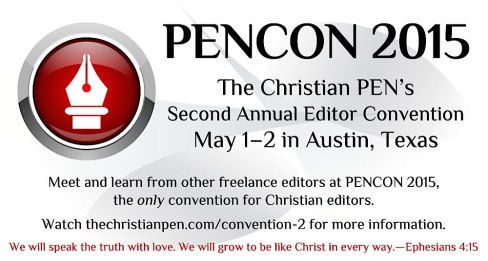
PENCON horizontal ad, web res

Manuscript [preparation] Guidelines

#DailyFixEA

The Chicago Manual of Style on manuscript preparation:

Publishers’ manuscript-prepartion guidelines. Many publishers have specific requirements or preferences regarding choice of software and typeface, as well as formats for submitting illustrations and tables along with your manuscript. These should be followed to the letter. Consistency and simplicity in all matters is essential: authors should know that their manuscripts will almost always be converted into another software environment for publication and that, therefore, the consistency and accuracy of the content (i.e., the words themselves) are more important than the style of presentation. A simple presentation is always preferable to an elaborately formatted manuscript. Authors who want a more explicit idea of what publishers look for in the format and structure of a manuscript would do well to consider the steps in a manuscript editor’s typical cleanup routine (see 2.77).”

The University of Chicago Press‘s 16th edition, The Chicago Manual of Style, is an excellent resource for writers of all kinds. You can find it here.

Parallel [straight & narrow] Structure

#DailyFixEA

Laurie E. Rozakis, Ph.D. on parallel structure:

Parallel structure means putting ideas of the same rank in the same grammatical structure. Your writing and speech should have parallel words, phrases, and clauses. Parallel structure gives your writing many admirable strengths, including the following:

    • Rhythm
    • Emphasis
    • balance
    • Impact
    • Crispness
    • Conciseness

Parallel words share the same part of speech (such as nouns, adjectives, or verbs) and tense (if the parallel word are verbs).

    • My date was obnoxious, loud, and cheap; no doubt he thought I was gorgeous, personable, and witty.
    • We pleaded, begged, and prayed—to no avail.

Parallel phrases create an underlying rhythm in your speech and writing…

    • “For taking away our Charters, abolishing our laws, and altering the Forms of our Government . . . ” (Declaration of Independence)
    • “Now the trumpet summons us again—not as a call to bear arms, though arms we need—not as a call to battle, though embattled we are—but a call to bear the burden of a long twilight struggle…” (John F. Kennedy’s inauguration speech)

Parallel clauses can give your writing balance as well….

    • “Let every nation know, whether it wishes us well or ill, that we shall pay any price, bear any burden, meet any hardship, support any friend, oppose any foe to assure the survival and success of liberty.” (John F. Kennedy’s inauguration speech)
    • “Our chiefs are killed; Looking-Glass is dead; Ta-Hool-Shute is dead.” (Chief Joseph’s surrender speech, 1877)”

Rozakis‘s book, The Complete Idiot’s Guide to Grammar and Style, is an excellent resource for writers of all kinds. You can find it here.

Quick book-signing trick

#DailyFixEA

[found on acuff.me; by Jon Acuff]

“Pssst Writers! Quick book signing trick.

If you’re an author, and lots of you are, you are going to sign books. Here’s a trick my friend Robert D. Smith taught me.

Always sign in blue sharpie, not black. Why? Well, the publisher can publish in black. Sometimes books are printed with a signature. If you sign in blue though, readers know with completely certainty that you actually signed it. It’s a small thing, but small things can be awesome.

Go blue!”

[found on http://acuff.me/2014/10/pssst-writers-quick-book-signing-trick/]


Hook Your Literary Agent

#DailyFixEA

[found on writersdigest.com]

“The 4 Components That Hook Literary Agents

1. Tell the literary agent who you are

State your name and job title, or the title of the position you’re seeking. “Hi, my name is Miranda Mechanic, and I’m a licensed automotive mechanic who writes how-to articles for women who don’t want their cars to get the best of them.”

2. Literary agents want to know what you want

Don’t beat around the bush. State what you’re after. “I’m interested in placing some of my articles with your magazine, Auto Care for Everybody.”

3. Show the literary agents why you’re the best choice

List any degrees, writing credentials, training or experience that relate to what you’re seeking. “I’ve been taking mechanical things apart since before I could walk, and I’m the owner-operator of my own body shop.” Be sure the qualifications match your stated goal. Saying you want to write an article on mechanics and then listing your degrees in early Russian literature won’t help. If you’re unable to come up with any related experience, name qualities or skills you possess, such as attention to detail, passion for the subject and so on.The key is to be brief and memorable. You’re looking for that special something that separates you from the crowd.

4. Give literary agents a call to action

You can do a great job selling yourself, but if you don’t follow through by asking for what you want, you’ve wasted your time. Take a deep breath and go for it. “I’d like to show you copies of my articles, including ‘How to Change a Tire When It’s Twenty Below Zero’ and ‘How to Add Oil When You’re Wearing a Power Suit.’ ” The call to action is what leads to further interaction. Don’t neglect this most important step.”

[found on http://www.writersdigest.com/literary-agents?et_mid=691229&rid=239481182]


Punctuation [semi] Outdone

#DailyFixEA

Lynne Truss on punctuation:

“But colons and semicolons — well, they are in a different league, my dear! They give such lift! Assuming a sentence rises into the air with the initial capital letter and lands with a soft-ish bump at the full stop, the humble comma can keep the sentence aloft all right, like this, UP, for hours if necessary, UP, like this, UP, sort-of bouncing, and then falling down, and then UP it goes again, assuming you have enough additional things to say, although in the end you may run out of ideas and then you have to roll along the ground with no commas at all until some sort of surface resistance takes over and you run out of steam anyway and then eventually with the help of three dots . . . you stop.

But the thermals that benignly waft our sentences to new altitudes — that allow us to coast on air, and loop-the-loop, suspending the laws of gravity — well, they are the colons and semicolons.”

Truss’s book, Eats, Shoots & Leaves, is an excellent resource for writers of all kinds. You can find it here.

Writers: How to Decide if You Need a Blog or Website

 Guest Blog by Robert Mening


I’ve been building websites since 2009 and I wanted to share my knowledge on that topic to help fellow freelance writers.

Lately, I’ve been helping a lot of writers, small businesses and even startups to set up their own sites. I’ve also received a ton of questions from my visitors.

One of the main question that is being asked a lot is following: “Is it difficult to create a website for myself? Or perhaps I should hire a web designer?”

In short, setting up a website is easy as boiling eggs these days. Fairly easy, but you can still get a couple of things wrong.

Decide: Blog or a website?

Blog is a type of website, nothing else. Blogs are built on CMS (Content management software), such as WordPress, Tumblr, Blogspot, Drupal and so on.

I’m preaching WordPress since this is by far the easiest platform to add new content, images and even videos. So if you are a writer, go with WordPress. Or if you don’t like the interface for some reason, you could also try Blogspot.

WordPress has a big variety of different FREE themes, which you can easily change on your WordPress admin page. It’s very user-friendly and doesn’t have a huge learning curve.

With those platforms (WordPress & Blogspot) you are able to create a blog as well as a website or just a mixture of them. Problem solved. There’s absolutely no need to start learning HTML5 or any other coding languages.

Decide: Self-hosted or not?

If you have some money to spend on your website – go with self-hosted option.

If you don’t want to spend ANY money on your website – go with a free service.

When you go with a self-hosted version, you’ll also need a hosting and domain name. This will cost you approx. $40 – $80 per year. One of the best in the hosting & domain industry is HostGator and Godaddy. Here’s what you can get from them:

  • You get a personal e-mail address: john@YourAwesomeSite.com
  • You have your own personal domain name, rather than having a blogspot.com/yoursitenamehere
  • You have full control over your site. No one can take it down or delete it.

As an alternative, you could try free blogging/website services such as Blogger or free version of WordPress.

What should YOU add on your website

Now that you’ve got a website with a theme, be sure to add a couple of really important pages.

1) Add an “About me” page, so the people can check out whose stories they are reading. Just write a few lines about yourself – who you are, what you do and so on. This can get readers hooked up with your content very quickly.

2) Add a “Contact” page where the audience can reach you from if they have any questions regarding your writings. Be aware, though: If your website is starting to get a lot of traffic, you’ll get some spam as well.

3) Integrate email subscription service with your website so that you could gather your visitors email addresses and let them know about your new content, offers or even e-books. This email “marketing” software can be bought from MailChimp and Aweber. At first you won’t probably need it, but it’s worth adding at some point for sure.

Conclusion

As I mentioned above, creating a website is not a rocket science. There’s absolutely no need to fill a web designer/developer pockets with your hard-earned money. It’s easy – just try it out and see how far can you go. If you get stuck, you can always search information from Google.

Meet our Guest Blogger, Robert Mening:

Robert-Mening-251x300“My name is Robert Mening and I was born in Sweden, Malmö 28 years ago. All my life I’ve been interested in computers and web. I built my first website in 2004 and ever since then I’ve been a full-time web designer and web developer.”

 | WebsiteSetup.org | Email |


Cliché Not After My Own Heart

Strong writing is a unique feature of capable authors. It is not merely words strung together, copied and pasted, from society’s lingo.

Here are clichés to avoid…like the plague:

[found on clichesite.com]
  • A rose by any other name would smell as sweet
  • Abandon ship
  • About face
  • Above board
  • Absence makes the heart grow fonder
  • Absolute power corrupts absolutely
  • Ace in the hole
  • Ace up his sleeve
  • Achilles heel
  • Acid test
  • Acorn doesn’t fall far from the tree, The
  • Actions speak louder than words
  • After my own heart
  • Ah, to be young and foolish…
  • Airing dirty laundry
  • All bent out of shape
  • All bets are off
  • All dressed up and nowhere to go
  • All ears
  • All for one, and one for all
  • All hands on deck
  • All hands to the pump
  • All heck (hell) breaks loose
  • All in a day’s work
  • All in due time
  • All over the map
  • All paled in comparison
  • All talk and no action
  • All that glitters is not gold
  • All that jazz
  • All the bits and pieces


To see the complete list of clichés from clichesite.com, click here.

[found on http://clichesite.com/alpha_list.asp?which=lett+1]