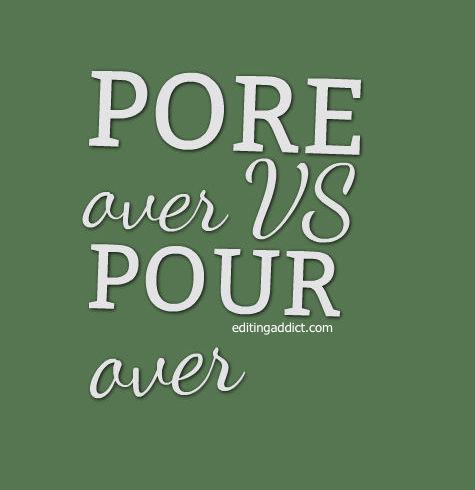
Grammar Bomb: Pore VS Pour

You PORE over books, and you POUR words from your mouth.

#GrammarBombEA


Pore [THINK: ponder]
Pour [THINK: cup (U)]


Pore means “to read or study with great attention.” You pore over books.”

“…Pour, on the other hand, means “to send flowing or falling,” as in He poured a cup of coffee.”

[read more about it on blog.dictionary.com]

Manuscript [preparation] Guidelines

#DailyFixEA

The Chicago Manual of Style on manuscript preparation:

Publishers’ manuscript-prepartion guidelines. Many publishers have specific requirements or preferences regarding choice of software and typeface, as well as formats for submitting illustrations and tables along with your manuscript. These should be followed to the letter. Consistency and simplicity in all matters is essential: authors should know that their manuscripts will almost always be converted into another software environment for publication and that, therefore, the consistency and accuracy of the content (i.e., the words themselves) are more important than the style of presentation. A simple presentation is always preferable to an elaborately formatted manuscript. Authors who want a more explicit idea of what publishers look for in the format and structure of a manuscript would do well to consider the steps in a manuscript editor’s typical cleanup routine (see 2.77).”

The University of Chicago Press‘s 16th edition, The Chicago Manual of Style, is an excellent resource for writers of all kinds. You can find it here.

Parallel [straight & narrow] Structure

#DailyFixEA

Laurie E. Rozakis, Ph.D. on parallel structure:

Parallel structure means putting ideas of the same rank in the same grammatical structure. Your writing and speech should have parallel words, phrases, and clauses. Parallel structure gives your writing many admirable strengths, including the following:

    • Rhythm
    • Emphasis
    • balance
    • Impact
    • Crispness
    • Conciseness

Parallel words share the same part of speech (such as nouns, adjectives, or verbs) and tense (if the parallel word are verbs).

    • My date was obnoxious, loud, and cheap; no doubt he thought I was gorgeous, personable, and witty.
    • We pleaded, begged, and prayed—to no avail.

Parallel phrases create an underlying rhythm in your speech and writing…

    • “For taking away our Charters, abolishing our laws, and altering the Forms of our Government . . . ” (Declaration of Independence)
    • “Now the trumpet summons us again—not as a call to bear arms, though arms we need—not as a call to battle, though embattled we are—but a call to bear the burden of a long twilight struggle…” (John F. Kennedy’s inauguration speech)

Parallel clauses can give your writing balance as well….

    • “Let every nation know, whether it wishes us well or ill, that we shall pay any price, bear any burden, meet any hardship, support any friend, oppose any foe to assure the survival and success of liberty.” (John F. Kennedy’s inauguration speech)
    • “Our chiefs are killed; Looking-Glass is dead; Ta-Hool-Shute is dead.” (Chief Joseph’s surrender speech, 1877)”

Rozakis‘s book, The Complete Idiot’s Guide to Grammar and Style, is an excellent resource for writers of all kinds. You can find it here.

Punctuation [semi] Outdone

#DailyFixEA

Lynne Truss on punctuation:

“But colons and semicolons — well, they are in a different league, my dear! They give such lift! Assuming a sentence rises into the air with the initial capital letter and lands with a soft-ish bump at the full stop, the humble comma can keep the sentence aloft all right, like this, UP, for hours if necessary, UP, like this, UP, sort-of bouncing, and then falling down, and then UP it goes again, assuming you have enough additional things to say, although in the end you may run out of ideas and then you have to roll along the ground with no commas at all until some sort of surface resistance takes over and you run out of steam anyway and then eventually with the help of three dots . . . you stop.

But the thermals that benignly waft our sentences to new altitudes — that allow us to coast on air, and loop-the-loop, suspending the laws of gravity — well, they are the colons and semicolons.”

Truss’s book, Eats, Shoots & Leaves, is an excellent resource for writers of all kinds. You can find it here.

Direct [not long-winded] Narrative

Hopper, Gale, Foote & Griffith on narrative:


“In narrating an incident the writer should begin with the circumstances in which it occurred and the events immediately preceding it. Do not begin with unnecessary explanations or remote and inconsequential events.

An indirect or long-winded approach bores the reader and destroys the impact of the story.

Furthermore, you may get lost in a maze of inconsequential details or exhaust yourself before you have narrated the climax of your story.

Suppose Susan is telling how she and Steve were nearly drowned when they rowed into the ship’s channel at Gloucester, Massachusetts, and their boat was swamped by a passing freighter.

This story should probably begin with their taking the boat out. The writer can then concentrate on how, unthinkingly, they rowed into the channel and on the ensuing events together with their emotional reactions to them. The story should not begin with an explanation of why the couple decided to vacation in Gloucester. Nor is it necessary to say that on the preceding evening a guest at their hotel suggested the excursion, or even that they were eager to get out on the water because they had been kept indoors for three days by a northeaster.”


Hopper, Gale, Foote, and Griffith‘s book, Essentials of English, is an excellent resource for writers of all kinds. You can find it here.
Simple [decluttered] Writing

William Zinsser on the need for simplicity in writing:


“Clutter is the disease of American writing. We are a society strangling in unnecessary words, circular constructions, pompous frills and meaningless jargon.

Who can understand the clotted language of everyday American commerce: the memo, the corporation report, the business letter, the notice from the bank explaining its latest “simplified” statement? What member of an insurance or medical plan can decipher the brochure explaining his costs and benefits? What father or mother can put together a child’s toy from the instructions on the box? Our national tendency is to inflate and thereby sound important. The airline pilot who announces that he is presently anticipating experiencing considerable precipitation wouldn’t think of saying it may rain. The sentence is too simple—there must be something wrong with it.

But the secret of good writing is to strip every sentence to its cleanest components. Every word that serves no function, every long word that could be a short word, every adverb that carries the same meaning that’s already in the verb, every passive construction that leaves the reader unsure of who is doing what—these are the thousand and one adulterants that weaken the strength of a sentence….”


William Zinsser’s book, On Writing Well, is an excellent resource for writers of all kinds. You can find it here.

Under [sentence] Construction

Edward D. Johnson on sentence construction:


“Write in whole sentences, not in fragments….The fragment is easy to see in I discovered the overalls. When I was ladling out the chowder. The second “sentence” is merely a dependent clause of the first sentence and shouldn’t be separated from it by a period; in this example even a separating comma would be wrong (the when clause is a defining construction; see Rule 2-1)….

Such fragments are surprisingly common…after all, it’s hard to see what isn’t there…

…and it’s what isn’t there that makes a sentence or clause a fragment. Whenever something seems wrong with a sentence but it’s not clear what, check for fragments.”


Johnson’s book, The Handbook of Good English, is an excellent resource for writers of all kinds. You can find it here.