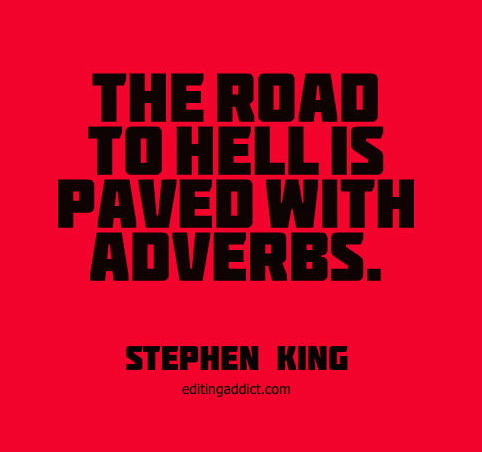
“The road to hell is paved with adverbs.”
— Stephen King
Ten Mistakes Writers Don’t See (But Can Easily Fix When They Do)
In her article, Patricia Holt hits all the major mistakes writers [new and old] make. The fixes are EASY to grasp. Read up!
“Like like and other filler words, certain adverbs have saturated our speech and our writing, making once-meaningful phrases seem totally vapid. The idea that adverbs are just extraneous fluff has led to a smear campaign against them, and it’s become common to suggest axing the part of speech altogether in order to make writing more powerful. This forceful call for more forceful writing is misguided; adverbs can be phonetically pleasing, can imbue sentences with subtlety, and should not be entirely shunned.
First, a refresher: What does an adverb do? It tells us more about a verb. If a character is running from point A to point B, “he ran” is a description that doesn’t sufficiently set the scene. How did he run? Quickly? Scatteredly? “He ran quickly and scatteredly” is less powerful than “he scampered,” an adverbless sentence that conveys the same point more succinctly. And so, many writers have spoken vehemently against the use of adverbs.
This is unfortunate because when used well, adverbs serve an important purpose, and can enhance writing rather than detract from it.”
“The real question to ask isn’t whether Mrs. Swingingjowls was right or wrong in teaching you to modify your sentences with adverbs. The question is, why are you modifying your verbs with adverbs?
This is an easy one to answer, when you think about it:
Because your verbs are weak.
Mark Twain once said, “Adverbs are the tool of the lazy writer.” Amen, Mark.
See, what’s going on is, you’re using a word that doesn’t really convey the sense, the feeling, the mood or whatever, you’re hoping to get across to your reader. “Walk” isn’t a very exciting word, and it doesn’t get across the antsy feeling you’re trying to portray in your description, so you make it “walk quickly” or “quickly walked”. You want your reader to see the force, the power in your characters’ argument, so instead of saying “they shouted across the table” you say “they shouted angrily and vehemently across the table.”
The problem is, the verbs you’ve chosen aren’t doing the job you wanted them to do in the first place. You don’t want your character to walk, you want your character to hasten, hurry, quick-step. You don’t want your characters shouting, you want them spitting words through clenched teeth, veins throbbing on reddened necks, molars locked and spittle misting between them.
The reason you’re reaching for adverbs to tell the story is because the verbs you’ve chosen are too weak to do it for you. The adverb isn’t the solution, however. Strengthening your writing is.
Think about this: If the verbs you’re using to describe the action in your story are weak and flimsy, the action description may be weak and flimsy too.
You wouldn’t be writing something with the intent of being flimsy or weak, would you? The reason you’re grabbing adverbs in the first place is because of discontent with what’s being said without them, right?
Why bother with modifiers for words that aren’t cutting it in the first place? The real crux of the problem is finding the right actions and descriptions for those actions, so that modifiers — adverbs AND adjectives — will be needed with rare and prudent infrequency.
When you’re writing adult fiction, the need to limit — if not eliminate — adverbs altogether becomes pretty obvious. What adult wants to read a grade school type of book?
No, adults want to be pulled into the story, and be engaged by it. The use of adverbs won’t get the job done, and loses the reader early on.
Show, Don’t Tell — Adverbs are NOT Good Description
With the evil adverb dragging your writing down, it’s now safe to say that using adverbs isn’t a way to make a lousy description good. It’s a lazy way to make a weak description obvious.
What adverbs do, in a nutshell, is tell the reader what’s going on in the story. That’s NOT what you want to do.
“But — I thought I was TELLING a story here?”
No. You’re not. If you’re a serious writer, you’re not “telling” a story, you’re SHOWING a story.
Don’t be lazy. Be specific. Use specific nouns and verbs to do the bulk of the work in your writing. By letting good, descriptive words do the heavy lifting, the occasional adjective and adverb aren’t the problematic, amateur-flagging beacons common in weak writing.”
For more great tips from DarcKnyt, click HERE.
Glimpse inside the mind of a contemporary philosopher...
reciprocity
The Life of a Teenage-Traveler
Plus ça change, plus c'est la même chose / The more things change, the more they stay the same
writer & mother, feeding my dream and my family
AWAKENING THE SLEEPING READERS
A blog full of humorous and poignant observations.
The only thing worse than being 'blind' is having a Sight but no Vision
A contrast between elegance and grunge.
The strings of my life’s soulfulness in the beauty of eternity.
Adult & YA Romantic Fantasy Author
A topnotch WordPress.com site
Think upon your thoughts and it will take you higher
Words of Wonder, Worry and Whimsy
Finding the Light in the Darkness and the Darkness in the Light
A vacant mind and lost thoughts


 Editing Addict, LLC