100 Expressive Interjections

[found on dailywritingtips.com by Mark Nichol]

“They often seem disreputable, like sullen idlers loitering in a public thoroughfare, but they actually do a lot of hard work and are usually persnickety about the tasks to which they are put. They are interjections — one class of them, anyway: those lacking etymological origins but packed with meaning.

But how do you know how to distinguish similar ones — or spell them, for that matter? Here’s an incomplete inventory of interjections (not including variations of actual words such as yeah for yes or onomatopoeic echoes of externally produced sounds like boom):

Ack communicates disgust or dismissal.

Ah can denote positive emotions like relief or delight (generally, pronounced with a long a).

Aha signals triumph or surprise, or perhaps derision.

Ahem is employed to gain attention.

Argh, often drawn out with additional h’s, is all about frustration.

Aw can be dismissive or indicative of disappointment, or, when drawn out, expressive of sympathy or adoration.

Aye denotes agreement.

Bah is dismissive.

Blah communicates boredom or disappointment.

Blech (or bleah or bleh) implies nausea.

Boo is an exclamation to provoke fright.

Boo-hoo is imitative of crying and is derisive.

Boo-ya (with several spelling variants) is a cry of triumph.

Bwah-hah-hah (variously spelled, including mwah-hah-hah) facetiously mimics the stereotypical archvillain’s triumphant laugh.

D’oh is the spelling for the muttering accompanying Homer Simpson’s trademark head-slapping self-abuse.

Duh derides someone who seems dense.

Eek indicates an unpleasant surprise.

Eh, with a question mark, is a request for repetition or confirmation of what was just said; without, it is dismissive.

Er (sometimes erm) plays for time.

Ew denotes disgust, intensified by the addition of one or more e’s and/or w’s.

Feh (and its cousin meh) is an indication of feeling underwhelmed or disappointed.

Gak is an expression of disgust or distaste.

Ha expresses joy or surprise, or perhaps triumph.

Ha-ha (with possible redoubling) communicates laughter or derision.

Hamana-hamana, variously spelled, and duplicated as needed, implies speechless embarrassment.

Hardy-har-har, or har-har repeated as needed, communicates mock amusement.

Hee-hee is a mischievous laugh, while its variants heh and heh-heh (and so on) can have a more derisive connotation.

Hey can express surprise or exultation, or can be used to request repetition or call for attention.

Hist signals the desire for silence.

Hm, extended as needed, suggests curiosity, confusion, consternation, or skepticism.

Hmph (also hrmph or humph) indicates displeasure or indignation.

Ho-ho is expressive of mirth, or (along with its variant oh-ho) can indicate triumph of discovery.

Ho-hum signals indifference or boredom.

Hubba-hubba is the vocal equivalent of a leer.

Huh (or hunh) is a sign of disbelief, confusion, or surprise, or, with a question mark, is a request for repetition.

Hup, from the sound-off a military cadence chant, signals beginning an exerting task.

Hurrah (also hoorah, hooray, and hurray, and even huzzah) is an exclamation of triumph or happiness.

Ick signals disgust.

Lah-de-dah denotes nonchalance or dismissal, or derision about pretension.

Mm-hmm, variously spelled, is an affirmative or corroborating response.

Mmm, extended as needed, conveys palatable or palpable pleasure.

Mwah is suggestive of a kiss, often implying unctuous or exaggerated affection.

Neener-neener, often uttered in a series of three repetitions, is a taunt.

Now (often repeated “Now, now”) is uttered as an admonition.

Oh is among the most versatile of interjections. Use it to indicate comprehension or acknowledgment (or, with a question mark, a request for verification), to preface direct address (“Oh, sir!”), as a sign of approximation or example (“Oh, about three days”), or to express emotion or serves as a response to a pain or pleasure. (Ooh is a variant useful for the last two purposes.)

Oh-oh (or alternatives in which oh is followed by various words) is a warning response to something that will have negative repercussions.

Olé, with an accent mark over the e, is borrowed from Spanish and is a vocal flourish to celebrate a deft or adroit maneuver.

Ooh, with o’s repeated as needed, conveys interest or admiration, or, alternatively, disdain.

Ooh-la-la is a response to an attempt to impress or gently mocks pretension or finery.

Oops (and the jocular diminutive variation oopsie or oopsy and the variant whoops) calls attention to an error or fault.

Ouch (or ow, extended as needed) signals pain or is a response to a harsh word or action.

Oy, part of Yiddish expressions such as oy gevalt (equivalent to “Uh-oh”), is a lament of frustration, concern, or self-pity.

Pff, extended as needed, expresses disappointment, disdain, or annoyance.

Pfft, or phfft, communicates abrupt ending or departure or is a sardonic dismissal akin to pff.

Phew, or pew, communicates disgust, fatigue, or relief. (Phooey, also spelled pfui, is a signal for disgust, too, and can denote dismissal as well. PU and P.U. are also variants.)

Poof is imitative of a sudden disappearance, as if by magic.

Pooh is a contemptuous exclamation.

Pshaw denotes disbelief, disapproval, or irritation or, alternatively, communicates facetious self-consciousness.

Psst calls for quiet.

Rah, perhaps repeated, signals triumph.

Shh (extended as necessary) is an imperative for silence.

Sis boom bah is an outdated encouraging cry, most likely to be used mockingly now.

Tchah communicates annoyance.

Tsk-tsk and its even snootier variant tut-tut are condemnations or scoldings; the related sound tch is the teeth-and-tongue click of disapproval.

Ugh is an exclamation of disgust.

Uh is an expression of skepticism or a delaying tactic.

Uh-huh indicates affirmation or agreement.

Uh-oh signals concern or dismay.

Uh-uh is the sound of negation or refusal.

Um is a placeholder for a pause but also denotes skepticism.

Va-va-voom is an old-fashioned exclamation denoting admiration of physical attractiveness.

Whee is an exclamation of excitement or delight.

Whew is a variant of phew but can also express amazement.

Whoa is a call to halt or an exclamation of surprise or relief.

Whoop-de-doo and its many variants convey mocking reaction to something meant to impress.

Woo and woo-hoo (and variations like yahoo, yee-haw, and yippee) indicate excitement. (Woot, also spelled w00t among an online in-crowd, is a probably ephemeral variant.)

Wow expresses surprise.

Yay is a congratulatory exclamation. (Not to be confused with yeah, a variant of yes.)

Yikes is an expression of fear or concern, often used facetiously.

Yo-ho-ho is the traditional pirates’ refrain.

Yoo-hoo attracts attention.

Yow, or yowza, is an exclamation of surprise or conveys being impressed.

Yuck (also spelled yech or yecch) signals disgust. (Not to be confused with yuk, a laugh.)

Yum, or yummy, is a response to the taste of something delicious and, by extension, the sight of an attractive person.

Zoinks is an expression of surprise or amazement popularized by the cartoon character Shaggy, of Scooby Doo fame.

Zowie, often in combination following wowie, a variant of wow, expresses admiration or astonishment.”

[found on http://www.dailywritingtips.com/100-mostly-small-but-expressive-interjections]

Never Give Up, Throw Something

“That’s the difference between a champ and a knife thrower. The champ may have lost his stuff temporarily or permanently, he can’t be sure. But when he can no longer throw the high hard one, he throws his heart instead. He throws something. He doesn’t just walk off the mound and weep.” 

― Raymond ChandlerThe Raymond Chandler Papers: Selected Letters and Nonfiction 1909-1959

Write For Fun, For Life

“So I write mainly for the fun of it, the hell of it, the duty of it. I enjoy writing, and will probly be a scribbler on my dying day, sprawled on some stony trail halfway between two dry waterholes.” 

― Edward AbbeyPostcards from Ed: Dispatches and Salvos from an American Iconoclast

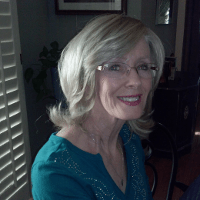
Featured Writing Addict: Emjay Luby

Emjay Luby

164938_104098889782206_213049138_n

Since the day Emjay haltingly read See Spot Run, she was hooked on the written word. As a child, she looked forward to bedtime, because bed and reading went together. All the Luby kids slept with their arms wrapped around books — not stuffed animals.

When she first read A Tree Grows in Brooklyn at the age of 15, she determined that she wanted to be a word spinner — an author — like Betty Smith. She signed up for the Famous Writers Course when she was an 18-year-old stay-at-home mom. Her first story was painstakingly pounded out on an ancient Underwood typewriter.

Many more courses followed over the years, until she finally learned that if she wanted to become a good writer, she needed to spend less time reading about writing, and more time putting words on paper.

She sent an article to a Sunday School quarterly, and was thrilled when they not only accepted her story but paid her $15 for doing what she loved. A Christian magazine accepted an article about her family’s missionary trip to Mexico a few years later.

Many years have passed since she first came up with the idea for The Courting Dress. The outline, character studies, and a couple of chapters sat in the back of a closet until she shared a few pages of the story at an Abba’s Writers meeting. “The women encouraged, prodded, and coerced me to continue writing, and get the book published. I’m grateful for their patience and perseverance as I limped my way to the finish line.”

What’s Emjay Luby’s Genre?

Fiction: Young Adult, Science Fiction, Romance

What’s  Emjay Luby’s Inspiration?

“I’m fascinated by old mining towns like Madrid in New Mexico and Jerome in Arizona. One day as I was walking through a mining museum, I thought, It would be so cool to go back in time and meet some of the people who lived and worked in these rough-and-tumble towns. Nathan Pierce, Mandy Steven’s love interest in The Courting Dress, is one of those men.”

What is Emjay Luby’s book about?

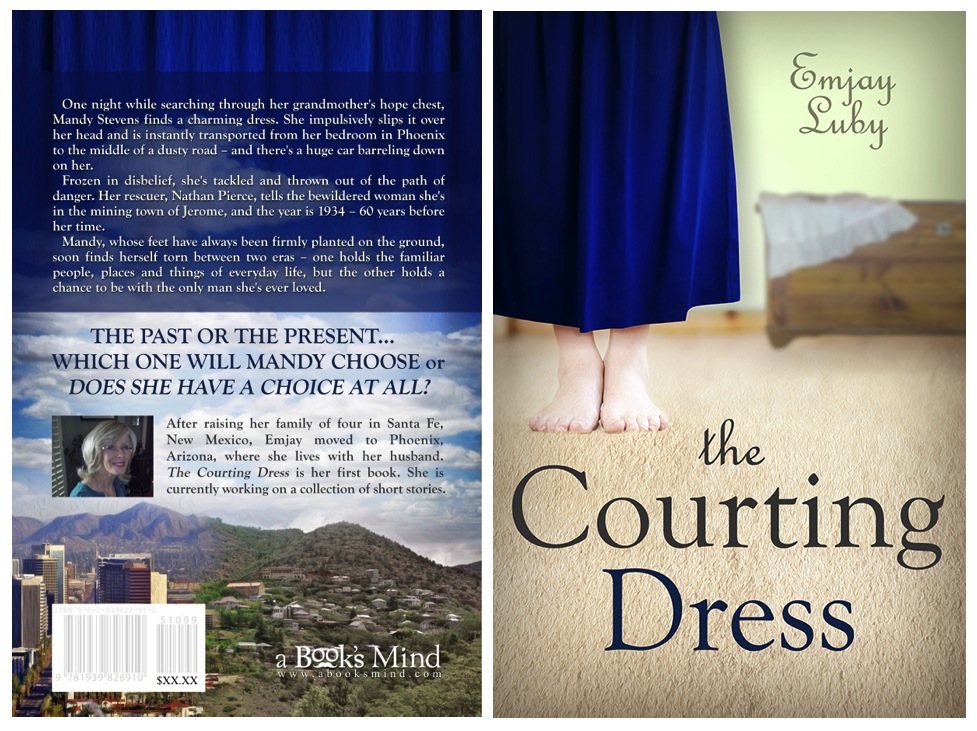
The Courting Dress

EMJAY.004“One night in March of 1994, while searching through her grandmother’s hope chest, Mandy Stevens finds a charming dress. She impulsively slips it over her head, and is instantly transported from her bedroom in Phoenix, to the middle of a dusty road, and there’s a car barreling down on her! Frozen in disbelief, she’s tackled and thrown out of the path of danger. Her rescuer, Nathan Pierce, tells the bewildered woman she’s in the mining town of Jerome, and the year is 1934.  Mandy, whose feet have always been firmly planted on the ground, soon finds herself torn between two eras — one holds the familiar people, places, and things of everyday life, but the other holds a chance to be with the only man she’s ever loved. The past or the present…which one will Mandy choose, or does she have a choice at all?”


To reach Emjay Luby, buy her books, or schedule a book-signing event:

Panic Not, Thou Writer of the Failing Plot Line

“Don’t panic. Midway through writing a novel, I have regularly experienced moments of bowel-curdling terror, as I contemplate the drivel on the screen before me and see beyond it, in quick succession, the derisive reviews, the friends’ embarrassment, the failing career, the dwindling income, the repossessed house, the divorce . . . Working doggedly on through crises like these, however, has always got me there in the end. Leaving the desk for a while can help. Talking the problem through can help me recall what I was trying to achieve before I got stuck. Going for a long walk almost always gets me thinking about my manuscript in a slightly new way….” 

― Sarah Waters

Even Good Writers Make Mistakes? Yes. Five of them…

[found on writersdigest.com by Steven James]

“In fiction, story matters more than anything else.

Yet too often authors forget this and, in their zeal to impress readers or wow editors, pepper their writing with distracting devices that only end up undermining the story itself.

Never let anything get between your story and your readers. Here are five of the most common ways even the best writers veer off-course—and simple strategies for avoiding them.

1. Overdoing Symbolism/Themes

A few years ago I picked up a literary novel that everyone was talking about. In the first chapter there was a storm; in the second, someone was washing his hands; then a character was crying; then there was a baptism. I remember thinking, OK, I get it. Your image is water and your theme is cleansing—now get on with the story.

Problem was, from that point on, guess what I was doing?

Yup … looking for the next way the writer was going to weave a water image into her story. And she delivered, scene after predictable scene.

As a reader I was no longer emotionally present in the story. I’d become a critic, an observer. And that’s definitely not what a storyteller wants her readers to do.

The more your readers are on the lookout for your images, your themes, your symbolism, and so on, the less they’ll be impacted by the real essence of your story.

Does that mean that themes and images don’t have a place in your work? Not at all. But it does mean that rather than building your story around that theme (love, forgiveness, freedom, etc.), or advice (“Follow your dreams,” “Be true to your heart,” etc.), or a cliché (“Every cloud has a silver lining,” “Time heals all wounds,” etc.), it’s better to drive your narrative forward through tension and moral dilemmas.

So, instead of using the theme “justice,” let the events of the story pose a more engaging question: “What’s more important, telling the truth or protecting the innocent?”

Rather than giving the advice, “You should forgive others,” let your story explore a dilemma: “How do you forgive someone who has done the unthinkable to someone you love?”

Let your story do more than reiterate the cliché, “The needs of the many outweigh the needs of the few.” Instead, challenge that axiom by presenting your characters with situations that raise the question, “When do the needs of the few outweigh the needs of the many?”

Respect your readers. Assume that they’re as smart as you are. If you can easily identify your own imagery, symbolism, themes and so on, expect that they will, too. And as soon as they do, they’ll be distracted from the story itself.

2. Trying Too Hard

There’s nothing less impressive than someone trying to be impressive. There’s nothing less funny than someone trying to be funny. Eloquence doesn’t impress anyone except for the person trying so hard to be eloquent.

So look for places in your story where you were trying to be funny, clever or impressive, and change those sections or remove them.

Some writers shoot for humor by writing things like, “she joked,” “he quipped,” “he mentioned in his usual fun-loving way,” and so on. Don’t fall into this trap. If your dialogue is really funny, you don’t need to point that out to your readers. (And if it’s not as funny as you’d intended, you don’t need to draw attention to the fact.)

Some authors resort to using a profusion of speaker attributions. Their characters chortlegruntexclaim,reiterategasphowlhiss and bark. Whenever I read a book like this I find myself skimming through the dialogue just to see what the next synonym for said will be. Readers get it. They know you own a thesaurus. Just tell the story.

In the same way, drop antiquated or obscure words unless they’re necessary for character development or maintaining voice. This isn’t to say that you can’t write intelligent, incisive, challenging prose, but any time the meaning of an unfamiliar word isn’t immediately obvious within the context of the story, choose another word that won’t trip readers up. This is especially true as you build toward the climax, since the pace of the story needs to steadily increase.

Similarly, avoid the temptation to impress your readers with your research, your plot structure or your knowledge of the flora and fauna of western North Carolina. When readers pick up your book, they’re not preparing for a spelling bee or a doctoral dissertation or a medical exam; they’re hoping for an entertaining, believable story that will transport them to another world and move them on a deep, emotional level.

Textbook literary devices fall under this same umbrella—they’re too contrived. Writing something like, “She cautiously closed the closet door and crept across the carpet,” might have impressed your English professors, but it does nothing to serve readers in today’s marketable fiction. As soon as readers notice the alliteration, they’ll be distracted—and whether they’re counting up the number of times you used the letter C, or rolling their eyes at your attempt to be clever, they’ve momentarily disengaged from your story. And that’s the last thing you want them to do.

Believe it or not, you don’t want readers to admire your writing: You want them to be so engaged in the story itself that they don’t notice the way you use words to shape it. Anything that jars readers loose from the grip of the story needs to go, even if it seems “literary.” Weed out figures of speech that don’t serve the mood of the scene. For example, if you’re curled up with a book and are deep in the midst of a chapter depicting an airplane hijacking, you wouldn’t want to read, “The clouds outside the window were castles in the sky.” Not only does the superfluous description undermine the suspense, but castles carry a positive connotation that further disrupts the tension. If you can’t resist the urge to use a figure of speech when writing a scene like this, choose one that accentuates the mood: “The jet plummeted through the dungeon of clouds.”

Over the years I’ve heard of authors who’ve written books without punctuation, or without the word said, or without quotation marks, or by using an exact predetermined number of words. To each his own. But when these artificial constraints become more important to the author than the reader’s experience with the story is, they handcuff it.

Whenever you break the rules or keep them, it must be for the benefit of your readers. If your writing style or techniques get in the way of the story by causing readers to question what’s happening, analyze the writing, or page back to earlier sections in order to understand the context, you’ve failed.

You want your writing to be an invisible curtain between your readers and your story. Anytime you draw attention to the narrative tools at your disposal, you insert yourself into the story and cause readers to notice the curtain. Although it may seem counterintuitive, most authors looking to improve their craft need to cut back on the devices they use (whether that’s assonance, onomatopoeia, hyperbole, similes or whatever), rather than add more.

3. Failing to Anticipate the Readers’ Response

A plot flaw is, simply put, a glitch in believability or causality. When a character acts in a way that doesn’t make sense, or when one scene doesn’t naturally follow from the one that precedes it, readers will stumble.

Imagine your protagonist hears that a killer is in the neighborhood and then, in the next scene, decides to spend a cozy evening in the kitchen making homemade pasta. Readers will think, What? Why doesn’t she lock all the doors and windows, or call the police, or run to her car and get out of the area? Thus, at the very moment where you want them to be drawn deeper into the narrative, your readers pull away and start to question your character’s actions—and, to some degree, your storytelling ability.

As soon as an event isn’t believable, it becomes a distraction. So ask yourself at every plot point: “Is there enough stimulus to motivate this action?” And then make sure there is. Always anticipate your readers’ response.

Try to step back and read your work-in-progress as objectively as you can, through the eyes of a reader who has never seen it before. If you come to a place where you think, Why doesn’t she just … ? or, Wait, that doesn’t make sense … that’s where you have some revising to do. And the solution doesn’t have to be complicated. Often you can solve a plot flaw in your story simply by having your characters point it out. If your protagonist says something like, “I couldn’t believe she would do such a thing—it just didn’t compute,” readers will think,Yes, exactly—I thought the same thing! There’s more going on here than meets the eye. The more you admit that the scene has a believability problem, the less readers will hold you responsible for it.

With this in mind, you should also make sure every special skill or gadget needed in the climax is foreshadowed earlier in the story. Coincidences drive a wedge in believability. Foreshadowing removes them. So if the diver suddenly needs a harpoon to fight off the killer barracuda and he reaches down and—how convenient!—just happens to find one, readers won’t buy it. Show us the harpoon earlier so it makes sense when it reappears at the climactic battle.

4. Using a Hook as a Gimmick

Many well-meaning writing instructors will tell you that you need to start your story with a good “hook” to snag your readers’ attention. And they’re right—to a certain degree.

While I was teaching at one writing conference a woman gave me her story for a critique. It started with an exciting car chase. I said, “Great, so this is an action story.”

“No,” she told me. “It’s a romance. The woman goes to the hospital and falls in love with the doctor.”

“But it starts with a car chase and explosion. Readers will expect it to escalate from there.”

“I had a different opening,” she admitted, “but my critique group told me I needed a good hook.”

It may have been true that her story needed a better hook, but she landed on the wrong one. Hooks become gimmicks if they don’t provide the platform for escalation.

Too many times a writer will grab readers’ attention early on with a scene that’s clearly been contrived just for that purpose, without introducing the characters or the setting of the story. Consequently the writer is forced to insert excessive backstory into the next scene—thus undermining the forward momentum of the plot. Take your time, trust your readers and craft a hook that orients them to the world you’ve created. Then drive the story forward without having to explain why you started it the way you did.

5. Leaving Readers Hanging

Never annoy your readers.

Sometimes I read books in which the author withholds key information from readers, presumably in an effort to create suspense. But failing to give readers what they want doesn’t create suspense, it causes dissatisfaction.

For example, don’t leave a point-of-view character in the middle of an action sequence. If, in the final sentence of a chase scene, you write that your protagonist “careened around the bend and crashed into the cement pylon jutting up from the side of the road,” readers will turn to the next chapter wanting to find out if she is
conscious, dead, etc.

But if that next chapter instead begins with another point-of-view character, one in a less stressful situation, readers will be impatient. They don’t want to wait to come back to the woman in the car (or maybe she’s in the hospital by then) a chapter later.

If readers are tempted to skip over part of your story to get to a part they want to read, you need to fix that section. As you write, constantly ask yourself what the readers want at this moment of the story.

Then, give it to them—or surprise them with something even better.”

[found on http://www.writersdigest.com/whats-new/5-story-mistakes-even-good-writers-make]