Audiobooks, Your Friend

[found on thecreativepenn.com; by  JOANNA PENN]

“Your book is not just a physical book or an ebook. There are plenty of other subsidiary rights that you can exploit and audiobooks are high on the list because of the rise in popularity of listening during commutes or workouts, and the increased penetration of smartphones. In today’s interview, we explore how you can get into this market.”

To read the info from Joanna Penn on creating your own audiobook, and listen to the podcast, click HERE.

[found on http://www.thecreativepenn.com/2013/03/06/audiobook]

Write A Personal Bio

[found on blog.brandyourself.com; by ]

“1. Make three versions: short, medium and long. 

Most of the time, someone else will dictate the length of your bio. They will likely tell you how many words you can use to ensure that yours is the same length as other bios. Because of this, one bio will not do. You need three bios:

    • One sentence bio
    • 100 word bio
    • 250 word bio

Each bio has its place. You will save you time and energy when the time comes time to post it, and establish consistency between every professional bio about you that is published.

2. Introduce yourself as if you’re meeting a stranger.

Lead in with your name. People need to know who you are before they hear what you’re all about.

3. Immediately state what you do.

If you are “Portrait Photographer,” don’t wait until the last moment to say it. Your most important details should go in the first sentence. Remember: people on the web rarely read more than the first and last sentence.

4. Touch upon your most important accomplishments.

Don’t list them, and make sure they fit. A bio is not a resume; it is simply a quick summary of who you are. If you have space, mention them. If not, ignore them.”

To see the rest of the ideas on writing a personal bio, click here.

[found on http://blog.brandyourself.com/how-tos/8-tips-on-how-to-write-a-personal-biography]

How To Manage Your Edits

“As an editor, I have heard horror stories about authors who didn’t know how to process the edits they received back from their editors. Instead of asking what to do with the Word document, [caution, you’re going to scream] some of the authors printed the full manuscript, compared item by item, then RETYPED the entire manuscript.

Don’t let this be you.

Firstly, your editor is on your TEAM. An editor wants you to succeed. And even though you may feel like we are all jackals, we don’t really bite. Ask us questions—especially when you feel overwhelmed or uncertain.”

— Billi Joy Carson / Senior Editor, Editing Addict

  EDITOR Sends Completed File Back to AUTHOR:

THE AUTHOR’S JOB:

1. READ through document

2. CHOOSE FROM (to accept and/or reject changes)

a. Accept All Changes in Document

b. Accept and Move to Next

c. Reject All Changes in Document

d. Reject and Move to Next

3. SHORTCUT for authors

a. Save TWO* versions of the file you received from your editor.

i. File A [edits accepted]

1. In Word Doc, under REVIEW tab [File A]

2. Select Accept All Changes in Document [File A]

ii. File B [edits visible]

1. Leave the file the way you received from the editor

b. Read through File A side-by-side with File B

i. If you find an edit you don’t want

1. In File B

a. Under REVIEW tab [File B]

b. Select Reject and Move to Next [File B]

ii. When you are finished reading File A, and correcting File B,

1. In File B

a. Under REVIEW tab [File B]

b. Select Accept All Changes in Document [File B]

c. File B is now fully edited, and author approved

*At Editing Addict, I do this beforehand for my authors, however, not all editors have the [File A & File B] policy, and expect the author to do it on their end. How To Manage Your Edits
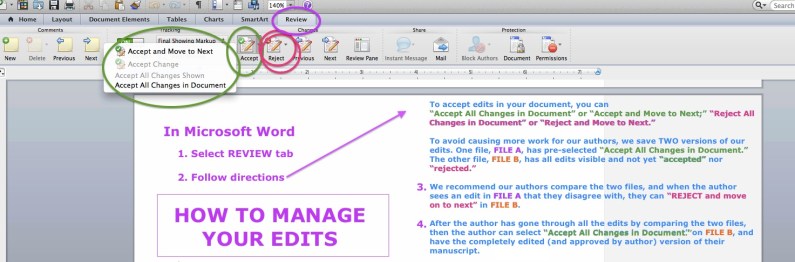
How to Accept and/or Reject Tracked Changes in a Word Document: YouTube Video

Still have questions? Leave a comment below, or send  a message to the editor: billijoycarson@editingaddict.com. Teamwork brings success!

Jealous, Your Writing Is

“Authors always carry a means for scribbling and an excuse for pausing, often inopportunely, to record those fleeting sparks of creative fancy that might otherwise vanish like a wisp in the wind if ignored.  Writing is a jealous and needy lover.” 

― Richelle E. Goodrich

Children’s Book, Here You Come

[found on wvculture.org; by Mary Rodd Furbee]

“Consider why you want to write children’s books.
If you want to write books for children, it helps to be a little crazy. I developed a passion to write nonfiction biographies for middle-school children about four years ago. My daughter’s experiences made me realize that there were hardly any children’s books on America’s founding mothers. It hit me, hard: This was what I had to write. There was a need. The subject was fascinating. I knew I could do it, and found the prospect exciting. If you have a similar passion, perfect. If not, perhaps you are meant to do something else. It’s hard to write books, harder still to write books for children. It’s difficult to get published, and you’ll face a lot of rejection.

Don’t expect to make big money or make it quickly.
Writing books for children is like starting a business. You must invest both time and money. I hoped to make money writing my first books, but I didn’t. Four years and six published books later, I still haven’t made as much money as I could have in most professional writing or editing positions. It’s the rare children’s book that hits the bestseller list or wins a Newbery Award, and the rare full-time children’s writer who makes a living.

Read children’s books.
When I decided to write biographies of women in American history, I read biographies, histories, books about writing biographies, and lots of middle-grade fiction and nonfiction. It’s amazing what you can learn by reading the books you want to write – be they board books for infants and toddlers, picture books, early readers, middle-grade novels or young adult nonfiction. Read the best authors – over and over. If you can, take a class in children’s literature or writing for children.”

For more tips on writing children’s books from Mary Rodd Furbee, click here.

[found on http://www.wvculture.org/arts/Artworks/Fall01/childrens.html]