Webinar: Meet the Editor

931cbead-a86d-4017-a390-753fa47deca0


Editing Addict’s Billi Joy Carson is joining A Book’s Mind in a free webinar on June 19, 7pm (AZ time). Come join her as she shares about the editing process, and discusses its value in the publishing industry.

Registration:

When:

    • Thursday, June 19, 2014

    • 7:00 PM – 7:30 PM (Mountain Time – Arizona)

Where:

Tips on Capitalization in Titles

[found on grammar.about.com; by ]

“Style guides disagree on which words to capitalize in a title (of a book, article, essay, movie, song, or video game). Here’s a basic guide to the two most common methods: sentence case and title case….

There’s not a single set of rules for capitalizing words in a title. For most of us, it’s a matter of selecting one convention and sticking to it. The big decision is whether to go with sentence case (simple) or title case (a little less simple).

Sentence case (also known as Down style)

Capitalize only the first word of the title and any proper nouns: “Rules for capitalizing the words in a title.” This form, recommended by the Publication Manual of the American Psychological Association for titles in reference lists, is popular with many online and print publications. In fact it’s now the standard form for titles and headlines in most countries–but not (yet) in the United States.

Title Case (also known as Headline Style or Up Style)

Capitalize the first and last words of the title and all nounspronounsadjectivesverbsadverbs, and subordinating conjunctions (if, because, as, that, and so on): “Rules for Capitalizing the Words in a Title.”

It’s the little words that style guides disagree on. The Chicago Manual of Style, for instance, notes that “articles (a, an, the), coordinating conjunctions (and, but, or, for, nor), and prepositions, regardless of length, are lowercased unless they are the first or last word of the title.”

But The Associated Press Stylebook is fussier:

  • Capitalize the principal words, including prepositions and conjunctions of four or more letters.
  • Capitalize an article—the, a, an—or words of fewer than four letters if it is the first or last word in a title.

Other guides say that prepositions and conjunctions of fewer than five letters should be in lowercase—except at the beginning or end of a title. (For additional guidelines, see the glossary entry for title case.)

So pick a form—any form. And then try to be consistent.”

[found on http://grammar.about.com/od/grammarfaq/f/capitalstitle.htm]

Die Not, My Adverb—Overwhelm Not

[found on huffingtonpost.com; by Maddie Crum]

In Defense of Adverbs

“Like like and other filler words, certain adverbs have saturated our speech and our writing, making once-meaningful phrases seem totally vapid. The idea that adverbs are just extraneous fluff has led to a smear campaign against them, and it’s become common to suggest axing the part of speech altogether in order to make writing more powerful. This forceful call for more forceful writing is misguided; adverbs can be phonetically pleasing, can imbue sentences with subtlety, and should not be entirely shunned.

First, a refresher: What does an adverb do? It tells us more about a verb. If a character is running from point A to point B, “he ran” is a description that doesn’t sufficiently set the scene. How did he run? Quickly? Scatteredly? “He ran quickly and scatteredly” is less powerful than “he scampered,” an adverbless sentence that conveys the same point more succinctly. And so, many writers have spoken vehemently against the use of adverbs.

This is unfortunate because when used well, adverbs serve an important purpose, and can enhance writing rather than detract from it.”

[found on http://www.huffingtonpost.com/madeleine-crum/in-defense-of-adverbs_b_4860325.html?ncid=fcbklnkushpmg00000063]

Not All Is Possessive

[found on grammarphobia.com; by The Grammarphobia Blog]

 Nouns: Possessive vs Genitive

“Normally, nouns used with numbers to form adjectival phrases are singular, as in “two-inch rain,” “three-year-old boy,” “two-dollar word,” “eight-volume biography,” and “four-star restaurant.”

However, where a plural noun is used by tradition to form such a phrase, it’s generally followed by an apostrophe, as in “the Thirty Years’ War” and “the Hundred Years’ War.”

The plural followed by an apostrophe is also used in phrases like “ten dollars’ worth” or “five years’ experience” or “two days’ time.”

Apostrophe constructions like these aren’t “possessive” in the sense of ownership; strictly speaking, they’re genitive.”

To learn more from grammarphobia.com, click here.

[found on http://www.grammarphobia.com/blog/2010/08/sui-genitive.html]

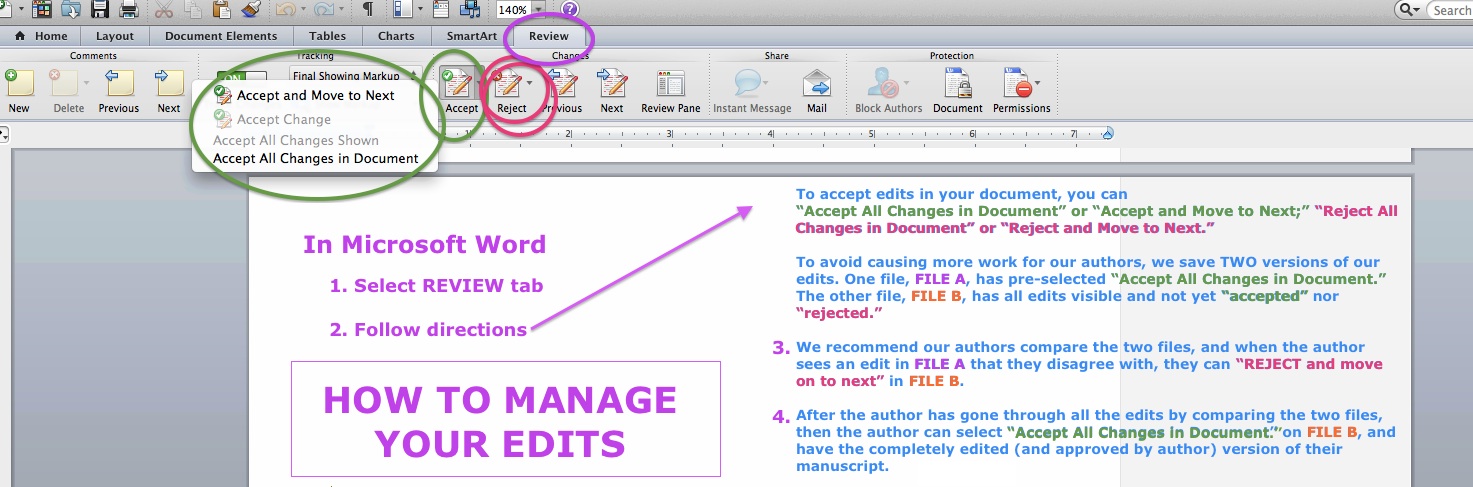
How To Manage Your Edits

“As an editor, I have heard horror stories about authors who didn’t know how to process the edits they received back from their editors. Instead of asking what to do with the Word document, [caution, you’re going to scream] some of the authors printed the full manuscript, compared item by item, then RETYPED the entire manuscript.

Don’t let this be you.

Firstly, your editor is on your TEAM. An editor wants you to succeed. And even though you may feel like we are all jackals, we don’t really bite. Ask us questions—especially when you feel overwhelmed or uncertain.”

— Billi Joy Carson / Senior Editor, Editing Addict

  EDITOR Sends Completed File Back to AUTHOR:

THE AUTHOR’S JOB:

1. READ through document

2. CHOOSE FROM (to accept and/or reject changes)

a. Accept All Changes in Document

b. Accept and Move to Next

c. Reject All Changes in Document

d. Reject and Move to Next

3. SHORTCUT for authors

a. Save TWO* versions of the file you received from your editor.

i. File A [edits accepted]

1. In Word Doc, under REVIEW tab [File A]

2. Select Accept All Changes in Document [File A]

ii. File B [edits visible]

1. Leave the file the way you received from the editor

b. Read through File A side-by-side with File B

i. If you find an edit you don’t want

1. In File B

a. Under REVIEW tab [File B]

b. Select Reject and Move to Next [File B]

ii. When you are finished reading File A, and correcting File B,

1. In File B

a. Under REVIEW tab [File B]

b. Select Accept All Changes in Document [File B]

c. File B is now fully edited, and author approved

*At Editing Addict, I do this beforehand for my authors, however, not all editors have the [File A & File B] policy, and expect the author to do it on their end. How To Manage Your Edits
How to Accept and/or Reject Tracked Changes in a Word Document: YouTube Video

Still have questions? Leave a comment below, or send  a message to the editor: billijoycarson@editingaddict.com. Teamwork brings success!
How to: Nonfiction Proposal

[found on bradfordlit.com; by ]

“How To Write A Non-Fiction Proposal

Most non-fiction books are sold on the basis of a book proposal, often with one or more sample chapters rather than on a completed manuscript. While every agency and editor may have a slightly different opinion on the mechanics of writing a winning non-fiction proposal, most successful proposals have the following elements in common:

  1. Overview
    This is an introduction that summarizes the book’s contents and tells why the book should be published. In essence, this is your main selling statement. Concisely address all that is the most exciting, interesting, introspective and unique about your book. Make it clear that you are the best and most qualified person to write this wonderful and very necessary piece of non-fiction, as well as make a persuasive case for your intended market.
  2. Competition
    Understand and present how your book will fit in the marketplace. Select 4-6 of your major competing titles and compare them to your own. How is your book different and unique? The point here is not to denigrate other works (which may very well be beloved by your audience), but to highlight how your book successfully fills a gap in the market. Be honest but always keep in mind that each component of the proposal is to help you SELL your book, and showing how your project is at the head of the class is an excellent way to do so. It is not advisable to state that your book is “like no other” and decline to cite any comparative titles.
  3. Market
    Who is your intended audience? Who will relate to your book and rush to buy it? In this section, illustrate how the market for this book not only exists, but is a large, robust, book-buying section of the general public. It is unrealistic to make a statement that everyone will buy your book, so be mindful of exactly who your subject will appeal to. If there are any special markets that you can tap through any of your own personal connections this would be the place to mention it. An editor needs to see how your market translates to bottom-line sales.
  4. Biography
    This is your space for telling the editor a little more about yourself, specifically about how your experiences relate to this book. For example, if you are writing a cookbook, you’ll want to tell the editor about your experience working under the tutelage of Jacques Pepin. Be sure to mention your publishing history, if applicable. Keep this section as concise and professional as possible.
  5. Publicity
    If there are built-in publicity opportunities for your project, address them here. Any ideas for marketing or promotions you may have, especially if you have personal connections or direct access to likely prospects, should be mentioned. Make sure you let the editor know if you have any previous publicity experience.
  6. Chapter Outline
    This is one of the most critical sections of your proposal. List each chapter, with chapter title and give a brief description of the material covered. The style in which you deliver the description should be informed by the type of non-fiction book you are selling. A how-to book chapter description would necessarily be quite different from a travel narrative chapter description.
  7. Projected length and date of delivery
    Estimate the number of months you expect to take writing the book from signing to contract until completion. Give either a projected manuscript page length (use the standard of 250 words per page) or word count.
  8. Sample Chapters
    Sample chapters may or may not be necessary if you have written a complete and compelling proposal. If you have a track record of previous publications, you may not need to include sample chapters. If, however, you do elect to write a sample, you should draft the chapter that “puts your best foot forward” so to speak. Write the section that is the most interesting, the most compelling and the one that you feel most passionate about.”

For more tips on writing from Bradford Literary Agency, click here.

[found on http://www.bradfordlit.com/how-to-write-a-non-fiction-proposal]

A Good Editor

“A good editor will not just point out errors; she explains them, providing you with an education to enable you to perform a stronger rewrite. For instance, if your manuscript includes point-of-view violations—a major reason for fiction rejection—she will offer a thorough explanation of the concept and provide easy-to-understand examples. A good editor will encourage you and compliment you on your strengths, but she will not hold back in showing you where you need improvement or are making repeated mistakes. She does not expect you to know all the book publishing rules for copyediting—that’s her job. But she does try to help you understand some basic underlying principles that you might need to learn in order to be a better writer. A good editor knows your book is your “baby” and that you have poured many hours into writing it, but her goal is to help you make that book the best it can be, and sometimes that requires you, the author, to make drastic changes. In other words, a good editor is “on your side” and wants to help, but she is mostly concerned with getting your book in the best shape possible.”

— C. S. Lakin / critiquemymanuscript.com

Edit Your Book…Before You Take It To An Editor

[found on writersdigest.com; by Mike Nappa]

“1. The Close-In Writing
The basic method: You write a day’s worth of work (either fiction or nonfiction)—whatever that means for you. Next day, before you write anything new, you revise and edit the previous day’s work. This is the “close-in writing,” and becomes the first draft—the first time your write your book.

2. The Close-In Edit
When the entire first draft is complete, you go back through and, beginning with word one to the end, you revise and edit the entire manuscript on your computer. This is the “close-in edit,” and becomes your second draft: the second time you write your book.

3. The Distance (or “Hand”) Edit
Next, you print a hard copy of the second draft of your entire manuscript. Beginning with word one to the end, you hand-edit the hard copy, scrawling notes and profanities to yourself all the way through the margins. Then, using your hand-edit notes as a reference, you go back into your computer file and revise the manuscript as needed. This is the “distance edit,” and becomes your third draft: the third time you’ve written your book.

4. The Oral Edit
Finally, you print a new hard copy and read your entire manuscript aloud. Read it to the walls, to your spouse, to the patrons at Starbucks, to your dog, to the bowl of soggy Cocoa Puffs left over from breakfast. Doesn’t matter who’s in the room, only that you can hear yourself reading it. Start with word one and don’t stop until you read the last word. Yes, it may take you several days, but that’s OK. Keep reading every word out loud until you’re done.”

To read more on how to edit your book to its best, with tips from WritersDigest, click HERE.

[found on http://www.writersdigest.com/editor-blogs/there-are-no-rules/how-to-edit-your-book-in-4-steps]

Vocabulary? Can’t I just write how I talk?

[found on time4writing.com]

“Why is a Strong Vocabulary Important?

We use spoken and written words every single day to communicate ideas, thoughts, and emotions to those around us. Sometimes we communicate successfully, and sometimes we’re not quite so successful. “That’s not what I meant!” becomes our mantra (an often repeated word or phrase). However, a good vocabulary can help us say what we mean.

For example, let’s say that you are outside in your yard and see a large black car stop in the road. You can see four tinted windows on one side of the car, and you assume there are four tinted windows on the other side, too. Just then, the driver’s door opens, and a man wearing white gloves steps out. He walks to the back of the car and looks underneath. He shrugs his shoulders, climbs back into the car, and drives away. After you remember to close your mouth, which has been hanging open, you run next door to tell your friend what you saw. What do you say? If you know a couple of key words, you can quickly explain to this person what you saw. Instead of describing the number of windows and the length of the car, you could simply say that you saw a black limousine (a long, luxurious car). Then, instead of describing the man with the white gloves, you could say you saw the chauffeur (someone paid to drive a car or limousine) walk to the back of the car. Knowing these key words can help you quickly and effectively communicate your meaning.

When you’re faced with a writing assignment, a good vocabulary is an indispensable (very important or necessary) tool. If you have several synonyms (words with similar meanings) in your repertoire (“toolbox”), you’ll be able to choose the best word for the job. Avoid vague words like “stuff” or “things” when you write. These words do not give the reader a good sense of your meaning. Also, use strong verbs that give the reader good information.

Here’s an example:

    • POOR: People do a lot of things.
    • BETTER: People perform a lot of tasks.

Work on building your vocabulary so that you can choose the stronger, more descriptive words in your writing.

You may also want to vary your vocabulary depending on your audience. Are you writing for children? Then stick with simpler words. Are you writing for college students? Then pull the more difficult words out of your “toolbox” to avoid talking down to them. It’s important to consider your audience when writing.

You may also find it difficult to choose the best word for a sentence when you’re writing. If you have a strong vocabulary, these choices will be easier!”

For more great tips on writing from Time4Writing, click HERE.

[found on http://www.time4writing.com/writing-resources/vocabulary]