Tag: fiction

Don’t Be Nebulous…or Cloudy
“In displaying the psychology of your characters, minute particulars are essential. God save us from vague generalizations!”
― Anton Chekhov (Letter to Alexander Chekhov, May 10, 1886)
Share this:
Calling All Fiction Authors — Platform Up!
[found on thewritepractice.com by Joe Bunting]
“What Fiction Authors Really Need to Know About Their Platform
“…Several times a month, writers ask me, “How can I balance blogging, Tweeting, Facebooking, Goodreading, and all the other stuff I’m supposed to do to build myplatform, while also focusing on my writing? I have a full time job, a family, and a cat. I just don’t have time for all that other stuff.”
Writers today are overwhelmed, frustrated, and let’s be honest, a little pissed off.Why do we have to build a platform anyway? Can’t we just focus on writing?
It all came to a head for me when I read Michael Hyatt’s bestselling book Platform: How to Get Noticed in a Noisy World. The book was interesting enough, but when I looked for information that related to fiction writers, I found the only advice specifically focused on helping fiction writers was tossed into an appendix in the back of the book.
An appendix!
That’s when I realized most of the so-called “experts” who said every author needs a platform were really just speaking to non-fiction authors. They didn’t have a clue what a fiction platform would even look like.
Meanwhile, thousands of fiction writers followed their advice, creating blogs they resented, Twitter accounts that overwhelmed them, and Facebook pages with thirty-seven likes. For most creative writers, this whole platform experiment has been a waste of time.
That’s when I decided I needed to learn everything I could about how to build a platform specifically designed for fiction writers.”
There is too much excellent information on this, to put it here. To learn more about Fiction Writer’s Platforms from TheWritePractice, click HERE.
[found on http://thewritepractice.com/fiction-platform]
Share this:
It’s Alive!
“Our willingness to write truthfully brings the story to life.”
― Alan Watt, The 90-Day Novel: Unlock the story within
Share this:
No Monkey Business!
“If you can write each day, do it, and meet a quota. Minimum 350 words a day. A baboon can do 350 words a day. Don’t be shown up by a baboon.”
― James Scott Bell
Share this:
Don’t Twain Yourself
“One should never use exclamation points in writing. It is like laughing at your own joke.”
― Mark Twain
Share this:
Muahahahahaha!
Secret & Silent—Inspiration
“In fiction, I exercise my nosiness. I am as curious as my cats, and indeed that has led to trouble often enough and used up several of my nine lives. I am an avid listener. I am fascinated by other people’s lives, the choices they make and how that works out through time, what they have done and left undone, what they tell me and what they keep secret and silent, what they lie about and what they confess, what they are proud of and what shames them, what they hope for and what they fear. The source of my fiction is the desire to understand people and their choices through time.”
― Marge Piercy, Braided Lives
Share this:
Featured Writing Addict: H. Squires
H. Squires
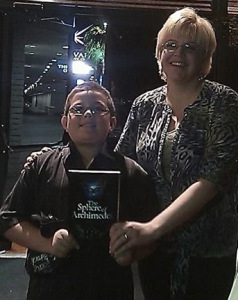
Heather Squires’ life calling to be an author began in 1989 in Phoenix, Arizona. As an editorial writer on staff at the Utopian Newspaper, she decided to seek further review and publishing. The first project to be completed outside of the journaling world was To Desecrate Man, an action novel; completed in 2005, it became over shadowed by the second project: Rogue, a young adult fiction-adventure novel.
Upon completion of Rogue in 2009, Squires’ place in the young adult fiction world became clear. The Sphere of Archimedes began to take shape, and was finished in 2011. Currently working on the sequel, The Omphalos of Delphi, she continues to create anticipation for the future of young adult fiction.
What is H. Squires’s Genre?
Fiction: Young Adult, Science Fiction
What is H. Squires’s Inspiration?
“As an observer, I watch ominous clouds collide in the blue firmament. A black-hooded, male sparrow puffs out his chest, and struts to impress a potential mate. While skating over a broad leaf, a snail’s eyes –perched on tall stalks, nods from the slightest breeze.
The daily creations displayed before our eyes, inspires me to write. I cannot go to my grave without trying to verbally describe God’s handiwork—and, if I can tell a story within the narrative, then [I hope] I do Him justice.”
What is H. Squires’s book about?
The Sphere of Archimedes
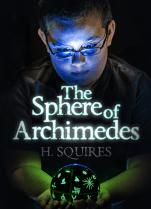
“Professor Donovan Spiegler, and nine-year-old Oliver Abernathy have no warning that their seemingly routine lives will free-fall into danger and adventure in this sci-fi thriller: THE SPHERE OF ARCHIMEDES.
Oliver, a chubby, freckle-faced boy, is surviving a mundane school-life as the helpless victim of a bully, Dylan Parker.
The Professor, and his assistant, Cedrick Wilhelm, are researching a mysterious metallic orb when Cedrick goes missing, and so does the orb.
On a trip to the Grand Canyon with his family, Oliver discovers a metallic sphere that has special powers. His boyish curiosity builds as he tests the abilities and hazards the orb possesses. He learns the alarming side of the orb when Dylan Parker, the bully, opens it, and is vaporized—or so Oliver believes.

A group of threatening men turn up at Professor Spiegler’s class; at knife point, they demand he relinquish the orb, and show them how to release its powers. In an attempt to flee, the Professor inadvertently leads the mobsters straight to Oliver Abernathy and his family.
In the thrilling adventure that follows, the characters discover the need to work together in order to stay alive. The Professor and the Abernathys encounter other worlds, and meet deadly enemies. Their survival is hinged on solving THE SPHERE OF ARCHIMEDES.”
| Amazon | Barnes & Noble | A Book’s Mind |
| HSquiresNovels.com | Facebook | Twitter | Goodreads | Email |
[See what H. Squires had to say about our editor!]
Tell H. Squires you heard about her on editingaddict.com!
Share this:

Too Weak To Write? Take Two Adverbs, and Don’t Call Me In The Morning
[found on darcknyt.deviantart.com]
“The real question to ask isn’t whether Mrs. Swingingjowls was right or wrong in teaching you to modify your sentences with adverbs. The question is, why are you modifying your verbs with adverbs?
This is an easy one to answer, when you think about it:
Because your verbs are weak.
Mark Twain once said, “Adverbs are the tool of the lazy writer.” Amen, Mark.
See, what’s going on is, you’re using a word that doesn’t really convey the sense, the feeling, the mood or whatever, you’re hoping to get across to your reader. “Walk” isn’t a very exciting word, and it doesn’t get across the antsy feeling you’re trying to portray in your description, so you make it “walk quickly” or “quickly walked”. You want your reader to see the force, the power in your characters’ argument, so instead of saying “they shouted across the table” you say “they shouted angrily and vehemently across the table.”
The problem is, the verbs you’ve chosen aren’t doing the job you wanted them to do in the first place. You don’t want your character to walk, you want your character to hasten, hurry, quick-step. You don’t want your characters shouting, you want them spitting words through clenched teeth, veins throbbing on reddened necks, molars locked and spittle misting between them.
The reason you’re reaching for adverbs to tell the story is because the verbs you’ve chosen are too weak to do it for you. The adverb isn’t the solution, however. Strengthening your writing is.
Think about this: If the verbs you’re using to describe the action in your story are weak and flimsy, the action description may be weak and flimsy too.
You wouldn’t be writing something with the intent of being flimsy or weak, would you? The reason you’re grabbing adverbs in the first place is because of discontent with what’s being said without them, right?
Why bother with modifiers for words that aren’t cutting it in the first place? The real crux of the problem is finding the right actions and descriptions for those actions, so that modifiers — adverbs AND adjectives — will be needed with rare and prudent infrequency.
When you’re writing adult fiction, the need to limit — if not eliminate — adverbs altogether becomes pretty obvious. What adult wants to read a grade school type of book?
No, adults want to be pulled into the story, and be engaged by it. The use of adverbs won’t get the job done, and loses the reader early on.
Show, Don’t Tell — Adverbs are NOT Good Description
With the evil adverb dragging your writing down, it’s now safe to say that using adverbs isn’t a way to make a lousy description good. It’s a lazy way to make a weak description obvious.
What adverbs do, in a nutshell, is tell the reader what’s going on in the story. That’s NOT what you want to do.
“But — I thought I was TELLING a story here?”
No. You’re not. If you’re a serious writer, you’re not “telling” a story, you’re SHOWING a story.
Don’t be lazy. Be specific. Use specific nouns and verbs to do the bulk of the work in your writing. By letting good, descriptive words do the heavy lifting, the occasional adjective and adverb aren’t the problematic, amateur-flagging beacons common in weak writing.”
For more great tips from DarcKnyt, click HERE.
 Editing Addict, LLC