Dialogue Your Characters

[found on theguardian.com]

“It’s never too soon to start thinking about what your characters will say and how they’ll say it. Giving each of your characters a distinct voice is key to writing great fiction.

The goal of Worksheet 9 is to encourage you to think about your characters’ individual speech patterns and specific word choices. Your characters will probably reveal these distinctions as your story progresses, but thinking about it early will make you more receptive to such revelations.

For each of your major characters, record information about individual speech patterns and any catchphrases they may use.

With this information in place on a dialogue sheet, you’ll know exactly what a given character will say and how he/she will say it. You can also use this worksheet during the final edit and polish of the manuscript to double-check speech patterns.”

[found on http://www.theguardian.com/books/2012/oct/19/researching-your-novel]

New Writers, Listen Up

[found on goinswriter.com; by Jeff Goins]

“Getting started

  • Start small. 300 words per day is plenty. John Grisham began his writing career as a lawyer. He got up early every morning and wrote one page. You can do the same. (Need some ideas for getting started? Check out these book ideas.)
  • Have an outline. Write up a table of contents that guide you. Then break up each chapter into a few sections. Think of your book in terms of beginning, middle, and end. Anything more complicated will get you lost. If you need help, read this book: Do the Work.
  • Have a set time to work on your book every day. If you want to take a day or two off per week, schedule that as time off. Don’t just let the deadline pass. And don’t let yourself off the hook.
  • Choose a unique place to write. This needs to be different from where you do other activities. The idea is to make this a special space so that when you enter it, you’re ready to work on your project.”

For more tips from GoinsWriter, click here.

[found on http://goinswriter.com/tips-writing-book]

Schedule, Not Afterthought

[found on chronicle.com; by Michael C. Munger]

“Write, then squeeze the other things in. Put your writing ahead of your other work. I happen to be a “morning person,” so I write early in the day. Then I spend the rest of my day teaching, having meetings, or doing paperwork. You may be a “night person” or something in between. Just make sure you get in the habit of reserving your most productive time for writing. Don’t do it as an afterthought or tell yourself you will write when you get a big block of time. Squeeze the other things in; the writing comes first.”

For more writing tips by Michael C. Munger, click here.

[found on http://chronicle.com/article/10-Tips-on-How-to-Write-Less/124268]

Be Passive The Writing Must Not

[found on bookcoaching.com; by Judy Cullins]

“Stop passive sentence construction.

When you write in passive voice, your writing slides along into long sentences that slow your readers down, even bore them.

Before you put your final stamp of approval on your writing, circle all the “is,” “was” and other passive verbs like: begin, start to, seems, appears, have, and could. Use your grammar check to count your passives. Aim for 2-4% only.

Instead of, ”Make sure that your name is included on all your household accounts and investments.” Passive culprits include “Make” and “is included.” Create more clarity with this revision,” Include your name on all household accounts and investments to keep your own credit alive after your divorce.”

For more tips on writing from Judy Cullins, click here.

[found on http://bookcoaching.com/wp/non-fiction-book-writing-solutions]

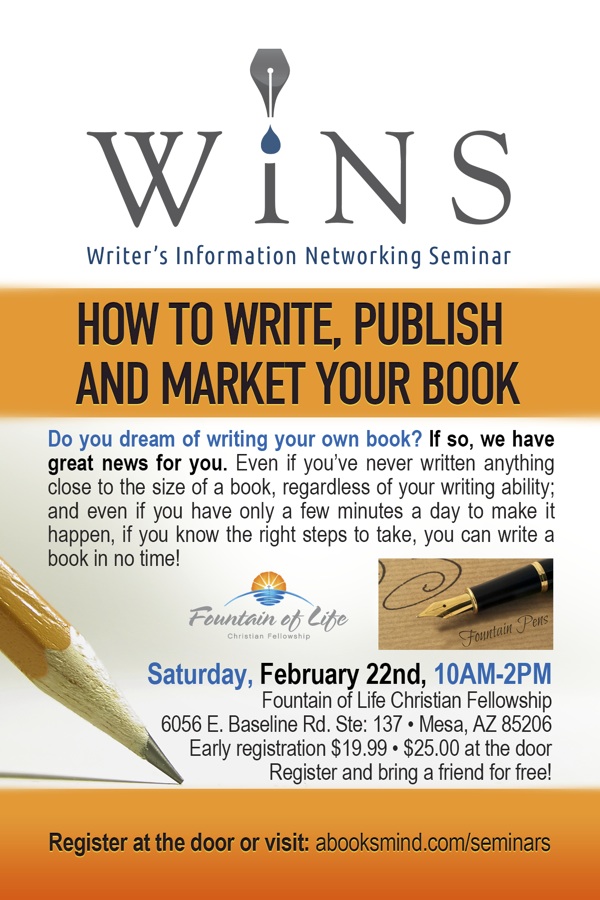
Win FREE Proofreading at WiNS Conference

Feb-22-WINS copy

Win a FREE Proofreading Prize for 20,000 words!

HOW THE CONTEST WORKS:

To enter into the contest, share both Editing Addict and A Book’s Mind on Facebook (see details below).

The winner of the contest will be the person with the MOST  registered referrals who ATTEND the WiNS Conference (minimum of nine referrals required).

PROOFREADING PRIZE can be used toward your publishing package with A Book’s Mind, or by independent editing on your own, through Editing Addict.

HOW TO ENTER:

1) Share both EDITING ADDICT and A BOOK’S MIND

a) Share Editing Addict’s Facebook Page, (remember to tag Editing Addict in the share, so you are registered in the contest).

b) Share the A Book’s Mind poster of the WiNS Conference (remember to tag A Book’s Mind, so you are registered in the contest).

2) Register YOURSELF and FRIENDS for the WiNS Conference

a) Early register yourself for the WINS conference (see poster for details)

b) Have the MOST early registered referrals who attended the WINS Conference (minimum of nine referrals required)

c) If you have already registered for the contest, let us know, and do STEP 1!

CONTEST ENDS AT THE DOOR ON FEBRUARY 22!

The Art of Conflict

[found on huffingtonpost.com; by Writer’s Relief Staff]

“Learn the art of conflict. Creating a powerful conflict and weaving it tightly throughout the story is a tricky thing to master, and can take years of practice. The catharsis that a reader will experience at the resolution, however, is worth the struggle. Conflict is what makes us interested in outcome. And your conflict must affect your characters in a way that forces them to act and grow as a result. A story with a weak conflict that leaves the characters exactly as they were at the start won’t be satisfying; your story won’t make a lasting impression.

Here’s a tip: The best way to learn how to write conflict is by reading it. The next time you’re reading a short story or novel, take note of how the author presents the main conflict and the specific ways in which the characters react to it.”

[found on http://www.huffingtonpost.com/2012/06/27/writing-tips-advice-fiction-authors_n_1628537.html]

How to Make a Who-Dun-It

[found on blog.karenwoodward.org; by Karen Woodward]

“1. Know who your murderer is and why they did it.

– What was their goal?
– What are the stakes?
– What motivates the killer?

By the end of the story make sure you’ve answered these questions in your manuscript.

2. Leave clues

The clues “do not have to be obvious or even fully explained. You’ll want to leave some “mystery in your mystery.”

3. After you finish the first draft add in clues where needed

Price’s tip: Red herrings are much easier to add in after the book is written as long as you don’t write yourself into a corner with your characters, such as explaining everything they do and why.

4. Don’t fully explain everything

Price writes: “Let your characters retain some mystery.”

People aren’t fully explained any more than they are wholly good or bad, your characters should reflect this.

5. Your protagonist doesn’t have to know everything, at least not right away

Like you and me, it’s okay if your sleuth doesn’t have all the answers and is unsure about what happened … as long as she gets there in the end.”

[found on http://blog.karenwoodward.org/2013/04/5-rules-for-writing-murder-mystery.html]

Plot Now, It’s Time

[found on fictionwriting.about.com; by ]

“Give Some Thought to Plot.

Writing a novel can be a messy undertaking. The editing process will go easier if you devote time to plot in the beginning. For some writers, this means an outline; others work with index cards, putting a different scene on each one. Still others only have a conflict and a general idea of where they plan to end up before diving in. If you’ve been writing for a while, you already know how your brain works and what kind of structure it needs in order to complete big projects. If you’re just starting out, then this may be something you’ll learn about your writing process as you revise your first novel.”

To read more tips from Ginny Wiehardt, click here.

[found on http://fictionwriting.about.com/od/novelwriting/tp/noveladvice.htm]

Grammar Up, It’s Important

[found on writerstreasure.com; by  ]

“Read up on Grammar, Spelling and Punctuation

Before you get offended for me saying such a suggestion, let me elaborate. There are some common misspellings found on the internet; two such lists are found here and here. “It’s and its”, “there and their”, “loose and lose” and so on. So if you make such a common mistake, people will see you as an amateur.

Grammar mistakes are as common as spelling mistakes. Some new school people say go ahead and break the grammar rules. That may be good advice for a few of them (for example, you should break the no sentence ending with a preposition rule and you’re perfectly free to begin a sentence with ‘and’ and ‘but’ if it appeals to you).

But not all grammar rules were made by stodgy people, and most make sense. If it appeals to you to break them, go ahead, but you must know the reason why you broke it in the first place, and why it wasn’t appropriate. If you don’t know that you broke a rule or why, your credibility goes out of the window.

In the same way, people make punctuation mistakes often without realizing that they did it. The confusion between “me, myself and I”, the improper and incorrect use of the apostrophe (some people have campaigned for its being banned since it causes so much confusion among people) etc has become rapidly larger and larger.

So that is why, if you really want to become a credible writer who is not governed by the rules, go read up on grammar, spelling and punctuation. A single book or two will clear confusions, enable to break rules knowing why you broke them, consciously following sensible rules and more.

Tip: – Don’t rely on Microsoft Word’s Grammar Checker. Its spell check is all right, but the grammar tool is atrocious. Many has been the time that it shows up its infamous green line under my words and calls out for incorrect and so called grammatically correct changes. Have you ever seen a “Fragment (consider revising)” call to change? It’s perfectly all right to ignore that, because you’re not writing a textbook, you’re a creative writer.”

For more excellent tips on writing from Writers’ Treasure, click here.

[found on http://www.writerstreasure.com/how-to-improve-your-creative-writing]

Which or That?

[found on writetothepoint.com; by Gary Kinder]

“The difference between “that” and “which” might be the most confounding piece of grammar in the English language, but it doesn’t have to be. Here’s what you need to know: Grammarians call the words following a “that” or a “which” a “relative clause.” That relative clause either “restricts” (I like the word “distinguishes” better, but grammar texts have long called the word “that” “restrictive”) what it modifies, or it “does not restrict” what it modifies. The writer tells us which it is by the word he chooses to introduce the clause.

“That” at the beginning restricts; it means that the writer wants the relative clause to distinguish one thing from a universe of like things. “Which” at the beginning means the writer addresses only one thing, and he simply wants to add information.”

[found on http://writetothepoint.com]