How Do I Publish My Book?

Upon request, here is a favorite re-post:

Congratulations! You have your book finished—and now you want to publish it. What do you do? How many options are there?

Firstly, what is your goal? Are you planning on sharing your book with your mom and  your great aunt Molly? Then you want to use Print On Demand. If you have a larger audience in mind, but don’t have the time—nor the patience—to wait for Traditional Publishing, you can always try Self Publishing; it is a road where you are judge, advocate and jury…so be prepared. If none of these fit your style, you can embrace the transformers of the publishing world: Hybrid Publishing. 

What is Print On Demand?

  • POD is an option to upload your manuscript AS IS to a site, and they will convert it to an eBook, as well as print a limited number of books for you.
  • This does not allow for formatting, editing, or reprinting without uploading to the site again.
  • It is an excellent mode for self-publishing comic books, instruction manuals, or family albums
  • Example of a POD site
    • CreateSpace
    • Tell CreateSpace you heard about them from editingaddict.com!

What is Traditional Publishing?

  • Just like an actor trying to land a role, traditional publishing requires authors to work through agents.
  • You have to find the agent that is looking for:
    • Your genre
    • Your concept
    • Your audience
    • Your style
    • Your chapter length
    • Your book
  • Agents reject authors daily, no matter how wonderful the book is—because it is not what THEY were looking for…
    • Rejected authors you may recognize (from literaryrejections.com):
      • Dr. Suess—“Too different from other juveniles on the market to warrant its selling.”
      • Zane Grey—”You have no business being a writer and should give up.”
      • Jack Canfield & Mark Victor Hansen authors of Chicken Soup for the Soul—140 rejections stating “Anthologies don’t sell.”
      • The Diary of Anne Frank—“The girl doesn’t, it seems to me, have a special perception or feeling which would lift that book above the ‘curiosity’ level.”
  • To find an agent, you must write a query letter
    • Each agent requires DIFFERENT information per query letter
      • Some want the first five chapters, some want no chapters…
      • Some want every chapter summarized, while others only want the entire book summarized
    • Research which agent requires what, and do not mix up your submissions
    • Never give up on your book, but it’s okay to give up on a certain agent
  • You FIND an agent
    • They talk to the big publishing companies, and know what they are looking for
    • They find you a publisher
      • You sign a contract
      • Your book is published
      • You retain NO rights to your work, or future books in the series
      • Movie rights are transferred to the publisher
      • Your name becomes well-known…or NOT.
      • The publisher has the right not to sell, or even promote your book—however, you have already signed all rights away to it.
      • The publisher does do the dirty work for you, they advertise, they publicize, they edit, they format, they print, they sell…they also keep.
  • A well-known author has more rights with a publisher than a new author. This is an important point to remember when entering the world of publishing. If you already have a following of readers when you reach a traditional publisher, your ability to maintain rights to your work vastly improve—because you have already proven your work is a success, and people want it.
  • Excellent article on traditional publishing: nathanbransford.com
    • “Now, chances are at this point you are going to be in a psychological state where you are ready to sign over a body part just to get an agent, and you will be predisposed to say “Yes, for crap’s sake, yes!!”. But take a step back, take your time, make sure you’re very comfortable with the agent before you enter into one of the most important business relationships you will have in your life. You and your agent are going to have to seriously trust one another, so ask questions, don’t be shy, and make sure you’re ready.” – Nathan Bransford

What is Self-Publishing?

  • The Tale of Peter Rabbit by Beatrix Potter was rejected so many times she decided to self-publish 250 copies. It has now sold 45 million.
  • With Self-Publishing, no agent is required, but you are responsible for EVERYTHING; you either must be skilled enough to accomplish all the parts necessary, or you are your own contractor, and need to find all the subcontractors to do your work.
    • Your TO DO list expands daily:
      • Editing
      • Formatting
        • Find a graphic design crew to format book to print, as well as create a workable cover design;
        • Pay graphic design group, as well as pay for the cover picture chosen
      • Printing
        • Find a POD service like Xulon Press, (and tell them you found them on editing addict.com)
        • Pay for each copy of your book to print
      • Advertising
        • Build a website
        • Build Social Media
        • Promote book
        • Sell book
        • Reach bookstores to ask to sell in-store
        • Order & reprint books
    • YOU retain all rights to your book, future books, and movie rights

What is Hybrid Publishing?

  • Finally, a merging between Traditional Publishing and Self Publishing has taken place—bringing the best of both worlds into a a format called the Hybrid Publishing option
    • No agent needed
    • Hire a Hybrid Publishing team
      • Team is pre-made—you don’t have to find an editor, a format team, or a PR group…the team is ready, willing, and very able. They will stay by your side through the entire process!
  • What Hybrid Publishing provides:
    • Editing
    • Formatting
    • Book Cover design
    • Team to walk alongside you through the journey
    • Advertising
    • Web Site
    • Social Media platform
    • Book promotion
    • Author promotion
  • You, as the author, maintain your rights:
    • You keep all rights to your book, and future books
    • You keep movie rights
    • You are not limited by an agent’s likes/dislikes
    • If you are picked up by a Traditional Publisher, you already have a base of readership, and you have a voice in your options/choices for future
  • Example of Hybrid Publisher:

If you have any questions, let Editing Addict know!


New Writer? Old Writer? 10 Things You Should Know.

[found on missourireview.com; by Michael]

“10 Things Emerging Writers Need To Learn

…You’re Talented, But Talented is Overrated. For better or worse, there is a sense of competition among writers. This happens naturally in the writing workshop environment. But it also happens long after the MFA degree is over. Thanks to social media, we see what other writers are doing all the time. Someone, somewhere, is publishing something new and wonderful. The writers achieving success are hard working. Being the most talented writer doesn’t necessarily translate into publishing success, which really comes from methodical and consistent work rather than raw talent.

Ignore the Clock. I’ve yet to meet the writer who was, in hindsight, happy with her/his first publication. In the rush to get things published, in whatever venue, it’s easy to forget publishing isn’t the ultimate goal. Publishing your best work is the goal. Anyone can publish. No one is waiting for your next great masterpiece. You might as well take the time to make your work the best it possibly can be.

Put Down The Phone. One of the biggest challenges for writers, a group of people (broadly) who are more introverted than most, is being social. Making it to readings, talks, and other community events, is an important step but you also need to be socially engaged. Hey, you already left your home to be out in public anyway, right? Take a moment to speak to the writer, the organizer, the other attendees. Believe me, this is not easy to do: I know I really struggle to say hello and shake hands too. But these small bits of engagement and consideration are not soon forgotten. Save the texting for another time.

Don’t Wait To Be Told What (or When) To Write. There comes a point where no one is going to tell what you should read, what you should write, and moreover, no one is going to point this out for you. Making time to write is not easy, but until we all get crowned with Guggenheims, we all need to carve out a few hours each week to focus on our writing. Protect this time with your life.”

To read more from MissouriReview, click HERE

[found on http://www.missourireview.com/tmr-blog/2013/08/10-things-emerging-writers-need-to-learn]

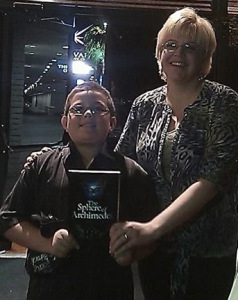
Featured Writing Addict: H. Squires

H. Squires

photo-1

Heather Squires’ life calling to be an author began in 1989 in Phoenix, Arizona. As an editorial writer on staff at the Utopian Newspaper, she decided to seek further review and publishing. The first project to be completed outside of the journaling world was To Desecrate Man, an action novel; completed in 2005, it became over shadowed by the second project: Rogue, a young adult fiction-adventure novel.

Upon completion of Rogue in 2009, Squires’ place in the young adult fiction world became clear. The Sphere of Archimedes began to take shape, and was finished in 2011. Currently working on the sequel, The Omphalos of Delphi, she continues to create anticipation for the future of young adult fiction.

What is H. Squires’s Genre?

Fiction: Young Adult, Science Fiction

What is  H. Squires’s Inspiration?

“As an observer, I watch ominous clouds collide in the blue firmament. A black-hooded, male sparrow puffs out his chest, and struts to impress a potential mate. While skating over a broad leaf, a snail’s eyes –perched on tall stalks, nods from the slightest breeze.

The daily creations displayed before our eyes, inspires me to write. I cannot go to my grave without trying to verbally describe God’s handiwork—and, if I can tell a story within the narrative, then [I hope] I do Him justice.”

What is H. Squires’s book about?

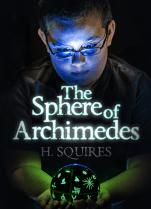
The Sphere of Archimedes

book cover

“Professor Donovan Spiegler, and nine-year-old Oliver Abernathy have no warning that their seemingly routine lives will free-fall into danger and adventure in this sci-fi thriller: THE SPHERE OF ARCHIMEDES.

Oliver, a chubby, freckle-faced boy, is surviving a mundane school-life as the helpless victim of a bully, Dylan Parker.

The Professor, and his assistant, Cedrick Wilhelm, are researching a mysterious metallic orb when Cedrick goes missing, and so does the orb.

On a trip to the Grand Canyon with his family, Oliver discovers a metallic sphere that has special powers. His boyish curiosity builds as he tests the abilities and hazards the orb possesses. He learns the alarming side of the orb when Dylan Parker, the bully, opens it, and is vaporized—or so Oliver believes.

 Nsphere

A group of threatening men turn up at Professor Spiegler’s class; at knife point, they demand he relinquish the orb, and show them how to release its powers. In an attempt to flee, the Professor inadvertently leads the mobsters straight to Oliver Abernathy and his family.

In the thrilling adventure that follows, the characters discover the need to work together in order to stay alive. The Professor and the Abernathys encounter other worlds, and meet deadly enemies. Their survival is hinged on solving THE SPHERE OF ARCHIMEDES.”


Rejected Before Fame

[found on bubblecow.net; by Gary Smailes]

“The list of famous writers who were rejected is long. Rejection and writing go hand-in-hand, but sometimes it feels that those pesky publishers simply don’t know what they are talking about.

We all know that quality of writing isn’t the only reason for reaction. Perhaps your book is not a good fit for the publisher, or the agent is looking for something ‘different’ or your work has just been misunderstood. Yet, no matter what the reason those rejection letters still sting!

Here’s eleven famous writers who were rejected and show that writers might just be right after all…

    1. Madeline L’Engle’s book, A Wrinkle in Time, was turned down 29 times before she found a publisher.
    2. C.S. Lewis received over 800 rejections before he sold a single piece of writing.
    3. Margaret Mitchell’s Gone With the Wind was rejected by 25 publishers.
    4. Zen and the Art of Motorcycle Maintenance was rejected 121 times.
    5. Johathan Livingston Seagull was rejected 40 times.
    6. Louis L’Amour was rejected over 200 times before he sold any of his writing.
    7. The San Francisco Examiner turned down Rudyard Kipling’s submission in 1889 with the note, “I am sorry, Mr. Kipling, but you just do not know how to use the English language.”
    8. An editor once told F. Scott Fitzgerald, “You’d have a decent book if you’d get rid of that Gatsby Character.”
    9. The Dr. Seuss book, And to Think I Saw it on Mulberry Street, was rejected for being “too different from other juveniles on the market to warrant selling.”
    10. George Orwell’s Animal Farm was rejected with the comment, “It’s impossible to sell animal stories in the USA.”
    11. The manuscript for The Diary of Anne Frank received the editorial comment, “This girl doesn’t, it seems to me, have a special perception or feeling which would lift that book above the curiosity level.”

I hope that these famous writers who were rejected will give you a little bit of hope on those dark rejection letter days!”

[found on http://bubblecow.net/11-famous-writers-who-were-rejected-before-making-it-big]

When Do You Stop Researching?

[found on howtoplanwriteanddevelopabook.blogspot.com; by Mary Carroll Moore]

“A children’s book writer sent me the following question:  “I am interested in writing a non fiction book for 11-18 year olds and wanted to know how to go about preparing myself to do the research for the book efficiently?”  This writer had a timeline for her book and wanted to complete it by the beginning of December.

Research is both a blessing and a bane for the book writer.  It’s very easy to research now that the world is at our fingertips via the Internet.

But this wealth of resources also poses a serious side tracking problem:  How can you really tell when you’re researching and when you’re just avoiding writing?

I love to research.  I worked as an editor for a small press for 18 years and was constantly being asked to research this or that fact from different authors’ books.  I knew how to get online and sail through the mediocre listings into the really meaty facts.  I became good friends (via phone) with several reference librarians at my local library–always a good call to make when stumped by the various options on the Internet.  Librarians (mostly) love research and they are there to help.

But often I found myself cruising from one article to the next, opening more layers of links, and finding it hard to actually come back to the writing I was supposed to be working on.

Since someone was paying me to get the editing done, and I was under a deadline, I always forced myself away from the research eventually.  But when you’re writing your book, you may not have this outer-imposed structure.  You may be your only boss, creating your own timeline, as my reader above is.  How do you stay efficient with research and still get your book done?

Researching Your Readership
I have dozens of stories from students in my classes who discovered they were writing to the wrong readership–after they did some bookstore research.  One woman thought her novel was geared toward adults but after she spent an hour browsing the YA bookstore shelves, she realized her language, tone, and subject matter was really meant for younger reader, in their late teens, as she had been when she experienced the specific changes she was writing about.  Another student was preparing to finish his memoir when he did some belated bookstore research and realized he didn’t want his story on the memoir shelf–it was way too raw and dangerous emotionally for him to imagine his family members picking up a copy of a “true story” that contained their histories.  So he switched horses in midstream and became a novelist.This sounds basic, but many writers forget that bookstores (and online bookstores) hold a wealth of information to help us orient our book projects.  So researching your readership is first on the list.

For the reader who wrote me the question for this post, as someone writing a book for a certain age group, you really need to know your audience well.  What language do these readers prefer?  They may be much more sophisticated readers than you were at that age, or they may not be.  What do they learn in school–and is your topic too sophisticated or way to basic for them?

And if you’re delivering a certain topic and need scientific, cultural, political, or historical data, you need to translate what you research into wording that kids would understand, crafting your writing to lead them point by point through the material.

Research Information
After you’ve researched your reader and gone through the steps to explore your book’s topic, you may have the urge to spend time on the Internet, in the library, or in your own book collection, making sure your facts are in order.  This is really important, and it used to be the provenance of fact checkers at a publishers.  No more.  It’s now up to the writer, and publishing contracts have long clauses to make sure the writer holds all responsibility for errors of fact in their manuscript.I love to research place, and I do that early on in the research process for my books.  I physically visit the location of my book as many times as I can, read other books set in that location, and take lots of notes–especially sensory details like the way things sound, smell, and look in that setting.  It’s important to convey accuracy of place to allow the emotion within the place to touch your reader.  And, believe me, readers who are familiar with the place will let you know if you’ve made mistakes in reporting the details of their favorite locations.

Historical facts are also important to get right.  Watch out for the Internet on this one.  When I was a professional editor at the small press in the Midwest, we rarely accepted the first or even fifth Internet mention of a fact as truth.  It took lots of browsing and comparing notes from different sites.  If a fact was repeated frequently, then it was more likely true.  But I collected a list of my favorite fact-checking sites that seemed reliable, and they were the ones I visited most often.  University research sites, library databases, and reputable publications online were the ones I leaned on most–and I strictly avoided the chats, blogs, and personal opinion posts that could be just that.

Putting Research in Its Proper Place
Make sure, though, that research doesn’t take over your writing time.  It’s a great time waster for us creative types, especially with the Internet making the world of research so very accessible.  Hours (days!) can go by while you happily browse, and not one word of your book actually gets written.When I am deep in research, I set a kitchen timer.  When the timer rings, I stop–no matter how exciting that next link looks.  I go back to the writing, to the blank page, and do what I came here for.  It takes discipline to leave the candy store of research and actually write.  But it’s the only way to make a book.

This Week’s Writing Exercise
1.  Make a list of topics you’d like to research for your book project.  They could be more information on the setting you’re writing about, historical facts, readership research, or anything you are interested in that might enhance your story.2.  Practice disciplined research:  get a kitchen timer or set your cell phone alarm for 30 minutes.  Begin your research.  See if you can stop when the alarm goes off.  Make sure you make notes or print interesting pages.

3.  Make notes to remind you where you were, so you can return easily.

4.  Look over the research notes you’ve made.  Take a highlighter and underline sections that might be useful to inform a chapter, character, or focus of your book.”

[found on http://howtoplanwriteanddevelopabook.blogspot.com/2011/04/researching-your-book-how-to-do-it-when.html]

You Need An Editor

If you are a writer of any type…

You need an editor.

Write novels? Write blogs? Write devotionals?

You need an editor.

Write joke books? Write How To manuals?

You need an editor.

If you write…

You need an editor.

**

It’s time.

Get a quote for your project.
Move forward.

Click HERE to get started.

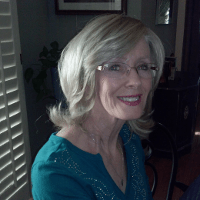
Featured Writing Addict: Emjay Luby

Emjay Luby

164938_104098889782206_213049138_n

Since the day Emjay haltingly read See Spot Run, she was hooked on the written word. As a child, she looked forward to bedtime, because bed and reading went together. All the Luby kids slept with their arms wrapped around books — not stuffed animals.

When she first read A Tree Grows in Brooklyn at the age of 15, she determined that she wanted to be a word spinner — an author — like Betty Smith. She signed up for the Famous Writers Course when she was an 18-year-old stay-at-home mom. Her first story was painstakingly pounded out on an ancient Underwood typewriter.

Many more courses followed over the years, until she finally learned that if she wanted to become a good writer, she needed to spend less time reading about writing, and more time putting words on paper.

She sent an article to a Sunday School quarterly, and was thrilled when they not only accepted her story but paid her $15 for doing what she loved. A Christian magazine accepted an article about her family’s missionary trip to Mexico a few years later.

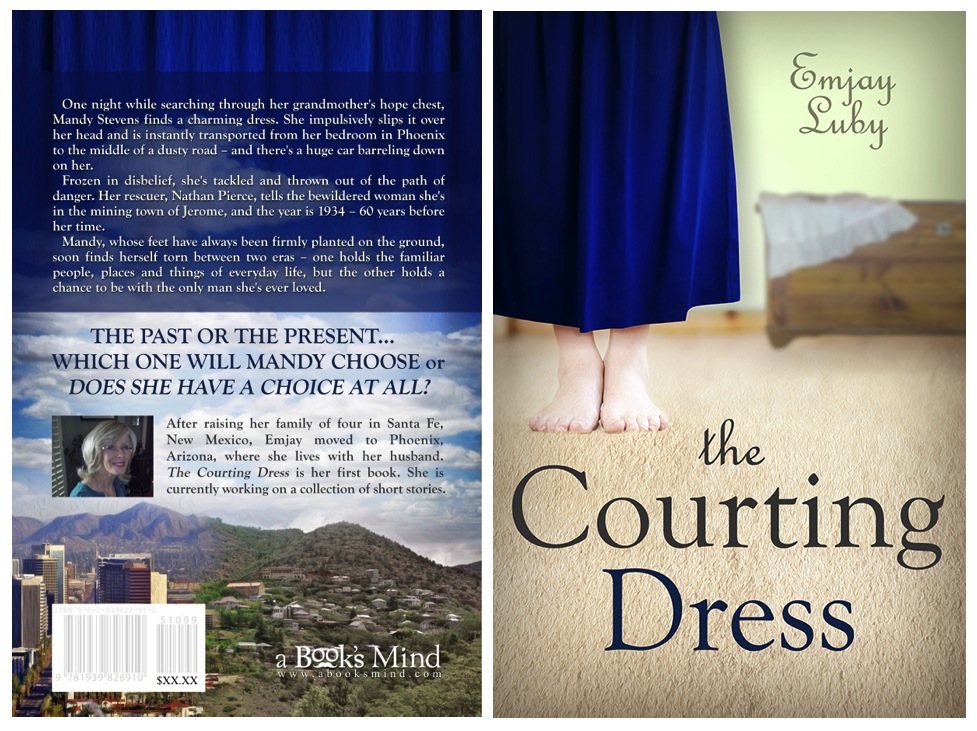
Many years have passed since she first came up with the idea for The Courting Dress. The outline, character studies, and a couple of chapters sat in the back of a closet until she shared a few pages of the story at an Abba’s Writers meeting. “The women encouraged, prodded, and coerced me to continue writing, and get the book published. I’m grateful for their patience and perseverance as I limped my way to the finish line.”

What’s Emjay Luby’s Genre?

Fiction: Young Adult, Science Fiction, Romance

What’s  Emjay Luby’s Inspiration?

“I’m fascinated by old mining towns like Madrid in New Mexico and Jerome in Arizona. One day as I was walking through a mining museum, I thought, It would be so cool to go back in time and meet some of the people who lived and worked in these rough-and-tumble towns. Nathan Pierce, Mandy Steven’s love interest in The Courting Dress, is one of those men.”

What is Emjay Luby’s book about?

The Courting Dress

EMJAY.004“One night in March of 1994, while searching through her grandmother’s hope chest, Mandy Stevens finds a charming dress. She impulsively slips it over her head, and is instantly transported from her bedroom in Phoenix, to the middle of a dusty road, and there’s a car barreling down on her! Frozen in disbelief, she’s tackled and thrown out of the path of danger. Her rescuer, Nathan Pierce, tells the bewildered woman she’s in the mining town of Jerome, and the year is 1934.  Mandy, whose feet have always been firmly planted on the ground, soon finds herself torn between two eras — one holds the familiar people, places, and things of everyday life, but the other holds a chance to be with the only man she’s ever loved. The past or the present…which one will Mandy choose, or does she have a choice at all?”


To reach Emjay Luby, buy her books, or schedule a book-signing event: