Tag: reader

Writer…Arrived
“All good books are alike in that they are truer than if they had really happened and after you are finished reading one you will feel that all that happened to you and afterwards it all belongs to you: the good and the bad, the ecstasy, the remorse and sorrow, the people and the places and how the weather was. If you can get so that you can give that to people, then you are a writer.”
― Ernest Hemingway
Share this:
Secret & Silent—Inspiration
“In fiction, I exercise my nosiness. I am as curious as my cats, and indeed that has led to trouble often enough and used up several of my nine lives. I am an avid listener. I am fascinated by other people’s lives, the choices they make and how that works out through time, what they have done and left undone, what they tell me and what they keep secret and silent, what they lie about and what they confess, what they are proud of and what shames them, what they hope for and what they fear. The source of my fiction is the desire to understand people and their choices through time.”
― Marge Piercy, Braided Lives
Share this:
Featured Writing Addict: H. Squires
H. Squires
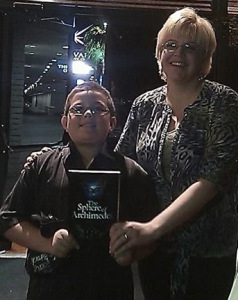
Heather Squires’ life calling to be an author began in 1989 in Phoenix, Arizona. As an editorial writer on staff at the Utopian Newspaper, she decided to seek further review and publishing. The first project to be completed outside of the journaling world was To Desecrate Man, an action novel; completed in 2005, it became over shadowed by the second project: Rogue, a young adult fiction-adventure novel.
Upon completion of Rogue in 2009, Squires’ place in the young adult fiction world became clear. The Sphere of Archimedes began to take shape, and was finished in 2011. Currently working on the sequel, The Omphalos of Delphi, she continues to create anticipation for the future of young adult fiction.
What is H. Squires’s Genre?
Fiction: Young Adult, Science Fiction
What is H. Squires’s Inspiration?
“As an observer, I watch ominous clouds collide in the blue firmament. A black-hooded, male sparrow puffs out his chest, and struts to impress a potential mate. While skating over a broad leaf, a snail’s eyes –perched on tall stalks, nods from the slightest breeze.
The daily creations displayed before our eyes, inspires me to write. I cannot go to my grave without trying to verbally describe God’s handiwork—and, if I can tell a story within the narrative, then [I hope] I do Him justice.”
What is H. Squires’s book about?
The Sphere of Archimedes
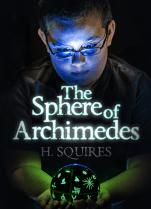
“Professor Donovan Spiegler, and nine-year-old Oliver Abernathy have no warning that their seemingly routine lives will free-fall into danger and adventure in this sci-fi thriller: THE SPHERE OF ARCHIMEDES.
Oliver, a chubby, freckle-faced boy, is surviving a mundane school-life as the helpless victim of a bully, Dylan Parker.
The Professor, and his assistant, Cedrick Wilhelm, are researching a mysterious metallic orb when Cedrick goes missing, and so does the orb.
On a trip to the Grand Canyon with his family, Oliver discovers a metallic sphere that has special powers. His boyish curiosity builds as he tests the abilities and hazards the orb possesses. He learns the alarming side of the orb when Dylan Parker, the bully, opens it, and is vaporized—or so Oliver believes.

A group of threatening men turn up at Professor Spiegler’s class; at knife point, they demand he relinquish the orb, and show them how to release its powers. In an attempt to flee, the Professor inadvertently leads the mobsters straight to Oliver Abernathy and his family.
In the thrilling adventure that follows, the characters discover the need to work together in order to stay alive. The Professor and the Abernathys encounter other worlds, and meet deadly enemies. Their survival is hinged on solving THE SPHERE OF ARCHIMEDES.”
| Amazon | Barnes & Noble | A Book’s Mind |
| HSquiresNovels.com | Facebook | Twitter | Goodreads | Email |
[See what H. Squires had to say about our editor!]
Tell H. Squires you heard about her on editingaddict.com!
Share this:

How To Write Historical Fiction
[found on caroclarke.com]
“…The realities of the everyday things in your chosen time period will shape what your characters can and can’t do. This will constrain your own plot choices. It’s part of the challenge and joy of writing historical fiction to share with your characters the real problems, the real world, they live in. It stretches your imagination. If you aren’t fussy about your details, if you think it’s all right to have Willem know latitude and longitude or for Maria Dolores to carry a purse, then you aren’t up to the demands of historical fiction. Your characters will not be real, your story will have no life, and you will have failed your readers. If you’re that kind of writer, you’ll have stopped reading this essay as soon as you hit the word ‘research’. But you’re that other kind of writer, the historical novelist, the one who cares. You’ll have done your mountain of research both for the love of it and for the love of your story. What to do with all those cherished, hard-won facts?
…Once you’ve created your plot, you begin to write. Knowing the realities of the small, everyday things of your time period now allows you to conjure an authenticity into Willem’s and Maria Dolores’ lives. Long skirts swept the floor. Willem knows she’s hiding in the courtyard because he sees the lines her skirts have made in the sand his sister sprinkles on the paving tiles. Maria Dolores seizes a tankard to brain him – it’s leather, not metal, and her escape attempt collapses in laughter. When a Calvinist mob, incited by Willem’s sister, bays for the blood of the Catholic woman hidden in their midst, Willem and Maria Dolores are able to escape across the ice in the harbour, for this is the time of the Little Ice Age, when broad rivers froze.
Notice that the sand on the paving tiles, the material of the tankard, the unusually cold winter, are only included because they help propel the plot. As much as you’d love to discuss the construction of the typical Dutch house or the rise of Calvinism in the Netherlands, these aren’t pertinent to the actual events in the story. It’s pertinent that the leader of the mob has skates, it’s pertinent that the gunpowder in Willem’s pistol cakes when soaked with ice-water, it’s pertinent that the woolen skirts of the time were thick and heavy enough to stop a bullet. But if a beloved fact (the wheat for their bread came from Poland) doesn’t propel the action of the story, it doesn’t belong. You’ll use less than 20% of the facts you’ve researched in the events of your story, but the other 80% filling your head will give you a heightened understanding of the period, illuminating your characters and their world for you so that what the reader sees is the distillation of your sympathetic imagination, a richness condensed….”
For more great insights about historical fiction from Caro Clarke, click HERE.
[found on http://www.caroclarke.com/historicalfiction.html]
Share this:
Pick Your Reader, Not Your Prose
“What model reader did I want as I was writing? An accomplice, to be sure, one who would play my game.”
― Umberto Eco, PostScript to the Name of the Rose
Share this:
Oceanic U.S.S. Writer
“Writing is a vessel…with readers the ocean and authors as its sails…”
― William Petersen
Share this:
Guilty…So Says The Literary Critic
“To literary critics a book is assumed to be guilty until it proves itself innocent.”
― Nelson Algren

 Editing Addict, LLC