Tag: writer

Step Away From Your Work
“My English teacher said that a writer is the worst judge of his own work.”
― Ilsa J. Bick, Ashes
Share this:
Hundreds of Writing Tips? Yes, please.
Here are a few…
[found on writetodone.com; by Mary Jaksch]
- “Be open, curious, present, and engaged.
- Accept all forms of criticism and learn to grow from it.
- Live with passion.
- Say to everyone: “I’m a writer.”
- Recognize your fear and overcome it.
- Rethink what is ‘normal’.
- Check if your assumptions are right.
- Accept no excuses.
- Break out of your comfort zone.
- Approach writing with gratitude, not just with a ‘must do this’ attitude.
- Take risks – don’t be afraid to shock. You are not who you think you are.
- Always think of your readers.
- Learn to LOVE writing and reading.
- Write like you’re on your first date.
- Simply let things be what they are.
- Expose yourself to as many new experiences in a short amount of time as possible.
- Love your tools. As St. Bumpersticker says, “My fountain pen can write better than your honor student!”
- Embrace your shadow. Discover what traits and characteristics you don’t want to express.
- Write to agitate the mind and the nerves.”
To read the rest of these 201 great writing tips, click HERE.
[found on http://writetodone.com/how-to-be-a-writer]
Share this:
Sound Off…ONE TWO…Sound Off…THREE FOUR…
New Writer? Old Writer? 10 Things You Should Know.
[found on missourireview.com; by Michael]
“10 Things Emerging Writers Need To Learn
…You’re Talented, But Talented is Overrated. For better or worse, there is a sense of competition among writers. This happens naturally in the writing workshop environment. But it also happens long after the MFA degree is over. Thanks to social media, we see what other writers are doing all the time. Someone, somewhere, is publishing something new and wonderful. The writers achieving success are hard working. Being the most talented writer doesn’t necessarily translate into publishing success, which really comes from methodical and consistent work rather than raw talent.
Ignore the Clock. I’ve yet to meet the writer who was, in hindsight, happy with her/his first publication. In the rush to get things published, in whatever venue, it’s easy to forget publishing isn’t the ultimate goal. Publishing your best work is the goal. Anyone can publish. No one is waiting for your next great masterpiece. You might as well take the time to make your work the best it possibly can be.
Put Down The Phone. One of the biggest challenges for writers, a group of people (broadly) who are more introverted than most, is being social. Making it to readings, talks, and other community events, is an important step but you also need to be socially engaged. Hey, you already left your home to be out in public anyway, right? Take a moment to speak to the writer, the organizer, the other attendees. Believe me, this is not easy to do: I know I really struggle to say hello and shake hands too. But these small bits of engagement and consideration are not soon forgotten. Save the texting for another time.
Don’t Wait To Be Told What (or When) To Write. There comes a point where no one is going to tell what you should read, what you should write, and moreover, no one is going to point this out for you. Making time to write is not easy, but until we all get crowned with Guggenheims, we all need to carve out a few hours each week to focus on our writing. Protect this time with your life.”
To read more from MissouriReview, click HERE.
[found on http://www.missourireview.com/tmr-blog/2013/08/10-things-emerging-writers-need-to-learn]
Share this:
Who Are You?
Want Your eBook to Sell? Read On.
[found on inboundpro.net; by hector cuevas]
“14 Invaluable Tips For Writing Ebooks That Sell
1. Lisa from Niche Website Success says:
“Take the time to survey your core audience to ensure your book meets their needs. We often assume we know what people want, but you never really know unless you ask.
Prior to writing my eBook, I used my email list to survey my subscribers. The feedback was invaluable and inspired much of the content in the book. Not to mention, it’s a great way to win over your readers. They ask. You deliver.”
2. Steve from Steve Aitchison says:
“Ask your audience what type of ebook they would like before writing one word of your ebook. I have made the mistake of writing an ebook, thinking, this is a great idea my readers will love this, only to find that they didn’t love it. The ONLY way to find out what type of ebook your readers will like is to ask them. You can do this in a blog post, an email to your subscribers, or use social media better yet ask them using all three.
Another thing is, make your ebook look fantastic. Presentation is everything and you want to give a professional looking ebook with a great cover. A lot of ebook creators write their book in a word document and turn it into a pdf without much thought for presentation. In this day and age of information overload, you need a great cover to catch the readers eye, a great title to capture their imagination, and a great presentation on the inside. It’s well worth spending a few hundred dollars to get a professional to design your ebook once you’ve written it.
One last thing, get someone to proof read your ebook. Again, I’ve made this mistake of not getting an ebook proof read only to find I get lots of emails pointing out errors in my book. If you don’t get it proof read it shows you’re not willing to invest that little extra to make it look and read great, and this will come across to the reader.””
To see more excellent advice from InBoundPro.net, click HERE.
[found on http://www.inboundpro.net/how-to-write-ebooks-that-sell]
Share this:
Featured Writing Addict: Katie Savage
Katie Savage
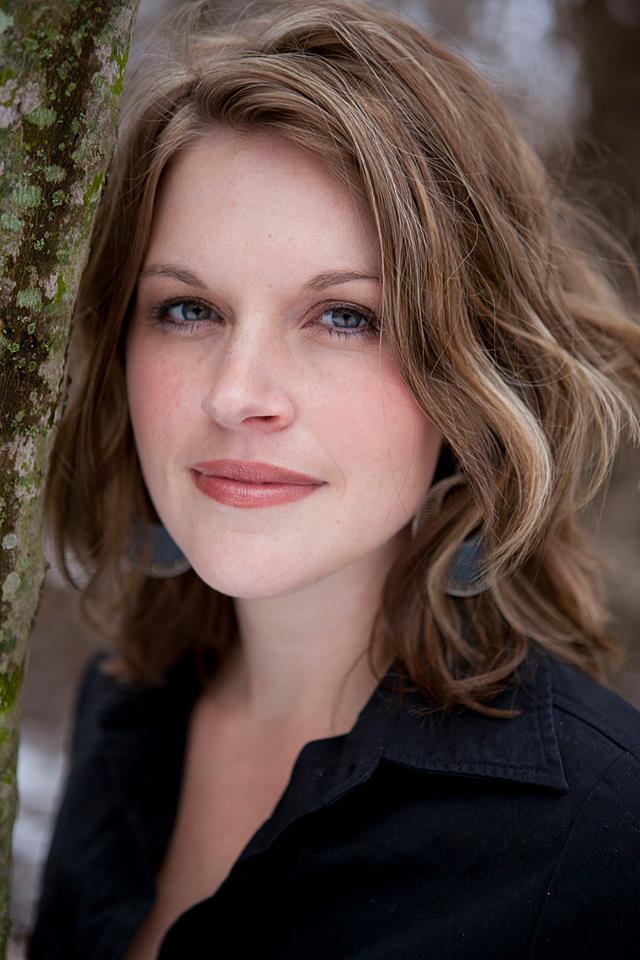 Katie Savage was born into the Protestant Evangelical Christian tradition and has been writing about it ever since. (Although she will refuse to show you any of her prayer journals from high school. Those are totally embarrassing.) Katie has a BA in Creative Writing and English Education from Point Loma Nazarene University.
After college, Katie spent time teaching high school and junior high English and earning her MFA from the University of Kansas. She and Scott now live in Kansas City, with their two children, Miles and Genevieve. They are members of Redemption Church, where Scott is the associate pastor. Grace in the Maybe: Instructions on Not Knowing Everything about God is her first book.
What’s Katie Savage’s Genre?
Personal essays about faith, with a style somewhere between Anne Lamott and Ann Voskamp
What’s on Katie’s Heart?
“It seems to me that somewhere in the recent future, many Christians have begun to feel pressured to know all of the answers when it comes to God. I remember seeing a T-shirt in a Christian bookstore that said, “God said it. I believe it. That settles it.” When I was a girl, that sounded great! But as I’ve matured in my faith, I’ve come to realize that there is a great deal of mystery and unknowing when we talk about God. This is not a lack of faith—the acknowledgment that we don’t know all the answers about how God operates—in fact, I think the realization has deepened my faith and has helped me to understand, in the depths, that God is so much bigger and more holy than we have the capacity to gauge. Grace in the Maybe is all about how we can find glimpses of God’s nature in the everyday movements of our lives, in each spiritual season of faith, regardless of whether this gives us answers to anything.”
What is Katie Savage’s book about?
Grace in the Maybe: Instructions on Not Knowing Everything about God
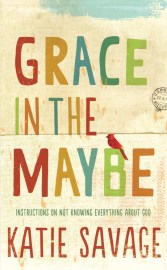
Excerpt from the book: “There was a time when I knew everything about God. I was young (you’re not surprised) and relatively arrogant (now you’re really not surprised). My team always won when we played Bible trivia games in my church youth group. I knew the stories of Jonah and Daniel and Saul like they were my own family stories; I could quote the most popular Bible verses; I memorized the order of the biblical books and could spell all their names. Somewhere along the way, I lost all that knowledge about God—or at least I began to realize how much there was to learn. Each day I was a Christian seemed to be a step backward in understanding my faith. I started acknowledging the questions in my heart, began discussing those questions with friends and fellow saints, as those in the church are called, however undeserving the label may sometimes seem. And I discovered, after whining about how difficult all of this Christian stuff was, that the mystery of not knowing was also absolutely, undeniably wonderful.”
What Others Are Saying:
“Katie Savage is smart, funny, and a little bit sassy. She writes with a feminine voice… vibrant, earthy, and honest enough to appeal to both genders. When I read her work I find myself hoping that if I don’t take myself too seriously, maybe even I can see God. ” (Tim Suttle, pastor, author of Public Jesus) “Although I myself am not religious, I found this wonderful collection to be thought provoking and often hilarious—Katie writes with humility, warmth, and complete candor. She knows how to tell a story, and I have no doubt that her smart observations and searching honesty will soon make her the favorite writer of many readers.” (Laura Moriarty, author of The Chaperone)To reach Katie Savage, buy her books, or schedule a book-signing event:
- Facebook: facebook.com/author.katiesavage
- Website: authorkatiesavage.com
- Twitter: @_katiesavage_
- Tell her you heard about her on editingaddict.com!
Share this:

What Real Authors Use For Tools
[found on flavorwire.com; by Alison Nastasi]
“It’s no secret that writers can be quite particular about their writing tools. Some might call it an obsession or fetish, but the pens, pencils, notebooks, and other implements that authors have used to create their most famous works endlessly fascinates us. After reading an ode to the beloved Eberhard Faber Blackwing 602 pencil, adored for its smooth, firm graphite, we had to find out more about the tools of the literary elite. Take notes, and save your pennies to purchase these writing instruments for yourself.”
To see these incredible writing tools listed from Flavorwire, click HERE.
[found on http://flavorwire.com/410384/the-writing-tools-of-20-famous-authors]
Share this:
Need A Writing Prompt?
[found on dailywritingtips.com; by Simon Kewin]
“Where To Find Writing Prompts Online
The internet is a wonderful source of writing prompts. There are sites dedicated to providing them which a quick search will turn up. Examples include :
There are also numerous blogs that offer a regular writing prompt to inspire you and where you can, if you wish, post what you’ve written. Examples include :
There are also many other sites that can, inadvertently, provide a rich seam of material for writing prompts – for example news sites with their intriguing headlines or pictorial sites such as Flickr.com that give you access to a vast range of photographs that can prompt your writing.
If you’re on Twitter, there are users you can follow to receive a stream of prompts, for example :
Another idea is just to keep an eye on all the tweets being written by people all over the world, some of which can, inadvertently, be used as writing prompts.
How To Make Your Own Writing Prompts
You can find ideas for writing prompts of your own from all sorts of places : snatches of overheard conversation, headlines, signs, words picked from a book and so on. Get used to keeping an eye out for words and phrases that fire your imagination, jot them down and use them as writing prompts to spark your creativity. You never know where they might take you.”
For more great information on writing from DailyWritingTips, click HERE.
 Editing Addict, LLC