Tag: writer

5 Creative Flaws Exposing Lack of Storytelling Experience
[found on storyfix.com; by Larry Brooks]
“There are a million ways to cripple a story. Here are five of them.
There’s absolutely nothing wrong with being inexperienced (we’ve all been there). Unless it shows up in your story in a way that detracts from it.
Or kills it.
Pop quiz: which is the more unforgiving audience: agents, editors, or readers?
Used to be that the only answers that mattered were the first two, because you’d never get your work in front of the latter if your story was guilty of and of these five deal killers. They were grounds for rejection.
Nowadays, though, you can skip the grouchy agents and rejection-happy acquisitions editors and go digitally direct to the marketplace. And if for a moment you think that this brave new world lowers the craft bar, that digital readers won’t care about the small stuff in the same way that agents and editors do, think again.
This is actually good news.
Because when you finally conquer these five demons, you’ll stand out as a professional storyteller worthy of publication – even if you’re self-publishing – amidst a sea of competition that, quite frankly, isn’t.Without word-of-mouth buzz, your digital story is going nowhere beyond your circle of loyal family and friends. And with these five flaws crippling your pages, a wider readership isn’t likely.
Not just because of the technical impropriety of it. But because the writer who doesn’t recognize the folly of these things isn’t likely to spin a story that competes with those of writers who do.
Here they are, in no particular order of toxicity.
1. Proper Names Within Dialogue
Which equates to bad dialogue.
Listen closely to conversations in your life. Count the number of times somebody uses your name in those audible exchanges. Better yet, how often you use the name of the person you are talking to, either face to face or on the phone.
It’ll be a low number. It is likely to be zero.
And yet, some writers seem to think this sounds cool when written into dialogue. To wit:
Hey, Bob, good to see you.
You too, Joe. Been well?
Bob, you have no idea.
Well Joe, times are tough.
Tell me about it, Bob. I hear you, man.
Only a bit of an exaggeration here. I see this all the time in the manuscripts I’m hired to critique and coach. If it only happened once it might fly under the radar – because it does happen, once in a blue moon, in real life, and it sounds odd then, too – but usually when it appears it pops up throughout the entire manuscript like a skin rash.
Rule of thumb: never do this in your dialogue. Never.
With experience comes an ear for dialogue. But you can shorten that learning curve dramatically by simply axing out the use of proper names.
Unless someone is calling on the phone and opens with, “Is Mary there?”, don’t make this mistake.
2. Chit-Chat
William Goldman, the senior statesman of screenwriting who is also an accomplished novelist, advises us to begin our scenes at the last possible moment.
This is huge. Some of the best advice ever, even for novelists. Because implicit within its genius is the assumption – the prerequisite – that the writer completely knows the mission of each and every scene.
Read that again, it can change your entire storytelling experience.
Skip the pleasantries when two people meet. Avoid the weather talk. The how-have-you-beens. Instead, opt for something like this:
After a few minutes of catching up Laura popped the question she’d come for.
“Are you having an affair with my husband?” she asked.
The first of those two lines can replace many paragraphs of useless chit-chat. Even when said chit-chat demonstrates characterization, without expositional value it’s a useless distraction that eats away at pace. And pace is always important.
Characterization when it counts trumps characterization when it doesn’t, every time.
I’ve read pages upon pages of chit-chat before a scene finally kicks in. I’ve seen entire scenes full of it without the scene ever arriving at a point. And I have to remind myself that I’m getting paid to read it.
But never in the story of an accomplished pro.
It’s a judgment call, and with experience comes an evolved sense of pace and reader tolerance.
3. Too Much Description of Food
This is more common than you can imagine among newer writers. Meals are described with exquisite detail. Course after course, drenched with spicy, worshipful adjectives.
Delicious. Steaming hot. Slathered in a sweet sauce.
The only justification for doing this is when the meal is laced with arsenic. Because – and I’m serious about that analogy – because in such a case it would relate to the story.
If it doesn’t relate, skip it.
Nobody cares what your hero has for breakfast. It’s not important to know the menu of a meal prepared with love.
Ever. Unless, like I said, the meal matters. Which it hardly ever does.
4. Overwritten Sequential Time Fillers
Your hero has had a tough day at work. She comes home to shower and have a glass of wine before driving to the rendezvous point for her blind date that evening, which she’d been unable to stop thinking about all day.
As a writer, you now face a decision: cut to the date, or take us home with her for the shower and the wine and some lengthy pondering of her lonely life. Or better yet, cut straight to the date and cover any prior ground (her bad day at work, the shower and wine) with a short introductory sentence.
Inexperienced writers tend to take us home with her. Have us take a shower with her and ooh and ahh about how good the hot water feels. About the taste of the wine, a hint of cherry, a nice finish.
The more experienced writer cuts straight to the date.
This pitfall is similar to the chit-chat and food and transitional red flags described elsewhere in this article. The same standard applies: if it doesn’t deliver salient expositional information, if it doesn’tmatter, if it just moves the character forward in time (as if the writer is obliged to show us each and every moment and hour of the hero’s day, which isn’t true), then skip it.
Know what matters, what counts, and why. Then, like a chess piece, move the scenes from one square to the next. Every time you hit the pause button to take a shower or reflect on the drive home, you’re killing your story’s pacing.
Mission-driven scene writing is the Holy Grail of long form storytelling. It is the context for almost every problem and solution you’ll face.
5. Invisible Scene Transitions
Less is more. It really is. Unless we’re talking foreplay, but that’s another blog.
This principle leads us to the best transitional device known to the modern storyteller. The very best way to get from one scene to the next is… to do nothing.
Literally.
Two words: white space.
Just end a scene cleanly, then skip a couple of lines and jump into the next scene. Which happens when either time or place or point of view changes.
Read that again, too. It’s basic and critical.
If you’re jumping to a new chapter this takes care of itself. But chapters are legitimately able to house an untold number of scenes, and if you want to make sure the reader is as aware of the transitions with them as you are, skip a line or two when time or place of POV changes.
Otherwise, your transition might look like this:
The meeting dragged on for several hours, complete with boring Powerpoint presentations and the lengthy pontifications of the CEO, who had never been on a sales call in her life. Tomorrow would be no exception. The sales call began at noon, with a rubber chicken catered lunch already on the table. The client posse arrived together, as if they’d marshaled in the parking lot to finalize strategy and send off any last minute texts.
It’s not wrong, per se, it’s just that the transition from scene to scene (note, it’s now tomorrow, a different time and place) is not as clear and efficient as it could be. A reader who skims is likely to miss it.
Now look at it this way. A simple thing, with an empowering result:
The meeting went on for several hours, complete with boring Powerpoint presentations and the lengthy pontifications of the CEO, who had never been on a sales call in her life. Tomorrow would be no exception.
The sales call began at noon, with a rubber chicken catered lunch already on the table. The client posse arrived together, as if they’d marshaled in the parking lot to finalize strategy and send off any last minute texts.
Such simplicity. The power of the skipped line of white space is amazing.
These mid-chapter scenes – especially necessary transitional ones – can be as short as you want. One paragraph exposition that gets us from one point to the next are wonderful, especially if they replace two-page space fillers that seek to accomplish the exact same thing. The need to pad these scenes is the paradigm of the beginner… which, after being duly warned, you no longer are.
Such is the case with all five of these rookie mistakes. Your radar for them is the most important part of your review and edit process.
And if you can’t wrap your head around it, I’m betting your significant manuscript-reader other can. Because they’re readers, and readers are the victims when these things hit the page.”
[found on http://storyfix.com/5-creative-flaws-that-will-expose-your-lack-of-storytelling-experience]
Share this:
Did I Write That?
“Critics sometimes appear to be addressing themselves to works other than those I remember writing.”
― Joyce Carol Oates
Share this:
How Sharp Is Your Pen?
“Discipline and constant work are the whetstones upon which the dull knife of talent is honed until it becomes sharp enough, hopefully, to cut through even the toughest meat and gristle.”
― Stephen King, Danse Macabre
Share this:
Never Give Up, Throw Something
“That’s the difference between a champ and a knife thrower. The champ may have lost his stuff temporarily or permanently, he can’t be sure. But when he can no longer throw the high hard one, he throws his heart instead. He throws something. He doesn’t just walk off the mound and weep.”
― Raymond Chandler, The Raymond Chandler Papers: Selected Letters and Nonfiction 1909-1959
Share this:
12 Questions for Writers
[found on 12most.com by Kelly Belmonte]
“If you want to be a writer, you must do two things above all others: read a lot and write a lot. There’s no way around these two things that I’m aware of, no shortcut.” ~ Stephen King, On Writing
I cannot disagree with King on this point. I have been reading a lot and writing a lot my entire life. But only recently have I gotten “serious” about being a writer. To be clear, what I mean by “serious” is really “published” — someone whose written words are read a lot by folks who are not otherwise obligated to do so.
A big shift for me occurred when I realized I could apply my years of accumulated project management experience to my writing. I found that if I treated each written thing (whether a poem, a blog post, a technical document, or any other piece of writing) just as I would a project for a client, I’d get more traction on meeting realistic publishing goals.
This post offers a list of 12 questions that, when answered, will provide a workable project management framework for the “serious” (!) writer.
1. Who is the ideal reader (“end user”) of my piece?
If I want my words to be published, the assumption is I want someone else to read them. Communication 101: speak the same language as your audience. Even if you are thinking, “I want to write things that I want to read,” you still want to identify the key elements of what makes you tick so you can know how to find more people like you to read your stuff.
2. Who is my client?
The client is the person, group, or organization that will compensate you for your efforts, whether through money, copies, publicity, recognition, validation, connections, or something else of value to you as a writer. This is also who is going to connect you with your ideal reader. Unless you’re self-published (in which case you have a direct compensation relationship with your reader), this is usually going to be a publisher with a specific agenda, format, or type of writing they promote. It’s important to know what’s important to them. If you have a fantastic collection of sonnets, you probably don’t want to submit your chapbook to a publisher of haiku, right?
3. Who is on my team?
Writing is never just writing. There’s research. There’s first and second drafts. There’s proofreading, copy editing, content editing, and fact checking. There’s formatting, graphic design, and packaging. There’s marketing and distribution. Are you good at all of these things and (here’s the clincher) do you have the time to do them all? Do you seriously think you can edit your own words? (Guess what I think about that…) Figure out who can help you, whether for pay, barter, or goodwill. It will be worth it in the end.
4. What is the purpose of the piece?
Do you want to inspire, connect, challenge, relate, instruct, change behavior, anger, illustrate, or simply tell a darn good story? Or some combination? This is both your roadmap and your test in writing. Your purpose keeps you on track.
5. What is the scope?
This is where you describe what you think is being asked of you by your client and what you want to create for your ideal reader. Get a handle on whether you’re writing the entire history of the Great American Experiment or a day in the life of a 21st century Bostonian. Articulate for yourself (and confirm with your client, if possible) the number of words, lines, chapters, pages, required thematic and stylistic elements, and formatting constraints. Only then can you begin to map out a plan for completing your writing project.
6. What is your end state for this piece?
“As a result of my words being read, _________________ [fill in the blank].” This may be easily confused with number 4, the purpose. They are connected — one should lead to the other — but not the same. For example, if my purpose in a piece is to provide instructions for making a peanut butter and jelly sandwich, the desired end state will be “As a result… the reader will be able to make a pb&j sandwich.” If my purpose is to inspire, my end state may be, “… the reader has an ‘Ah ha’ moment.”
7. How much time will it take?
Your scope (and to some degree, your team) will provide you with a good guideline for the amount of time required (the “level of effort”) for each element. While there are some standard estimates for pages per hour, different types of writing require different levels of effort. Get to know your own pace, tracking the amount of time you spend on each project, so that estimating your time gets easier as you go along.
8. When does it need to be finished?
Even if there is no deadline or entry date, make up due dates for yourself. It will give you some basic math to work out the answer to the next question. (Due date – today’s date = number of days left to work on project.) Don’t forget to take into account time for review and editing.
9. When will I work on it?
Many writers like me have day jobs, families, friends, other interests, and need to work our writing in around an already full schedule. If I am going to be “serious” about my writing, I have to answer this in a real and manageable way. I have to recognize my priorities, logistical challenges, and areas I’m willing to sacrifice for the words. This, too, is clarifying.
10. When will I know it’s done?
This isn’t as easy to answer as it may appear on first glance, especially given the independent nature of many writing projects and the varying schedules of publishers. But this is the million-dollar “ship it” question. It can be crazy-making — there’s always just one more tweak, another review, an alternative viewpoint, a bit more white space perhaps. Will that tweak make the difference between rejection and acceptance, between runner-up and winner? You may never know. But one thing you can know for sure: if you never submit your work, you will never be published. Decide what “good enough” looks like for you.
11. How did it go?
Conduct an “after action review,” looking at your original purpose, scope, end state, and deadline. If possible (and if appropriate), engage a reader and the client in evaluating if your piece (and the process for completing it) met expectations. Listen, and learn from the gap between what you said you would do and what you actually did. This is a great opportunity to get better or to pat yourself on the back for hitting it out of the park. It’s also a constructive way to handle the inevitable disappointments that will come with writing, whether it’s negative feedback from your ideal readers, a missed deadline, or a rejection slip. Use those disappointments as fuel for the next project rather than a reason to give up.
12. Would I do it again?
Ah, there’s the rub. Would you go back to that well, that publisher, client, magazine, meta-blog site again for another opportunity to be published? It’s certainly ideal when you’ve found your niche, the exact right space where your words connect with ideal reader and are supported by an influential client-champion. But usually there’s some middle ground between lousy experience and ideal. Know your limits and your ideals. Find the opportunity in that middle ground where the good outweighs the bad.
And here’s my bonus question: Do you take yourself seriously as a writer? If the answer is yes, how many of these questions do you regularly ask yourself, and are there others that keep you moving forward on your own publishing goals?”
[found on http://12most.com/2013/05/27/12-getserious-questions-for-writers]
Share this:
Write For Fun, For Life
“So I write mainly for the fun of it, the hell of it, the duty of it. I enjoy writing, and will probly be a scribbler on my dying day, sprawled on some stony trail halfway between two dry waterholes.”
― Edward Abbey, Postcards from Ed: Dispatches and Salvos from an American Iconoclast
Share this:
Show Me The Egress!
“Actors are all about entrances, but writers are all about exits.”
― Vincent H. O’Neil, Death Troupe
Share this:
Featured Writing Addict: Emjay Luby
Emjay Luby
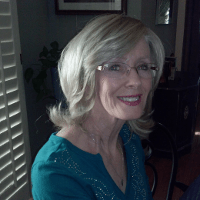
Since the day Emjay haltingly read See Spot Run, she was hooked on the written word. As a child, she looked forward to bedtime, because bed and reading went together. All the Luby kids slept with their arms wrapped around books — not stuffed animals.
When she first read A Tree Grows in Brooklyn at the age of 15, she determined that she wanted to be a word spinner — an author — like Betty Smith. She signed up for the Famous Writers Course when she was an 18-year-old stay-at-home mom. Her first story was painstakingly pounded out on an ancient Underwood typewriter.
Many more courses followed over the years, until she finally learned that if she wanted to become a good writer, she needed to spend less time reading about writing, and more time putting words on paper.
She sent an article to a Sunday School quarterly, and was thrilled when they not only accepted her story but paid her $15 for doing what she loved. A Christian magazine accepted an article about her family’s missionary trip to Mexico a few years later.
Many years have passed since she first came up with the idea for The Courting Dress. The outline, character studies, and a couple of chapters sat in the back of a closet until she shared a few pages of the story at an Abba’s Writers meeting. “The women encouraged, prodded, and coerced me to continue writing, and get the book published. I’m grateful for their patience and perseverance as I limped my way to the finish line.”
What’s Emjay Luby’s Genre?
Fiction: Young Adult, Science Fiction, Romance
What’s Emjay Luby’s Inspiration?
“I’m fascinated by old mining towns like Madrid in New Mexico and Jerome in Arizona. One day as I was walking through a mining museum, I thought, It would be so cool to go back in time and meet some of the people who lived and worked in these rough-and-tumble towns. Nathan Pierce, Mandy Steven’s love interest in The Courting Dress, is one of those men.”
What is Emjay Luby’s book about?
The Courting Dress
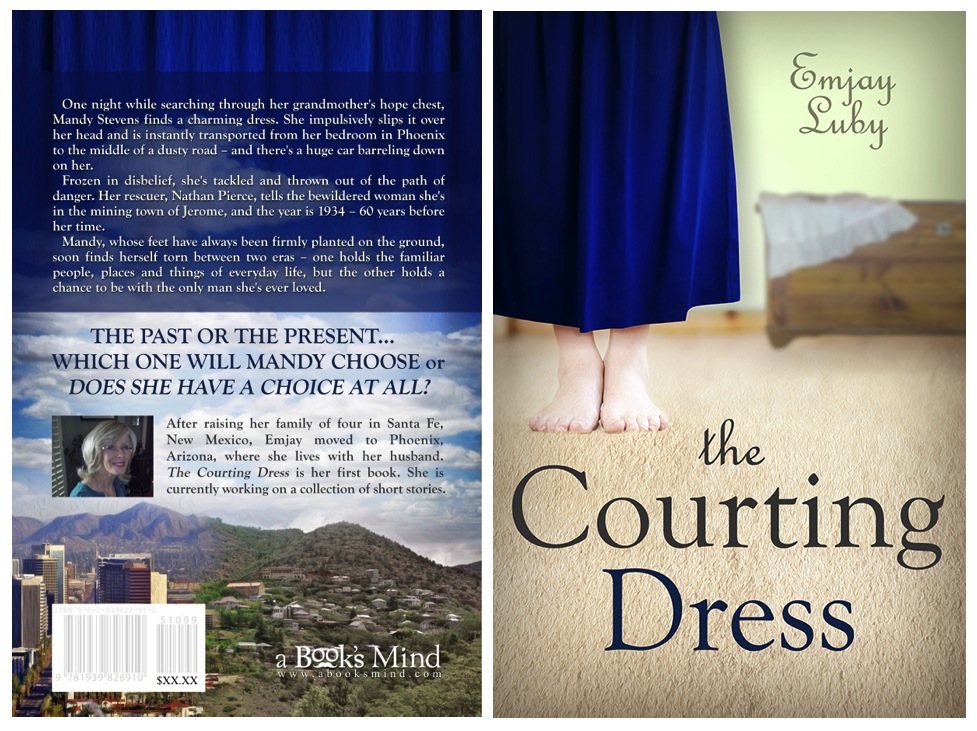 “One night in March of 1994, while searching through her grandmother’s hope chest, Mandy Stevens finds a charming dress. She impulsively slips it over her head, and is instantly transported from her bedroom in Phoenix, to the middle of a dusty road, and there’s a car barreling down on her! Frozen in disbelief, she’s tackled and thrown out of the path of danger. Her rescuer, Nathan Pierce, tells the bewildered woman she’s in the mining town of Jerome, and the year is 1934. Mandy, whose feet have always been firmly planted on the ground, soon finds herself torn between two eras — one holds the familiar people, places, and things of everyday life, but the other holds a chance to be with the only man she’s ever loved. The past or the present…which one will Mandy choose, or does she have a choice at all?”
To reach Emjay Luby, buy her books, or schedule a book-signing event:
- Facebook: facebook.com/pages/Emjay-Luby
- Email: eluby@reagan.com
- Site: www.emjaylubynovels.com
- Twitter: @emjayluby
- Tell her you heard about her on editingaddict.com!

 Editing Addict, LLC