Tag: writers

Win FREE Proofreading at WiNS Conference
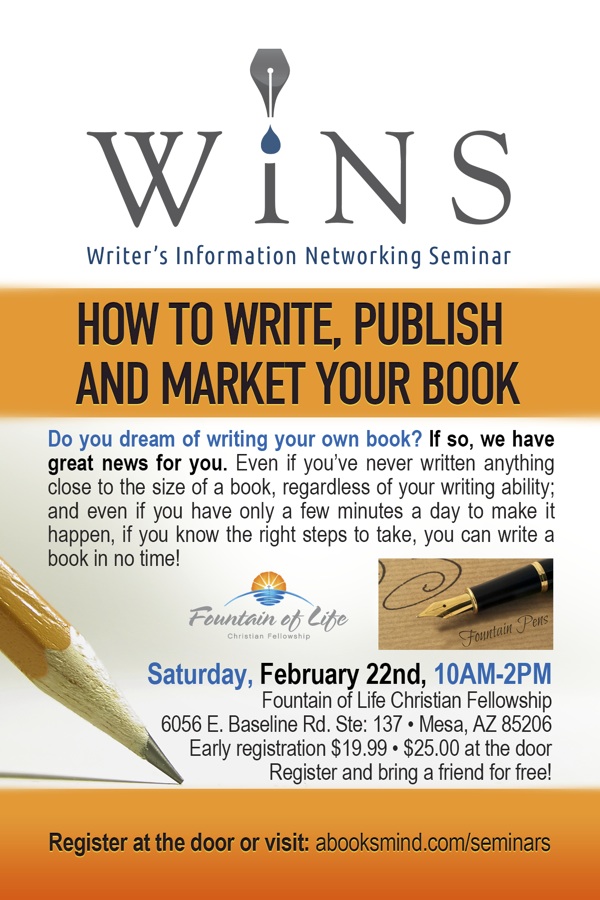
Win a FREE Proofreading Prize for 20,000 words!
HOW THE CONTEST WORKS:
To enter into the contest, share both Editing Addict and A Book’s Mind on Facebook (see details below).
The winner of the contest will be the person with the MOST registered referrals who ATTEND the WiNS Conference (minimum of nine referrals required).
PROOFREADING PRIZE can be used toward your publishing package with A Book’s Mind, or by independent editing on your own, through Editing Addict.
HOW TO ENTER:
1) Share both EDITING ADDICT and A BOOK’S MIND
a) Share Editing Addict’s Facebook Page, (remember to tag Editing Addict in the share, so you are registered in the contest).
b) Share the A Book’s Mind poster of the WiNS Conference (remember to tag A Book’s Mind, so you are registered in the contest).
2) Register YOURSELF and FRIENDS for the WiNS Conference
a) Early register yourself for the WINS conference (see poster for details)
b) Have the MOST early registered referrals who attended the WINS Conference (minimum of nine referrals required)
c) If you have already registered for the contest, let us know, and do STEP 1!
CONTEST ENDS AT THE DOOR ON FEBRUARY 22!
Share this:

Breathe, and Write
Pulse of a Book
“Write from the heart. A book without a pulse is like a person without a spirit.”
— Linda Radke, President of Five Star Publications
Share this:
How to Make a Who-Dun-It
[found on blog.karenwoodward.org; by Karen Woodward]
“1. Know who your murderer is and why they did it.
– What was their goal?
– What are the stakes?
– What motivates the killer?
By the end of the story make sure you’ve answered these questions in your manuscript.
2. Leave clues
The clues “do not have to be obvious or even fully explained. You’ll want to leave some “mystery in your mystery.”
3. After you finish the first draft add in clues where needed
Price’s tip: Red herrings are much easier to add in after the book is written as long as you don’t write yourself into a corner with your characters, such as explaining everything they do and why.
4. Don’t fully explain everything
Price writes: “Let your characters retain some mystery.”
People aren’t fully explained any more than they are wholly good or bad, your characters should reflect this.
5. Your protagonist doesn’t have to know everything, at least not right away
Like you and me, it’s okay if your sleuth doesn’t have all the answers and is unsure about what happened … as long as she gets there in the end.”
[found on http://blog.karenwoodward.org/2013/04/5-rules-for-writing-murder-mystery.html]
Share this:
Control the Voices
“Writers are nothing more than borderline schizophrenics who are able to control the voices.”
― Jennifer Salaiz
Share this:
Prompt Your Way
[found on writingforward.com; by Melissa Donovan]
“Creative Writing Prompts
- You’re digging in your garden and find a fist-sized nugget of gold.
- Write about something ugly–war, fear, hate, or cruelty–but find the beauty (silver lining) in it.
- The asteroid was hurtling straight for Earth…
- A kid comes out of the bathroom with toilet paper dangling from his or her waistband.
- Write about your early memories of faith, religion, or spirituality; yours or someone else’s.
- There’s a guy sitting on a park bench reading a newspaper…
- Write a poem about a first romantic (dare I say: sexual) experience or encounter.
- He turned the key in the lock and opened the door. To his horror, he saw…
- Silvery flakes drifted down, glittering in the bright light of the harvest moon. The blackbird swooped down…
- The detective saw his opportunity. He grabbed the waitress’s arm and said…”
[found on http://www.writingforward.com/writing-prompts/creative-writing-prompts/25-creative-writing-prompts]
Share this:
Define R E A L I T Y
“Good writers define reality; bad ones merely restate it. A good writer turns fact into truth; a bad writer will, more often than not, accomplish the opposite.”
― Edward Albee
Share this:
Strong Words Where Stand Ye?
[found on writershelper.com]
“Writing Tip #5: Use strong verbs and nouns
The verbs are the action words. They put things in motion. Make yours as strong as possible.
The verb to be (am, is, are, was, were) puddles on the floor. Eliminate it wherever possible. I spent a year in Ukraine and experienced Russian, where the verb to be exists, but almost never appears. People simply leave it out and I found the effect powerful. In English we can’t leave verbs out of our sentences, but we can make those we use work hard for us.
Nouns name the people, places, and things in our world. English has multiple words for almost everything. A male parent can be father, dad, pop, daddy, the old man, pater, progenitor, sire, begetter, conceiver, governor, abba, papa, pa, pap, pappy, pops, daddums, patriarch, paterfamilias, stepfather, foster father, and other family nicknames. Choose the noun that does the best work for you.
Short words are usually best. They have more punch. They hit the gut hard.
The paragraph above has only one word with more than one syllable.”
For more exciting tips on writing from Writer’s Helper, click here.
[found on http://www.writershelper.com/writingtips.html]
Share this:
Authors on Authoring
“Never open a book with weather. If it’s only to create atmosphere, and not a character’s reaction to the weather, you don’t want to go on too long. The reader is apt to leaf ahead looking for people. There are exceptions. If you happen to be Barry Lopez, who has more ways than an Eskimo to describe ice and snow in his book Arctic Dreams, you can do all the weather reporting you want.”
“You can never read your own book with the innocent anticipation that comes with that first delicious page of a new book, because you wrote the thing. You’ve been backstage. You’ve seen how the rabbits were smuggled into the hat. Therefore ask a reading friend or two to look at it before you give it to anyone in the publishing business. This friend should not be someone with whom you have a romantic relationship, unless you want to break up.”
“Do it every day. Make a habit of putting your observations into words and gradually this will become instinct. This is the most important rule of all and, naturally, I don’t follow it.”
 Editing Addict, LLC