Tag: Writing

5 Creative Flaws Exposing Lack of Storytelling Experience
[found on storyfix.com; by Larry Brooks]
“There are a million ways to cripple a story. Here are five of them.
There’s absolutely nothing wrong with being inexperienced (we’ve all been there). Unless it shows up in your story in a way that detracts from it.
Or kills it.
Pop quiz: which is the more unforgiving audience: agents, editors, or readers?
Used to be that the only answers that mattered were the first two, because you’d never get your work in front of the latter if your story was guilty of and of these five deal killers. They were grounds for rejection.
Nowadays, though, you can skip the grouchy agents and rejection-happy acquisitions editors and go digitally direct to the marketplace. And if for a moment you think that this brave new world lowers the craft bar, that digital readers won’t care about the small stuff in the same way that agents and editors do, think again.
This is actually good news.
Because when you finally conquer these five demons, you’ll stand out as a professional storyteller worthy of publication – even if you’re self-publishing – amidst a sea of competition that, quite frankly, isn’t.Without word-of-mouth buzz, your digital story is going nowhere beyond your circle of loyal family and friends. And with these five flaws crippling your pages, a wider readership isn’t likely.
Not just because of the technical impropriety of it. But because the writer who doesn’t recognize the folly of these things isn’t likely to spin a story that competes with those of writers who do.
Here they are, in no particular order of toxicity.
1. Proper Names Within Dialogue
Which equates to bad dialogue.
Listen closely to conversations in your life. Count the number of times somebody uses your name in those audible exchanges. Better yet, how often you use the name of the person you are talking to, either face to face or on the phone.
It’ll be a low number. It is likely to be zero.
And yet, some writers seem to think this sounds cool when written into dialogue. To wit:
Hey, Bob, good to see you.
You too, Joe. Been well?
Bob, you have no idea.
Well Joe, times are tough.
Tell me about it, Bob. I hear you, man.
Only a bit of an exaggeration here. I see this all the time in the manuscripts I’m hired to critique and coach. If it only happened once it might fly under the radar – because it does happen, once in a blue moon, in real life, and it sounds odd then, too – but usually when it appears it pops up throughout the entire manuscript like a skin rash.
Rule of thumb: never do this in your dialogue. Never.
With experience comes an ear for dialogue. But you can shorten that learning curve dramatically by simply axing out the use of proper names.
Unless someone is calling on the phone and opens with, “Is Mary there?”, don’t make this mistake.
2. Chit-Chat
William Goldman, the senior statesman of screenwriting who is also an accomplished novelist, advises us to begin our scenes at the last possible moment.
This is huge. Some of the best advice ever, even for novelists. Because implicit within its genius is the assumption – the prerequisite – that the writer completely knows the mission of each and every scene.
Read that again, it can change your entire storytelling experience.
Skip the pleasantries when two people meet. Avoid the weather talk. The how-have-you-beens. Instead, opt for something like this:
After a few minutes of catching up Laura popped the question she’d come for.
“Are you having an affair with my husband?” she asked.
The first of those two lines can replace many paragraphs of useless chit-chat. Even when said chit-chat demonstrates characterization, without expositional value it’s a useless distraction that eats away at pace. And pace is always important.
Characterization when it counts trumps characterization when it doesn’t, every time.
I’ve read pages upon pages of chit-chat before a scene finally kicks in. I’ve seen entire scenes full of it without the scene ever arriving at a point. And I have to remind myself that I’m getting paid to read it.
But never in the story of an accomplished pro.
It’s a judgment call, and with experience comes an evolved sense of pace and reader tolerance.
3. Too Much Description of Food
This is more common than you can imagine among newer writers. Meals are described with exquisite detail. Course after course, drenched with spicy, worshipful adjectives.
Delicious. Steaming hot. Slathered in a sweet sauce.
The only justification for doing this is when the meal is laced with arsenic. Because – and I’m serious about that analogy – because in such a case it would relate to the story.
If it doesn’t relate, skip it.
Nobody cares what your hero has for breakfast. It’s not important to know the menu of a meal prepared with love.
Ever. Unless, like I said, the meal matters. Which it hardly ever does.
4. Overwritten Sequential Time Fillers
Your hero has had a tough day at work. She comes home to shower and have a glass of wine before driving to the rendezvous point for her blind date that evening, which she’d been unable to stop thinking about all day.
As a writer, you now face a decision: cut to the date, or take us home with her for the shower and the wine and some lengthy pondering of her lonely life. Or better yet, cut straight to the date and cover any prior ground (her bad day at work, the shower and wine) with a short introductory sentence.
Inexperienced writers tend to take us home with her. Have us take a shower with her and ooh and ahh about how good the hot water feels. About the taste of the wine, a hint of cherry, a nice finish.
The more experienced writer cuts straight to the date.
This pitfall is similar to the chit-chat and food and transitional red flags described elsewhere in this article. The same standard applies: if it doesn’t deliver salient expositional information, if it doesn’tmatter, if it just moves the character forward in time (as if the writer is obliged to show us each and every moment and hour of the hero’s day, which isn’t true), then skip it.
Know what matters, what counts, and why. Then, like a chess piece, move the scenes from one square to the next. Every time you hit the pause button to take a shower or reflect on the drive home, you’re killing your story’s pacing.
Mission-driven scene writing is the Holy Grail of long form storytelling. It is the context for almost every problem and solution you’ll face.
5. Invisible Scene Transitions
Less is more. It really is. Unless we’re talking foreplay, but that’s another blog.
This principle leads us to the best transitional device known to the modern storyteller. The very best way to get from one scene to the next is… to do nothing.
Literally.
Two words: white space.
Just end a scene cleanly, then skip a couple of lines and jump into the next scene. Which happens when either time or place or point of view changes.
Read that again, too. It’s basic and critical.
If you’re jumping to a new chapter this takes care of itself. But chapters are legitimately able to house an untold number of scenes, and if you want to make sure the reader is as aware of the transitions with them as you are, skip a line or two when time or place of POV changes.
Otherwise, your transition might look like this:
The meeting dragged on for several hours, complete with boring Powerpoint presentations and the lengthy pontifications of the CEO, who had never been on a sales call in her life. Tomorrow would be no exception. The sales call began at noon, with a rubber chicken catered lunch already on the table. The client posse arrived together, as if they’d marshaled in the parking lot to finalize strategy and send off any last minute texts.
It’s not wrong, per se, it’s just that the transition from scene to scene (note, it’s now tomorrow, a different time and place) is not as clear and efficient as it could be. A reader who skims is likely to miss it.
Now look at it this way. A simple thing, with an empowering result:
The meeting went on for several hours, complete with boring Powerpoint presentations and the lengthy pontifications of the CEO, who had never been on a sales call in her life. Tomorrow would be no exception.
The sales call began at noon, with a rubber chicken catered lunch already on the table. The client posse arrived together, as if they’d marshaled in the parking lot to finalize strategy and send off any last minute texts.
Such simplicity. The power of the skipped line of white space is amazing.
These mid-chapter scenes – especially necessary transitional ones – can be as short as you want. One paragraph exposition that gets us from one point to the next are wonderful, especially if they replace two-page space fillers that seek to accomplish the exact same thing. The need to pad these scenes is the paradigm of the beginner… which, after being duly warned, you no longer are.
Such is the case with all five of these rookie mistakes. Your radar for them is the most important part of your review and edit process.
And if you can’t wrap your head around it, I’m betting your significant manuscript-reader other can. Because they’re readers, and readers are the victims when these things hit the page.”
[found on http://storyfix.com/5-creative-flaws-that-will-expose-your-lack-of-storytelling-experience]
Share this:
Did I Write That?
“Critics sometimes appear to be addressing themselves to works other than those I remember writing.”
― Joyce Carol Oates
Share this:
100 Expressive Interjections
[found on dailywritingtips.com by Mark Nichol]
“They often seem disreputable, like sullen idlers loitering in a public thoroughfare, but they actually do a lot of hard work and are usually persnickety about the tasks to which they are put. They are interjections — one class of them, anyway: those lacking etymological origins but packed with meaning.
But how do you know how to distinguish similar ones — or spell them, for that matter? Here’s an incomplete inventory of interjections (not including variations of actual words such as yeah for yes or onomatopoeic echoes of externally produced sounds like boom):
Ack communicates disgust or dismissal.
Ah can denote positive emotions like relief or delight (generally, pronounced with a long a).
Aha signals triumph or surprise, or perhaps derision.
Ahem is employed to gain attention.
Argh, often drawn out with additional h’s, is all about frustration.
Aw can be dismissive or indicative of disappointment, or, when drawn out, expressive of sympathy or adoration.
Aye denotes agreement.
Bah is dismissive.
Blah communicates boredom or disappointment.
Blech (or bleah or bleh) implies nausea.
Boo is an exclamation to provoke fright.
Boo-hoo is imitative of crying and is derisive.
Boo-ya (with several spelling variants) is a cry of triumph.
Bwah-hah-hah (variously spelled, including mwah-hah-hah) facetiously mimics the stereotypical archvillain’s triumphant laugh.
D’oh is the spelling for the muttering accompanying Homer Simpson’s trademark head-slapping self-abuse.
Duh derides someone who seems dense.
Eek indicates an unpleasant surprise.
Eh, with a question mark, is a request for repetition or confirmation of what was just said; without, it is dismissive.
Er (sometimes erm) plays for time.
Ew denotes disgust, intensified by the addition of one or more e’s and/or w’s.
Feh (and its cousin meh) is an indication of feeling underwhelmed or disappointed.
Gak is an expression of disgust or distaste.
Ha expresses joy or surprise, or perhaps triumph.
Ha-ha (with possible redoubling) communicates laughter or derision.
Hamana-hamana, variously spelled, and duplicated as needed, implies speechless embarrassment.
Hardy-har-har, or har-har repeated as needed, communicates mock amusement.
Hee-hee is a mischievous laugh, while its variants heh and heh-heh (and so on) can have a more derisive connotation.
Hey can express surprise or exultation, or can be used to request repetition or call for attention.
Hist signals the desire for silence.
Hm, extended as needed, suggests curiosity, confusion, consternation, or skepticism.
Hmph (also hrmph or humph) indicates displeasure or indignation.
Ho-ho is expressive of mirth, or (along with its variant oh-ho) can indicate triumph of discovery.
Ho-hum signals indifference or boredom.
Hubba-hubba is the vocal equivalent of a leer.
Huh (or hunh) is a sign of disbelief, confusion, or surprise, or, with a question mark, is a request for repetition.
Hup, from the sound-off a military cadence chant, signals beginning an exerting task.
Hurrah (also hoorah, hooray, and hurray, and even huzzah) is an exclamation of triumph or happiness.
Ick signals disgust.
Lah-de-dah denotes nonchalance or dismissal, or derision about pretension.
Mm-hmm, variously spelled, is an affirmative or corroborating response.
Mmm, extended as needed, conveys palatable or palpable pleasure.
Mwah is suggestive of a kiss, often implying unctuous or exaggerated affection.
Neener-neener, often uttered in a series of three repetitions, is a taunt.
Now (often repeated “Now, now”) is uttered as an admonition.
Oh is among the most versatile of interjections. Use it to indicate comprehension or acknowledgment (or, with a question mark, a request for verification), to preface direct address (“Oh, sir!”), as a sign of approximation or example (“Oh, about three days”), or to express emotion or serves as a response to a pain or pleasure. (Ooh is a variant useful for the last two purposes.)
Oh-oh (or alternatives in which oh is followed by various words) is a warning response to something that will have negative repercussions.
Olé, with an accent mark over the e, is borrowed from Spanish and is a vocal flourish to celebrate a deft or adroit maneuver.
Ooh, with o’s repeated as needed, conveys interest or admiration, or, alternatively, disdain.
Ooh-la-la is a response to an attempt to impress or gently mocks pretension or finery.
Oops (and the jocular diminutive variation oopsie or oopsy and the variant whoops) calls attention to an error or fault.
Ouch (or ow, extended as needed) signals pain or is a response to a harsh word or action.
Oy, part of Yiddish expressions such as oy gevalt (equivalent to “Uh-oh”), is a lament of frustration, concern, or self-pity.
Pff, extended as needed, expresses disappointment, disdain, or annoyance.
Pfft, or phfft, communicates abrupt ending or departure or is a sardonic dismissal akin to pff.
Phew, or pew, communicates disgust, fatigue, or relief. (Phooey, also spelled pfui, is a signal for disgust, too, and can denote dismissal as well. PU and P.U. are also variants.)
Poof is imitative of a sudden disappearance, as if by magic.
Pooh is a contemptuous exclamation.
Pshaw denotes disbelief, disapproval, or irritation or, alternatively, communicates facetious self-consciousness.
Psst calls for quiet.
Rah, perhaps repeated, signals triumph.
Shh (extended as necessary) is an imperative for silence.
Sis boom bah is an outdated encouraging cry, most likely to be used mockingly now.
Tchah communicates annoyance.
Tsk-tsk and its even snootier variant tut-tut are condemnations or scoldings; the related sound tch is the teeth-and-tongue click of disapproval.
Ugh is an exclamation of disgust.
Uh is an expression of skepticism or a delaying tactic.
Uh-huh indicates affirmation or agreement.
Uh-oh signals concern or dismay.
Uh-uh is the sound of negation or refusal.
Um is a placeholder for a pause but also denotes skepticism.
Va-va-voom is an old-fashioned exclamation denoting admiration of physical attractiveness.
Whee is an exclamation of excitement or delight.
Whew is a variant of phew but can also express amazement.
Whoa is a call to halt or an exclamation of surprise or relief.
Whoop-de-doo and its many variants convey mocking reaction to something meant to impress.
Woo and woo-hoo (and variations like yahoo, yee-haw, and yippee) indicate excitement. (Woot, also spelled w00t among an online in-crowd, is a probably ephemeral variant.)
Wow expresses surprise.
Yay is a congratulatory exclamation. (Not to be confused with yeah, a variant of yes.)
Yikes is an expression of fear or concern, often used facetiously.
Yo-ho-ho is the traditional pirates’ refrain.
Yoo-hoo attracts attention.
Yow, or yowza, is an exclamation of surprise or conveys being impressed.
Yuck (also spelled yech or yecch) signals disgust. (Not to be confused with yuk, a laugh.)
Yum, or yummy, is a response to the taste of something delicious and, by extension, the sight of an attractive person.
Zoinks is an expression of surprise or amazement popularized by the cartoon character Shaggy, of Scooby Doo fame.
Zowie, often in combination following wowie, a variant of wow, expresses admiration or astonishment.”
[found on http://www.dailywritingtips.com/100-mostly-small-but-expressive-interjections]
Share this:
How Sharp Is Your Pen?
“Discipline and constant work are the whetstones upon which the dull knife of talent is honed until it becomes sharp enough, hopefully, to cut through even the toughest meat and gristle.”
― Stephen King, Danse Macabre
Share this:
Writer’s Information Networking Seminar
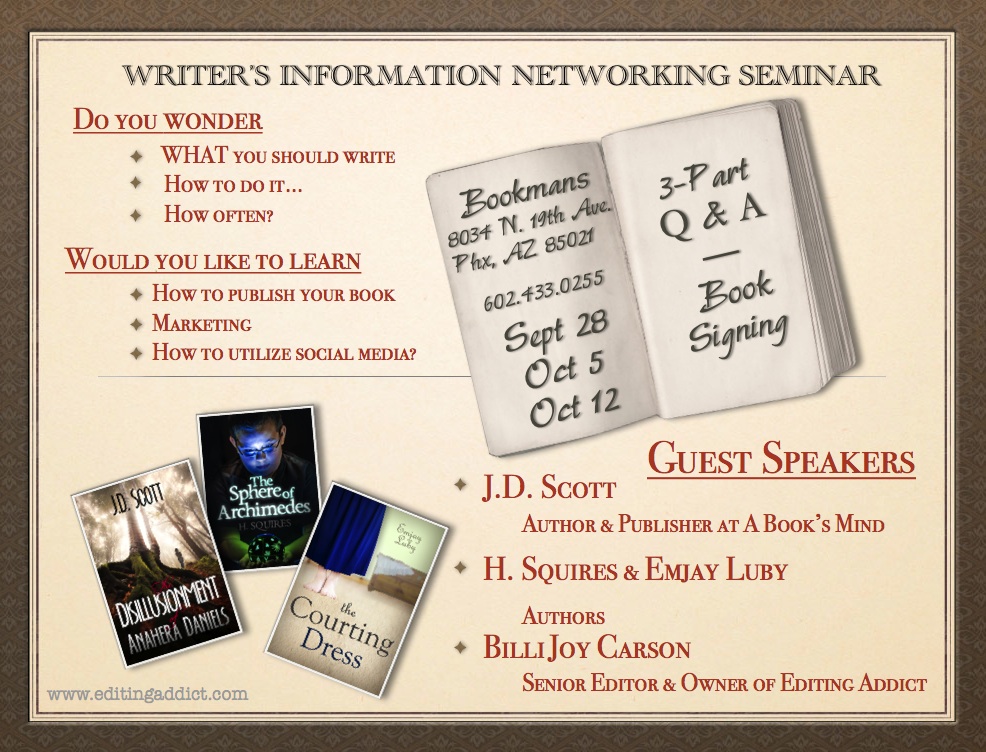
Do you want to learn?
Want to talk to published authors?
Need to get questions answered about publishing?
Haven’t had a chance to purchase your copy of their books?
3 Week Seminar
Share this:

12 Questions for Writers
[found on 12most.com by Kelly Belmonte]
“If you want to be a writer, you must do two things above all others: read a lot and write a lot. There’s no way around these two things that I’m aware of, no shortcut.” ~ Stephen King, On Writing
I cannot disagree with King on this point. I have been reading a lot and writing a lot my entire life. But only recently have I gotten “serious” about being a writer. To be clear, what I mean by “serious” is really “published” — someone whose written words are read a lot by folks who are not otherwise obligated to do so.
A big shift for me occurred when I realized I could apply my years of accumulated project management experience to my writing. I found that if I treated each written thing (whether a poem, a blog post, a technical document, or any other piece of writing) just as I would a project for a client, I’d get more traction on meeting realistic publishing goals.
This post offers a list of 12 questions that, when answered, will provide a workable project management framework for the “serious” (!) writer.
1. Who is the ideal reader (“end user”) of my piece?
If I want my words to be published, the assumption is I want someone else to read them. Communication 101: speak the same language as your audience. Even if you are thinking, “I want to write things that I want to read,” you still want to identify the key elements of what makes you tick so you can know how to find more people like you to read your stuff.
2. Who is my client?
The client is the person, group, or organization that will compensate you for your efforts, whether through money, copies, publicity, recognition, validation, connections, or something else of value to you as a writer. This is also who is going to connect you with your ideal reader. Unless you’re self-published (in which case you have a direct compensation relationship with your reader), this is usually going to be a publisher with a specific agenda, format, or type of writing they promote. It’s important to know what’s important to them. If you have a fantastic collection of sonnets, you probably don’t want to submit your chapbook to a publisher of haiku, right?
3. Who is on my team?
Writing is never just writing. There’s research. There’s first and second drafts. There’s proofreading, copy editing, content editing, and fact checking. There’s formatting, graphic design, and packaging. There’s marketing and distribution. Are you good at all of these things and (here’s the clincher) do you have the time to do them all? Do you seriously think you can edit your own words? (Guess what I think about that…) Figure out who can help you, whether for pay, barter, or goodwill. It will be worth it in the end.
4. What is the purpose of the piece?
Do you want to inspire, connect, challenge, relate, instruct, change behavior, anger, illustrate, or simply tell a darn good story? Or some combination? This is both your roadmap and your test in writing. Your purpose keeps you on track.
5. What is the scope?
This is where you describe what you think is being asked of you by your client and what you want to create for your ideal reader. Get a handle on whether you’re writing the entire history of the Great American Experiment or a day in the life of a 21st century Bostonian. Articulate for yourself (and confirm with your client, if possible) the number of words, lines, chapters, pages, required thematic and stylistic elements, and formatting constraints. Only then can you begin to map out a plan for completing your writing project.
6. What is your end state for this piece?
“As a result of my words being read, _________________ [fill in the blank].” This may be easily confused with number 4, the purpose. They are connected — one should lead to the other — but not the same. For example, if my purpose in a piece is to provide instructions for making a peanut butter and jelly sandwich, the desired end state will be “As a result… the reader will be able to make a pb&j sandwich.” If my purpose is to inspire, my end state may be, “… the reader has an ‘Ah ha’ moment.”
7. How much time will it take?
Your scope (and to some degree, your team) will provide you with a good guideline for the amount of time required (the “level of effort”) for each element. While there are some standard estimates for pages per hour, different types of writing require different levels of effort. Get to know your own pace, tracking the amount of time you spend on each project, so that estimating your time gets easier as you go along.
8. When does it need to be finished?
Even if there is no deadline or entry date, make up due dates for yourself. It will give you some basic math to work out the answer to the next question. (Due date – today’s date = number of days left to work on project.) Don’t forget to take into account time for review and editing.
9. When will I work on it?
Many writers like me have day jobs, families, friends, other interests, and need to work our writing in around an already full schedule. If I am going to be “serious” about my writing, I have to answer this in a real and manageable way. I have to recognize my priorities, logistical challenges, and areas I’m willing to sacrifice for the words. This, too, is clarifying.
10. When will I know it’s done?
This isn’t as easy to answer as it may appear on first glance, especially given the independent nature of many writing projects and the varying schedules of publishers. But this is the million-dollar “ship it” question. It can be crazy-making — there’s always just one more tweak, another review, an alternative viewpoint, a bit more white space perhaps. Will that tweak make the difference between rejection and acceptance, between runner-up and winner? You may never know. But one thing you can know for sure: if you never submit your work, you will never be published. Decide what “good enough” looks like for you.
11. How did it go?
Conduct an “after action review,” looking at your original purpose, scope, end state, and deadline. If possible (and if appropriate), engage a reader and the client in evaluating if your piece (and the process for completing it) met expectations. Listen, and learn from the gap between what you said you would do and what you actually did. This is a great opportunity to get better or to pat yourself on the back for hitting it out of the park. It’s also a constructive way to handle the inevitable disappointments that will come with writing, whether it’s negative feedback from your ideal readers, a missed deadline, or a rejection slip. Use those disappointments as fuel for the next project rather than a reason to give up.
12. Would I do it again?
Ah, there’s the rub. Would you go back to that well, that publisher, client, magazine, meta-blog site again for another opportunity to be published? It’s certainly ideal when you’ve found your niche, the exact right space where your words connect with ideal reader and are supported by an influential client-champion. But usually there’s some middle ground between lousy experience and ideal. Know your limits and your ideals. Find the opportunity in that middle ground where the good outweighs the bad.
And here’s my bonus question: Do you take yourself seriously as a writer? If the answer is yes, how many of these questions do you regularly ask yourself, and are there others that keep you moving forward on your own publishing goals?”
[found on http://12most.com/2013/05/27/12-getserious-questions-for-writers]
Share this:
It’s a bird, it’s a plane…it’s Super Writer!
“Writers are like supreme beings. We can create worlds in a matter of days, and we can destroy them just as fast.”
― Linda Nelson
Share this:
The World Needs You ALIVE
[found on chattingatthesky.com]
“three truths to remember when envy tries to keep you quiet:*
1 . Your goal is not to make something new, your goal is to reimagine what already is.
2. We live in a world of abundance, not scarcity.
3. We need you awake and alive.
*This message has been truncated at author’s request.
To read the rest of this great inspiration on writing, click here.
[found on http://www.chattingatthesky.com/2012/06/20/three-truths-to-remember-when-envy-tries-to-keep-you-quiet]
Share this:
Today We Remember
Today is 9/11. We remember.
Many books, articles, journals, magazines, pamphlets, and letters have been written about this day—about the trauma and the victory, about the heartache of loss and the joys of salvation.
In the beginning, the words poured from people’s hearts—covering the pages of time, as if simply to cement the moment in history, never to be forgotten. In the years since, stories have been written with greater thought, and deeper research. Our hearts still linger on the loss, but dance in the victory of the survivor stories.
Today, we challenge every Writing Addict to pause, collect thoughts, and write in remembrance of that day. What do you remember?


 Editing Addict, LLC