Tag: written

Prevent the Hatred of the Main Character
[found on jodyhedlund.blogspot.com; by Jody Hedlund]
“How can we know if we’re crossing the line and making our main characters too unlikable?
We hear this writing mantra over and over: Add tension to every page, increase the conflict, and get our main characters (MCs) into trouble. In humble obedience to the rules of fiction, we try to heap mountains of problems upon our MCs.
We do this externally in the form of villains, trauma, or drama. And we do it internally in the form of emotional struggles, character weaknesses, or relationship problems. A story wouldn’t be a page-turner without the conflict to move it forward.
However, at the beginning when we’re trying to establish the problems and the need for character growth, we may tip the scales too far. Yes, our MCs need flaws, things they have to work through as the story progresses (aka character arc). But in the process of making our MCs imperfect, we can’t turn them into bitter, whiny, selfish, angry, mean, cold-hearted jerks.
I’ve learned that in making my MCs have real, everyday, human problems, I have to be careful not to shape them into the kind of people no one wants to hang around for 300 plus pages.”
For more writing tips from Jody Hedlund, click here.
[found on http://jodyhedlund.blogspot.com/2011/05/how-to-avoid-trap-of-creating-unlikable.html]
Share this:
See Your Scene
[found on thewritepractice.com; by JB Lacaden]
“Visualize Your Scenes.
If you, the writer, cannot visualize the fight, expect the readers to have trouble as well. Visualize how each moment of the scenes will take place.
Try writing multiple ways of how the scene plays out. Ask other people to read them out. Did they like what they read? Were they able to picture out a clear image of the fight?
Remember: Action scenes don’t always involve fights. They can also be about your protagonist trying to race against time to stop a time bomb. But they always must be clearly written.”
For more great tips on writing from The Write Practice, click here.
[found on http://thewritepractice.com/pow-fight-scenes/]
Share this:
Dialogue Your Characters
[found on theguardian.com]
“It’s never too soon to start thinking about what your characters will say and how they’ll say it. Giving each of your characters a distinct voice is key to writing great fiction.
The goal of Worksheet 9 is to encourage you to think about your characters’ individual speech patterns and specific word choices. Your characters will probably reveal these distinctions as your story progresses, but thinking about it early will make you more receptive to such revelations.
For each of your major characters, record information about individual speech patterns and any catchphrases they may use.
With this information in place on a dialogue sheet, you’ll know exactly what a given character will say and how he/she will say it. You can also use this worksheet during the final edit and polish of the manuscript to double-check speech patterns.”
[found on http://www.theguardian.com/books/2012/oct/19/researching-your-novel]
Share this:
New Writers, Listen Up
[found on goinswriter.com; by Jeff Goins]
“Getting started
- Start small. 300 words per day is plenty. John Grisham began his writing career as a lawyer. He got up early every morning and wrote one page. You can do the same. (Need some ideas for getting started? Check out these book ideas.)
- Have an outline. Write up a table of contents that guide you. Then break up each chapter into a few sections. Think of your book in terms of beginning, middle, and end. Anything more complicated will get you lost. If you need help, read this book: Do the Work.
- Have a set time to work on your book every day. If you want to take a day or two off per week, schedule that as time off. Don’t just let the deadline pass. And don’t let yourself off the hook.
- Choose a unique place to write. This needs to be different from where you do other activities. The idea is to make this a special space so that when you enter it, you’re ready to work on your project.”
For more tips from GoinsWriter, click here.
[found on http://goinswriter.com/tips-writing-book]
Share this:
Writer’s Block?
“I’ve always said “Writer’s Block” is a myth. There is no such thing as writer’s block, only writers trying to force something that isn’t ready yet. Sometimes I don’t write for weeks. And then all of the sudden I’ll get a rush of inspiration and you can’t drag me away from my notebook. But I don’t stress out if I don’t hit some arbitrary word count each day or if I go a few days without writing something.”
― Julie Ann Dawson
Share this:
Be Passive The Writing Must Not
[found on bookcoaching.com; by Judy Cullins]
“Stop passive sentence construction.
When you write in passive voice, your writing slides along into long sentences that slow your readers down, even bore them.
Before you put your final stamp of approval on your writing, circle all the “is,” “was” and other passive verbs like: begin, start to, seems, appears, have, and could. Use your grammar check to count your passives. Aim for 2-4% only.
Instead of, ”Make sure that your name is included on all your household accounts and investments.” Passive culprits include “Make” and “is included.” Create more clarity with this revision,” Include your name on all household accounts and investments to keep your own credit alive after your divorce.”
For more tips on writing from Judy Cullins, click here.
[found on http://bookcoaching.com/wp/non-fiction-book-writing-solutions]
Share this:
Enter, and Resolve Thyself
[found on iuniverse.com]
“Introduce your main characters and themes in the first third of your novel. If you are writing a plot-driven genre novel make sure all your major themes/plot elements are introduced in the first third, which you can call the introduction. Develop your themes and characters in your second third, the development. Resolve your themes, mysteries and so on in the final third, the resolution.” — Michael MoorcockTo see the rest of the tips from iUniverse, click here.
[found on http://www.iuniverse.com/ExpertAdvice/20WritingTipsfrom12FictionAuthors.aspx]
Share this:
Win FREE Proofreading at WiNS Conference
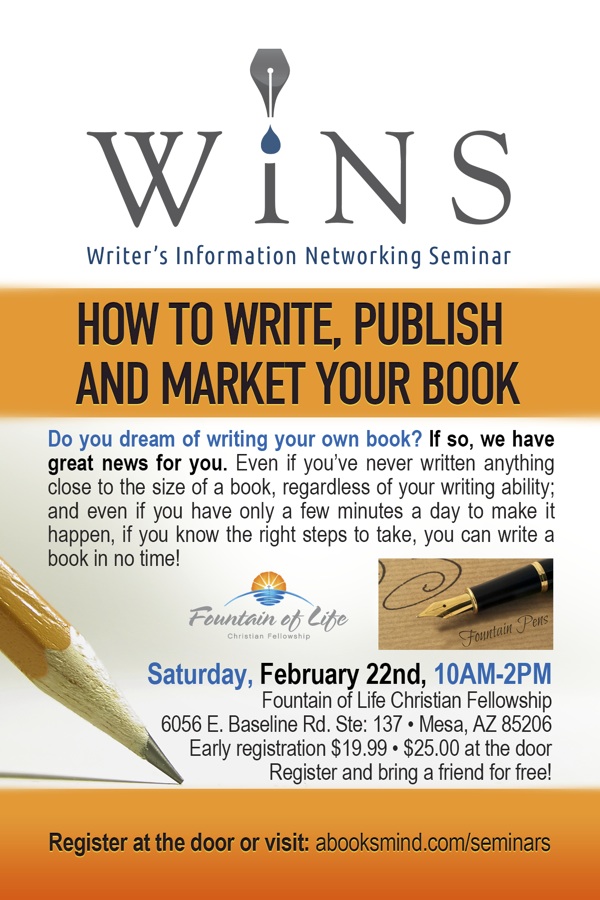
Win a FREE Proofreading Prize for 20,000 words!
HOW THE CONTEST WORKS:
To enter into the contest, share both Editing Addict and A Book’s Mind on Facebook (see details below).
The winner of the contest will be the person with the MOST registered referrals who ATTEND the WiNS Conference (minimum of nine referrals required).
PROOFREADING PRIZE can be used toward your publishing package with A Book’s Mind, or by independent editing on your own, through Editing Addict.
HOW TO ENTER:
1) Share both EDITING ADDICT and A BOOK’S MIND
a) Share Editing Addict’s Facebook Page, (remember to tag Editing Addict in the share, so you are registered in the contest).
b) Share the A Book’s Mind poster of the WiNS Conference (remember to tag A Book’s Mind, so you are registered in the contest).
2) Register YOURSELF and FRIENDS for the WiNS Conference
a) Early register yourself for the WINS conference (see poster for details)
b) Have the MOST early registered referrals who attended the WINS Conference (minimum of nine referrals required)
c) If you have already registered for the contest, let us know, and do STEP 1!
CONTEST ENDS AT THE DOOR ON FEBRUARY 22!
Share this:

The Perfect Scene
[found on advancedfictionwriting.com; by Randy Ingermanson]
“Writing the perfect scene:
- Goal: A Goal is what your POV character wants at the beginning of the Scene. The Goal must be specific and it must be clearly definable. The reason your POV character must have a Goal is that it makes your character proactive. Your character is not passively waiting for the universe to deal him Great Good. Your character is going after what he wants, just as your reader wishes he could do. It’s a simple fact that any character who wants something desperately is an interesting character. Even if he’s not nice, he’s interesting. And your reader will identify with him. That’s what you want as a writer.
- Conflict: Conflict is the series of obstacles your POV character faces on the way to reaching his Goal. You must have Conflict in your Scene! If your POV character reaches his Goal with no Conflict, then the reader is bored. Your reader wants to struggle! No victory has any value if it comes too easy. So make your POV character struggle and your reader will live out that struggle too.
- Disaster: A Disaster is a failure to let your POV character reach his Goal. Don’t give him the Goal! Winning is boring! When a Scene ends in victory, your reader feels no reason to turn the page. If things are going well, your reader might as well go to bed. No! Make something awful happen. Hang your POV character off a cliff and your reader will turn the page to see what happens next.
For more tips on writing from AdvancedFictionWriting, click here.
 Editing Addict, LLC