Build Screenwriting Characters

[found on thescriptlab.com]

“For a truly effective screenplay, you must know your characters backwards and forward. In screenwriting, the moment you begin to imagine character relationships – how your character deals with his parents, his siblings, his coworkers, and all that – you start to explore the world of your story, and suddenly scenes begin to emerge.

As you research your character (context, culture, occupation), creating details (attitudes, values, emotions), developing backstory (physiology, sociology, psychology), and establishing personality and behavior, you start putting the character in different situations in your mind, and you begin to imagine him or her in the most mundane and most exciting moments of his life.

The courage to deal with the trivial and banalities is something you should develop. Because often the best stories in screenwriting, are made from the most commonplace material, and if you don’t know how your character cooks dinner, does laundry, brushes his teeth, or what his little vexations are, his petty likes and dislikes, a dynamic, a full story will never happen.

Frank Daniel, the former chair of the Film Division at Columbia University and past dean of the School of Cinema-Television at USC, echos the point in five simple words: “A story starts with character.”

So if character is the key, and stories are only as good as the characters within them, you better create some damn, fine, outstanding characters.”

For more tips on writing screenplays from , click HERE.

[found on http://thescriptlab.com/screenwriting]

A Bad Review Can Be Your GOLD

[found on blog.bookbaby.com]

“A Bad Review Can Be a Learning Experience

Writing a book is a very emotional experience.  A bad review can feel like a personal attack, making you experience anger, hurt or both.  Take a moment (or several days) to work through those feelings.  When you can breathe again, move on.

Resist the urge to casually dismiss a bad review.  Ignoring those hurtful comments might be the best solution for your mindset; however, forgetting what your critics said could seriously hinder your writing.

As you were writing your book, you probably developed a sort of tunnel vision.  Now that the writing process is over, you must remove the blinders.  Find a way to look at the piece objectively and you can turn the bad review into a learning experience.

Sift through all the “I hate this book,” sentiments.  Find the real substance of the review – characters are flat, grammar and punctuation wasn’t perfect.  Take these tips to heart the next time you pick up your pen.  Look for ways to improve your writing.

A Bad Review Can Boost Book Awareness

You’ve heard of the book Fifty Shades of Grey, right?  Why has that particular literary piece drawn your attention?  Because of all the controversy!  People are reading the book just to see what the fuss is about.  Let me tell you, this is the ultimate example of a bad review doing good things for a book.

If you were to go to Amazon right now, you would see Fifty Shades of Grey has received 15,987 reviews.  Of those, nearly 30% are one star reviews!  And guess what, nearly half are 3 stars or less!”

For more tips on writing from BookBaby click HERE.

[found on http://blog.bookbaby.com/2013/01/you-can-benefit-from-a-negative-book-review]

Writers Find Accountability

[found on writersdigest.com; by  Chuck Sambuchino]

“Looking for an accountability partner? A few tips:

1. Go where other writers go. Join a professional writing organization such as SCBWI. Attend retreats and conferences. Browse book festivals. Hang out at bookstores.

2. Think beyond locally. (Donna and I live twelve hours away from each other in different states.) So, strike up conversations on social media. Join online writing groups. Comment on writing blogs….

3. Don’t get hung up on writing genre. Writers are writers. (Apologies to Donna’s husband, but even porn writers are writers.) It doesn’t matter if you write romance novels and your potential accountability partner writes rhymed picture books. What matters is how each of you approach your work, the time each of you is willing to put into your writing, your openness toward learning, and your willingness to accept criticism.

4. Put the word out that you’re looking for a writing buddy, and like everything else in this business, keep plugging away until you find one.”

For more tips on writing from , click HERE.

[found on http://www.writersdigest.com/editor-blogs/guide-to-literary-agents/ready-how-a-critique-and-accountability-partner-can-help-your-writing-and-career]

Are You A Writer? Or Are You A Writer?

[found on businessbuildingbooks.com; by  Lynne Klippel]

“Personally, I love hobbies. In my former profession as an Occupational Therapist, I taught people how important it was to have hobbies that bring them joy, reduce stress, and add meaning to life.

If you write simply for the pleasure of creating art with your words, I salute you. Writing is a hobby that you can enjoy for the rest of your life.

However, if you want to write a book and use it to help others while making an income, you are an entrepreneurial author. As an entrepreneurial author, you need more information and support than the hobbyist writer.

You need a solid plan to write, market, and use your book to build your business. In short, you need a way to create a great book and a great income so that the time and effort you invest in your book pays off.”

To read more from Lynne Klippel on writing helps, click HERE.

[found on http://businessbuildingbooks.com/your-book-just-hobby]

Audiobooks, Your Friend

[found on thecreativepenn.com; by  JOANNA PENN]

“Your book is not just a physical book or an ebook. There are plenty of other subsidiary rights that you can exploit and audiobooks are high on the list because of the rise in popularity of listening during commutes or workouts, and the increased penetration of smartphones. In today’s interview, we explore how you can get into this market.”

To read the info from Joanna Penn on creating your own audiobook, and listen to the podcast, click HERE.

[found on http://www.thecreativepenn.com/2013/03/06/audiobook]

Write A Personal Bio

[found on blog.brandyourself.com; by ]

“1. Make three versions: short, medium and long. 

Most of the time, someone else will dictate the length of your bio. They will likely tell you how many words you can use to ensure that yours is the same length as other bios. Because of this, one bio will not do. You need three bios:

    • One sentence bio
    • 100 word bio
    • 250 word bio

Each bio has its place. You will save you time and energy when the time comes time to post it, and establish consistency between every professional bio about you that is published.

2. Introduce yourself as if you’re meeting a stranger.

Lead in with your name. People need to know who you are before they hear what you’re all about.

3. Immediately state what you do.

If you are “Portrait Photographer,” don’t wait until the last moment to say it. Your most important details should go in the first sentence. Remember: people on the web rarely read more than the first and last sentence.

4. Touch upon your most important accomplishments.

Don’t list them, and make sure they fit. A bio is not a resume; it is simply a quick summary of who you are. If you have space, mention them. If not, ignore them.”

To see the rest of the ideas on writing a personal bio, click here.

[found on http://blog.brandyourself.com/how-tos/8-tips-on-how-to-write-a-personal-biography]

How To Write A Travel Guide

[found on writersworkshop.co.uk; by Robin Lloyd-Jones]
  • Do your research – pre-travel research enriches the whole experience; post-travel research adds depth and accuracy to what you write. While travelling keep notes or you will forget; and take photographs to illustrate your words.
  • Be curious – about everything and everybody. What makes many travel books enjoyable is the people encountered along the way. Talk to everyone and never stop asking questions. Listen with a sympathetic ear. Look behind the glossy façade, delve beneath the surface.
  • Have a sense of wonder – Colours seemed so much brighter when we were children. Try to see the world with that same freshness of vision.
  • Use all your senses – sight, sound, smell, taste and touch. Develop a feeling for the culture and history of a place. And a sense of humour allied to keen observation can make the most ordinary of experiences entertaining.
  • Don’t neglect your inner journey – Many of the most successful travel books are as much about the emotional journey the author makes as they are about the physical journey. The resolution of a personal issue or a change in attitude adds interest and brings the reader closer to the author.
  • Write with passion – To fully engage the reader (or indeed, a literary agent) your book must have something in it that you care about strongly –  an issue, a cause, the pursuit of a lifelong ambition. Without this your writing is in danger of seeming flat.
  • Be an open door, be receptive –  Travel with open eyes, ears, mind and heart.

For more tips on writing from Robin Lloyd-Jones, click here.

[found on http://www.writersworkshop.co.uk/Travel.html]

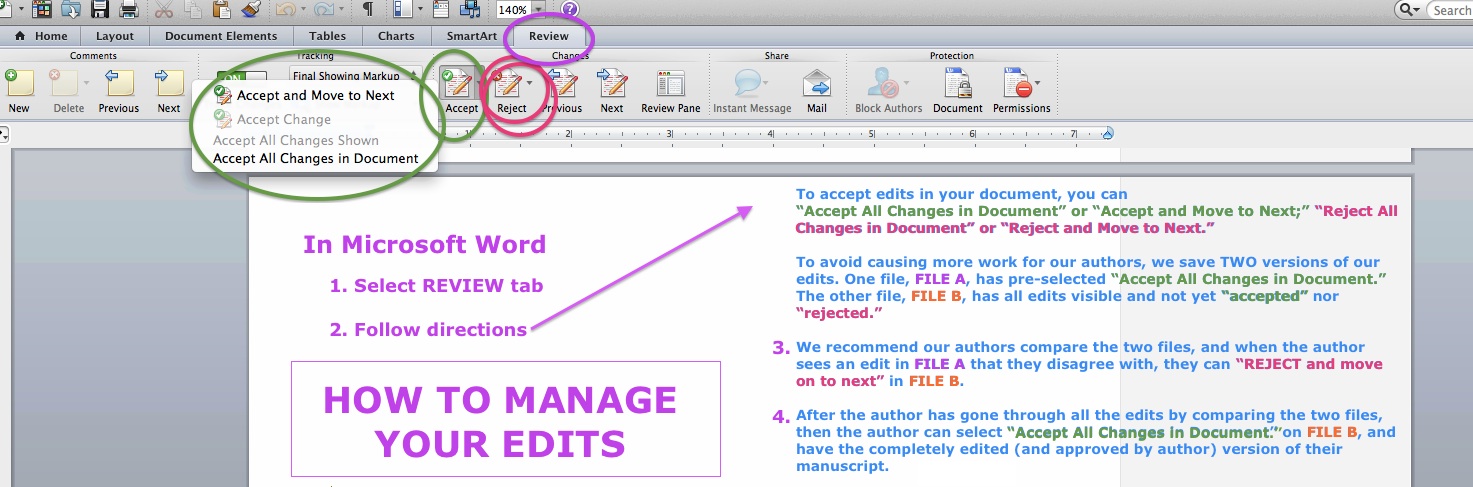
How To Manage Your Edits

“As an editor, I have heard horror stories about authors who didn’t know how to process the edits they received back from their editors. Instead of asking what to do with the Word document, [caution, you’re going to scream] some of the authors printed the full manuscript, compared item by item, then RETYPED the entire manuscript.

Don’t let this be you.

Firstly, your editor is on your TEAM. An editor wants you to succeed. And even though you may feel like we are all jackals, we don’t really bite. Ask us questions—especially when you feel overwhelmed or uncertain.”

— Billi Joy Carson / Senior Editor, Editing Addict

  EDITOR Sends Completed File Back to AUTHOR:

THE AUTHOR’S JOB:

1. READ through document

2. CHOOSE FROM (to accept and/or reject changes)

a. Accept All Changes in Document

b. Accept and Move to Next

c. Reject All Changes in Document

d. Reject and Move to Next

3. SHORTCUT for authors

a. Save TWO* versions of the file you received from your editor.

i. File A [edits accepted]

1. In Word Doc, under REVIEW tab [File A]

2. Select Accept All Changes in Document [File A]

ii. File B [edits visible]

1. Leave the file the way you received from the editor

b. Read through File A side-by-side with File B

i. If you find an edit you don’t want

1. In File B

a. Under REVIEW tab [File B]

b. Select Reject and Move to Next [File B]

ii. When you are finished reading File A, and correcting File B,

1. In File B

a. Under REVIEW tab [File B]

b. Select Accept All Changes in Document [File B]

c. File B is now fully edited, and author approved

*At Editing Addict, I do this beforehand for my authors, however, not all editors have the [File A & File B] policy, and expect the author to do it on their end. How To Manage Your Edits

How to Accept and/or Reject Tracked Changes in a Word Document: YouTube Video

Still have questions? Leave a comment below, or send  a message to the editor: billijoycarson@editingaddict.com. Teamwork brings success!

Fantasy? Nah, My Neighborhood

[found on terribleminds.com; by Chuck Wendig]

“ROOTED IN THE REAL

Reality is fantasy’s best friend. We, the audience, and you, the writer, all live in reality. The problems we understand are real problems. Genuine conflicts. True drama. The drama of families, of lost loves, of financial woes. Cruel neighbors and callow bullies and loved ones dead.

This is the nature of write what you know, and the fantasy writer’s version of that is, write what’s real. Which sounds like very bad advice, because last time I checked, none of us were plagued by dragons or sentient fungal cities or old gods come back to haunt us. But that’s not the point — the point is, you use the fantasy to highlight the reality.

The dragon is the callow bully. The lease on your fungal apartment is up and your financial woes puts you in tithe to the old gods who in turn make for very bad neighbors. You grab the core essence of a true problem and swaddle it in the mad glittery ribbons of fantasy — and therein you find glorious new permutations of conflict. Reality expressed in mind-boggling ways. Reach for fantasy. Find the reality.”

For more tips on writing fantasy from Chuck Wendig, click here.

[found on http://terribleminds.com/ramble/2012/06/19/25-things-you-should-know-about-writing-fantasyzzz]

Game of Thrones Writing Tips

[found on lifehacker.com.au; by ]

“Choose your point-of-view characters to broaden the narrative’s scope

My story is essentially about a world at war. It begins very small with everybody apart from Daenerys in the castle of Winterfell. It’s a very tight focus, and then as the characters split apart, each character encounters more people and additional POVs come into focus.

It’s like if you were trying to do World War 2 as a novel: do you just take one average GI? Well that would only cover the European theatre, not the Pacific. Do you make Hitler a point-of-view character to show the other side? What about the Japanese or Italy? Roosevelt, Mussolini, Eisenhower — all these characters have a unique viewpoint that presents something huge in Word War 2.

So you either need an omnificent viewpoint structure where you’re telling it from the point of view of God, which is a pretty outdated literary technique, or you have a mosaic of people who are seeing one small part of the story and through that you get the entire picture. That’s the path I chose to take.

It’s okay to “borrow” from history

Although my story is fantasy, it is strongly grounded in actual Medieval history. The War of the Roses was one of the major influences, which had the Yorks and the Lancasters instead of the Starks and the Lannisters. But I like to mix and match and move things around. As the famous saying goes; stealing from one source is plagiarism but stealing from lots of sources is research!”

For more tips from Chris Jager on writing, click here.

[found on http://www.lifehacker.com.au/2013/11/ten-tips-on-writing-a-fantasy-saga-from-game-of-thrones-author-george-r-r-martin]