Tag: author

No Foolish, Unless a Fool
“There are no foolish questions and no man becomes a fool until he has stopped asking questions.”
― Charles P. Steinmetz
Share this:
Featured Writing Addict: J.D. Scott
J.D. Scott

J.D. Scott has been the organizing member of Abba’s Writers in Phoenix, Arizona, for the past three years. She leads, organizes, and teaches both critiquing and story development to its 50+ members. She is also a participating member of West Valley Writers Group in Avondale, Arizona.
In February of 2013, J.D. Scott accepted the invitation to become part of the team at A Book’s Mind as a publishing consultant. She thoroughly enjoys working alongside writers, helping them fulfill their dreams of becoming published authors.
The Disillusionment of Anahera Daniels was released in 2013, and the second book in the Anahera Daniels series will be released in the fall of 2014.
What’s J.D. Scott’s Genre?
Fiction: Young Adult, Science Fiction
What’s J.D. Scott’s Inspiration?
“I spent nearly twenty years working with children and young adults as a nanny, mentor, camp counselor, daycare worker, and youth group leader. With a heart for today’s youth, I set out to write books that not only entertain, but also inspire today’s youth to rise above the current culture, and see their value.”
What’s J.D. Scott’s book about?
The Disillusionment of Anahera Daniels
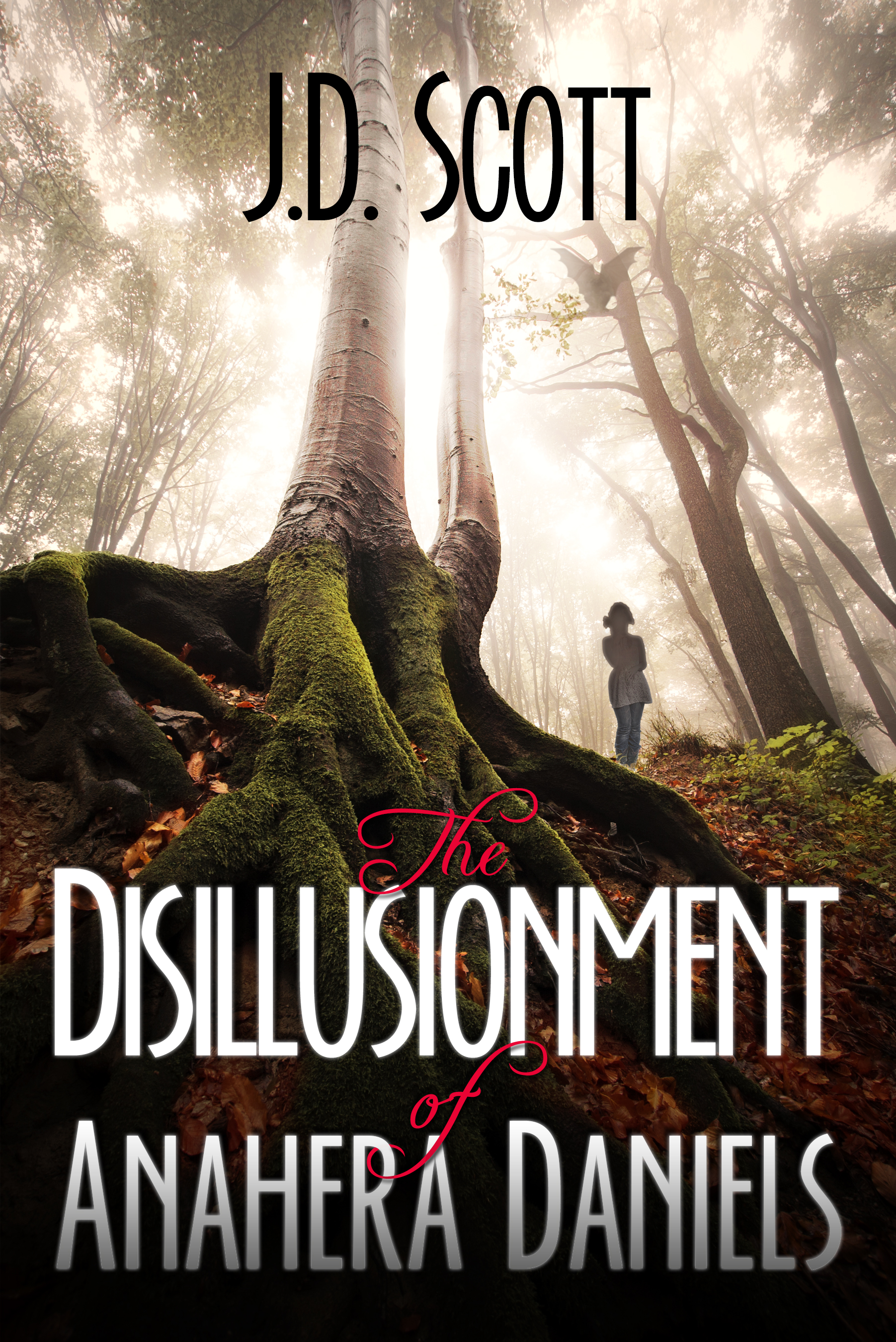
“Nothing of significance ever happened on Pleasant Avenue in the sleepy town of Prescott, Arizona. That is, nothing you’ve ever heard about…
On Anahera Daniels’ 18th birthday, she wakes from a disturbing nightmare, only to walk into another. After overhearing life-shattering news that her parents aren’t who she thought they were—she questions her place among family, friends, and in the heart of Nathan, her high school crush. Ana’s life splinters into two realities when strange dreams develop into a newfound ability to travel between Earth and the world of Posternis.
A world away, Ana finds herself wounded, and fleeing from a dark-winged creature when she collides into Adrian, an attractive Posternis native. Accepting the help of his outstretched hand, she unknowingly binds their fates together. Ana’s fierce determination drives her search to unravel the mystery of her biological parents, and their connection with the Cozen, the gargoyle-like creatures seemingly bent on her destruction.
Armed with only her sarcastic wit and a pocket knife, Ana must decipher where her loyalties lie, and choose between two worlds and two loves—before the deadly side-effects of traveling ends her life altogether.”
| Amazon | Barnes & Noble | A Book’s Mind | Blog |
| JDScottNovels.com | Facebook | Twitter | Goodreads | Email |
[See what J.D. had to say about our editor!]
Tell J.D. you heard about her on editingaddict.com!
Share this:

Principles of Fiction…?
“I gave up worrying about the principles of fiction writing when I realized that there weren’t any.”
― Teri Louise Kelly
Share this:
Seven Tips on How to Write a Devotion
[found on faithfulbloggers.com]
“Writing a devotion can offer hope to your readers and inspire them in a way that lectures or plain articles, may not. A devotional is a very well thought out piece about one very minute topic usually focusing on a particular spiritual lesson. Writing devotionals does not have to be difficult, there are many steps you can take to calm yourself down, get centered and write what God wants you to write.
Yes! There is something already inside you that God wants you to say. You just have to open your heart to the Holy Spirit, and listen.
- Be prayerful — Before you put pen to paper, or rather, start typing, pray. Ask God to tell you what He would have you to write about. What message does He want you to impart? Be mindful of what comes to mind as you are praying. Does a particular person come to mind with a specific issue? Does a specific verse pop into your head? Listen. He will tell you what to write.
- Pick one topic — After intensely praying about what to write, pick one topic that comes to mind and be very focused on that one topic. It is easy to get carried away writing with all the ideas that will come to you!
- Keep it short — Your devotional should be no more than one page, or 500 words. But it is even better if it’s less than 500 words, shoot for 250 words to keep yourself focused on one small laser targeted topic. This will also help to keep your reader interested and with you.
- Know your audience — When you have your topic, write it to a specific audience, this is known as your “target market” in business, but here, this is your audience. Ask yourself the question: Who is going to read this devotional? If it helps, write your devotional as if you’re writing it to a dear friend.
- Check your facts — Make sure, if you are quoting biblical scripture that you not only check the scriptures to make sure you are not taking something out of context, and that you are quoting it correctly, but make sure you are using a relevant verse to support your devotional.
- Inspire action — Ask the readers to do something at the end of your message in your closing paragraph. That action will depend on what your message was about. You can end with a very short prayer if you wish, but keep it related to the message.
- Be yourself — Remember to be yourself. You’re not perfect — no human is — and that is perfectly okay. Grammar isn’t as important as your message. Do check your spelling with the spell checker, and have someone else read it if you wish, but the message is the most important thing here.”
[found on http://faithfulbloggers.com/blogging/seven-tips-on-how-to-write-a-devotion]
Share this:
Invented Stories
“The vigor I lacked for physical activities became incandescent when, pen in hand, I filled those pages with invented stories. Sometimes they were intimately about me – family tales, parental exploits – sometimes they became horrific stories sprinkled with torture, death, and reunion: crazy games and tear-soaked sagas.”
― Philippe Grimbert, Memory
Share this:
Writing Characters of the Opposite Sex
[storymind.com by Melanie Anne Phillips, creator StoryWeaver, co-creator Dramatica]
“Perhaps the most fundamental error made by authors, whether novice or experienced, is that all their characters, male and female, tend to reflect the gender of the author. This is hardly surprising, since recent research finally proves that men and women use their brains in different ways. So how can an author overcome this gap to write characters of the opposite sex that are both accurate and believable to their own gender?
In this Dramatica Tip, we’ll explore the nature of male and female minds and provide techniques for crafting characters that are true to their gender.
At first, it might seem that being male or female is an easily definable thing, and therefore easy to convey in one’s writing. But as we all know, the differences between the sexes have historically been a mysterious quality, easily felt, but in fact quite hard to define. This is because what makes a mind male or female is not just one thing, but also several.
First, let’s consider that gender has four principal components:
Anatomical Sex Sexual Preference Gender Identity Mental SexAnatomical sex describes the physicality of a character – male or female. Now, we all know that people actually fall in a range – more or less hairy, wider or narrower hips, deeper or higher voice, and so on. So although there is a fairly clear dividing line between male and female anatomically, secondary sexual characteristics actually create a range of physicality between the two. Intentionally choosing these attributes for your characters can make them far less stereotypical as men and women.
Sexual Preferences may be for the same sex, the opposite sex, both, or neither (or self). Although people usually define themselves as being straight, gay, bi, or celibate, this is also not a fixed quality. Statistics shows, for example, that 1/3 of all men have a homosexual encounter at least once in their lives.
Although it often stirs up controversy to say so, in truth most people have passing attractions to the same sex, be it a very pretty boy or a “butch” woman.
Consider the sexual preference of your characters not as a fixed choice of one thing or another, but as a fluid quality that may shift over time or in a particular exceptional context.
Gender Identity describes where one falls on the scale between masculine and feminine. This, of course, is also context dependent. For example, when one is in the woods, at home with one’s family, or being chewed out by the boss.
Gender Identity is not just how one feels or things of oneself, but also how one act’s, how one uses one’s voice, and how one wishes to be treated. Often, a male character may have gentle feelings but cover them up by overly masculine mannerisms. Or, a female character may be “all-business” in the workplace out of necessity, but wishes someone would treat her with softness and kindness.
Actually, Gender Identity is made up of how one acts or wishes to act, and how one is treated or wishes to be treated. How many times have we seen a character who is forced by others to play a role that is in conflict with his or her internal gender self-image? Gender Identity is where one can explore the greatest nuance in creating non-stereotypical characters.
Finally, Mental Sex describes where one falls on the scale from practical, binary, linear, logistic, goal-oriented thinking to passionate, flexible, emotional, process-oriented thinking. In fact, every human being engages in ALL of these approaches to life, just at different times and in different ways.
Now, in creating characters, consider that each of the four categories we just explored is not a simple choice between one thing or another, but a sliding scale (like Anatomical Sex) or a conglomerate of individual traits (like Gender Identity). Then, visualize that wherever a character falls in any one of those four categories places absolutely no limits on where he or she may fall in the other categories.
For example, you might have a character extremely toward male anatomical sex, bi-sexual (but leaning toward a straight relationship at the moment), whose gender identity is rough and tumble (but yearns to be accepted for his secret sensitivity toward impressionistic paintings) who is practical all the time (except when it comes to sports cars).
Any combination goes.
But when it comes to Mental Sex itself, there are four sub-categories within that area alone which tend to define the different personality types we encounter:
Subconscious Memory Conscious PreconsciousIn brief, each of these “levels” or “attributes” of the mind can lean toward seeing the world in definable or experiential terms. Pre-conscious is a tendency to perceive the world in components or as processes that is determined before birth. It is the foundation of leaning toward the tradition “male” or “female” personality traits. Subconscious determines the tendencies we have to be attracted or repelled from component or process rewards.
Memory relies on our training to organize our considerations in a give situation toward components or processes. And every character always has a Conscious choice to focus on the components or processes at any given moment. In other words, in a given situation, at each level of Mental Sex does a character center on the way things are or the way things are going? At each level is the character more interested in getting his or her ducks in a row or in a pond?
Finally, beyond all of these considerations is the cultural indoctrination we all receive that leads us to respond within social expectations appropriately to the role associated with our anatomical sex. These roles are fairly rigid and include what is proper to wear, who speaks first, who opens the door or order the wine, who has to pretend to be inept where and skilled where else (regardless of real ability or lack there of in that area), the form of grammar one uses in constructing sentences, the words one is expected to use (“I’ll take a hamburger,” vs. “I’d like a salad”), and the demeanor allowable in social interaction with the same and the opposite sex, among many other qualities.
In the end, writing characters of the opposite sex requires a commitment to understand the difference between those qualities, which are inherent and those, which are learned, and to accept that we are all made of the same clay, and merely sculpt it in different ways.”
 Editing Addict, LLC