Tag: books

Learn You Must
“Not all marketing people are writers, but all writers must learn to be marketers.”
― Joanne Kraft
Share this:
The New Reality of Author Platforms
[found on forbes.com; by Alan Rinzler]
“It’s still about visibility, but today’s approach has changed. The New Author Platform requires a focus on developing an unobstructed back and forth between authors and their readers, with the authors — not the publishers — controlling the flow.
Now it’s the author, not a publicist, who inspires readers to buy the book. The New Author Platform allows not only well-established authors, but unknown, first-time beginners to do an end run around the conservative gate-keepers and reach readers directly.”
To find out more from Alan Rinzler about author platforms, and how to create your own, click here.
[found on http://www.forbes.com/sites/booked/2011/07/26/the-new-author-platform-what-writers-need-to-know]
Share this:
Writing Can Not Be Tone Deaf
[found on writersdigest.com]
“If you find yourself having a difficult time sustaining one tone over a long work, try these three tricks.
1. Find a paragraph that sounds exactly the way you want to sound for this work, and tape it to your computer so that it’s always in front of you.
2. Each time you’re about to return to the piece, spend 20 minutes reading the work of an author who writes in the tone you’re after.
We’re natural mimics. You might try taking this a step further by more closely examining the sentence rhythms and word choices and looking for ways to make them your own. John Lukacs once said, “Style begins the way fashion begins: Somebody admires how the other man dresses and adapts it for himself.”
3. Starts and finishes are especially important to tone.
When revising your work, try moving some of your best sentences, the ones with energy and just the right tone, up to the top of your document: “I’m so looking forward to Christmas this year. It will be the only day in December not entirely consumed by children’s theater performances.” Could the piece begin this way? Experiment with moving equally strong sentences to the conclusion of your piece, for a cohesive ending.”
For more tips on writing from Writer’s Digest, click here.
[found on http://www.writersdigest.com/whats-new/3-tips-for-consistent-tone-2]
Share this:
Sadness For Another Day
[found on helpingwritersbecomeauthors.com; by K.M. WEILAND]
“Are sad stories with sad endings the domain of the lonely, the manic-depressive, and the masochistic?
…Take a moment to think about the stories that have changed your life. I’m willing to bet many of them were stories of pain, loss, sacrifice, and sin.
These are the stories that speak bluntly about hard subjects and force their characters—and their readers—to face hard truths and, hopefully, walk away from the realizations as someone slightly different and perhaps slightly better.
Few of us would want to subsist on a steady diet of tragedy, but all of us are better for having occasionally cleansed our reading palate with the astringent bite of these unflinching portrayals of bittersweet truth….
Sad stories don’t have to be depressing stories. The stories that have broken my heart and changed my life are stories of great tragedy, but they’re also stories of great hope. That, right there, is where we find the true power of the sad story—because light always shines brightest in the darkness.”
For more tips on writing from K.M. Weiland, click here.
[found on http://www.helpingwritersbecomeauthors.com/2011/05/are-happy-endings-must.html]
Share this:
Thriller, Horror, Terror — Oh My!
[found on writersdigest.com]
“The three types of terror:
- The Gross-out: the sight of a severed head tumbling down a flight of stairs, it’s when the lights go out and something green and slimy splatters against your arm.
- The Horror: the unnatural, spiders the size of bears, the dead waking up and walking around, it’s when the lights go out and something with claws grabs you by the arm. And the last and worse one:
- Terror, when you come home and notice everything you own had been taken away and replaced by an exact substitute. It’s when the lights go out and you feel something behind you, you hear it, you feel its breath against your ear, but when you turn around, there’s nothing there …”
— Stephen King
“The horror genre is something that I’ve always been fascinated with. Luckily, I don’t think I’m the only one. People like to be frightened. If they didn’t, Stephen King wouldn’t have a thousand novels and you wouldn’t find every horror film ever made running on AMC at this time, every year. Seriously. Click over to AMC, I can almost guarantee Halloween, or one of its sequels, is on right now.
And horror has adapted. Yes, you can still find the slasher movies and those “gross-out” moments that King references. But it’s mental now. “Found footage” movies can be terrifying because it seems so normal, so everyday. The more real, the better. And the scarier. It’s the dark basement where the only thing you can hear is the beating of your own heart. That’s real horror. The kind of stuff that makes the hair on the back of your neck stand up, as if someone was standing inches behind you.
But writing horror isn’t so easy. With any type of fiction, it’s difficult to think of something that hasn’t already been done. With horror fiction, it’s especially true. Creepy basements, loud noises from the attic, hidden rooms, Indian burial grounds, old hotels, multiple personality disorder, etc.—it’s all been done before, and it’s all out there. These clichés shouldn’t restrain you, however. They’ve simply defined the space you’re working in. You know what’s there, now create your own story.”
For more tips from Writer’s Digest on writing thrillers, click here.
[found on http://www.writersdigest.com/editor-blogs/there-are-no-rules/the-horror-genre-on-writing-horror-and-avoiding-cliches]
Share this:
Make Stuff Up
“I’m an author. We don’t want to lead. We don’t need to follow. We stay home and make stuff up and write it down and send it out into the world, and get inside people’s heads. Perhaps we change the world and perhaps we don’t. We never know. We just make stuff up.”
― Neil Gaiman
Share this:
Describe In Short
[found on io9.com; by CHARLIE JANE ANDERS]
“World-building should be quick and merciless.
In a novel, you can spend ten pages explaining how the 29th Galactic Congress established a Peacekeeping Force to regulate the use of interstitial jumpgates, and this Peacekeeping Force evolved over the course of a century to include A.I.s in its command structure, etc. etc.
In a short story, you really need to hang your scenery as fast as possible. My friend and mentor d.g.k. goldberg always cited the Heinlein line: “The door dilated,” which tells you a lot about the surroundings in three words. Little oblique references to stuff your characters take for granted can go a long way.
Make us believe there’s a world beyond your characters’ surroundings.
Even though you can’t spend tons of time on world-building, you have to include enough little touches to make us believe there’s stuff we’re not seeing. It’s like the difference between the fake house-fronts in a cowboy movie and actual houses. We should glimpse little bits of your universe, that don’t necessarily relate to your characters’ obsessions.”
For more writing tips from Charlie Jane Anders, click here.
[found on http://io9.com/366707/8-unstoppable-rules-for-writing-killer-short-stories]
Share this:
Characters Develop Your Romance
[found on writing-world.com; by Karen Wiesner]
“Let your characters decide the level of intimacy, not publisher guidelines.
I used to base everything I wrote on what the publishers might buy. I suppose it makes some sense to do that when you’re not published. Target your publisher, then tailor what you write to that set of guidelines. Sounds logical, right? I’m not so sure. A part of me really believes that the reason I didn’t sell all those years was because I was trying to write for everyone else except myself and what fit my characters. If you’re writing for someone else, you’re not writing what’s in your heart… and it’s going to show.
The same is true for love scenes. In every one of my books, the level of intimacy is a little different, depending on what that particular hero and heroine dictate. Restless as Rain and Forever Man are strongly what I dub “romantic erotica” because the emotions are as hot as the physical lovemaking. The characters in these books are very extreme, larger than life and they demand a sexuality that suits their personalities. In First Love, the sexual tension is definitely there from start to finish and the love scenes are satisfying without being overtly erotic.
However, the hero and heroine in this book are in need of emotional healing, more so than sexual healing. Their lovemaking is part of that healing process, and it suited them to have emotionally sensual loves scenes rather than down-and-dirty, deep ones. Leather & Lace, my first published book, was completely different. The heroine in the book was very innocent and naive. When she thought of lovemaking, it was always in a more “romantic” sense and, because she was so private, having more low-key love scenes were appropriate. The sexual tension remained throughout, however.”
For more tips on writing from Karen Wiesner, click here.
[found on http://www.writing-world.com/romance/love.shtml]
Share this:
Featured Writing Addict: Hayley Rose
Hayley Rose

Multi-award-winning author, Hayley Rose, released her first children’s book in 2002, Fifo When I Grow Up, about a six-year-old bear starting school. That book was followed by the wildly popular geography book and #1 best-seller, Fifo 50 States, published in 2010. In 2012 Hayley was selected as one of “The Top 50 Writers You Should Be Reading” by AuthorsShow.com. In 2013 she branched out with a new series, featuring a new set of characters, Zach, Chloe, and Louis the Manner Monster. Her new book, The Do’s and Don’ts, was released in September 2013, and has already been honored by the Mom’s Choice Awards, along with a Readers Favorite bronze medal.
What’s Hayley’s Genre?
Children’s Picture Books
What is Hayley’s Inspiration?
“My life experiences are really my main inspiration for writing, along with my goddaughter and godson. I had a great childhood, full of adventure and support. Writing is my way of giving back, to be able to share great stories that inspire and educate.”
What are Hayley’s books about?
The Do’s and Don’ts
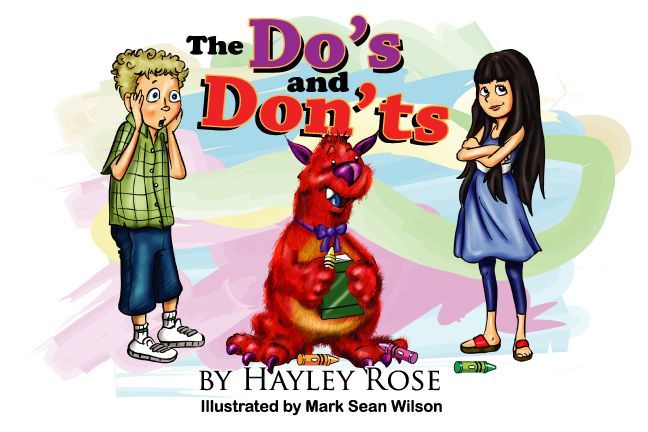 “The Do’s and Don’ts is a whimsical lesson book aimed at teaching young readers the difference between good and bad behavior, or etiquette. In the book, Zack and Chloe go from being manner monsters, to well-behaved children, as they provide samples of typical scenarios that not only young children encounter, but can relate to. For example, Zack becomes a Manner Monster when he loses a game, kicking and pouting like a poor sport. In contrast, good behavior is then modeled depicting Zack congratulating the winning team.
Unlike other etiquette books for children—that tell a story or just communicate positive behavior—The Do’s and Don’ts compares and contrasts between good and bad behavior. Simply, yet colorfully displayed, are examples of inappropriate behavior and decisions young children may display, followed by behavior and decisions that are more socially accepted. Each compare-and-contrast anecdote is set in the same scene, so that young readers can instantly see the differences between good and poor behavior.“
Fifo “When I Grow Up”
 “Fifo “When I Grow Up” is about Fifo, a brown bear from Denali National Park. He is six years old, and in the first grade. Today is the first day of school, and Fifo is a bit scared.
Mama comforts him with his favorite breakfast, and they talk about what he wants to be when he grows up. By the end of breakfast, Fifo’s been a doctor, a fireman, a pilot, a policeman, a teacher, and even the president. Now he’s ready for anything—even the first day of school.“
Fifo “50 States”
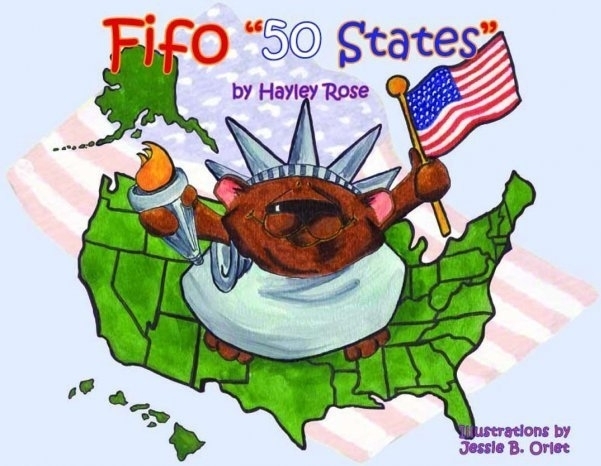 “Fifo “50 States” is a delightful rhyming story where Fifo, a warm and lovable brown bear, is bitten by the travel bug. Fifo dreams of digging up diamonds in Arkansas, looking for fossils in Kansas, enjoying a delicious bowl of gumbo in Louisiana, and even seeing a Broadway show in New York. Yes, America is an exciting place!
Fifo’s second book is full of adventure. A colorful reference-like geography book, Fifo discovers the wonders each state has to offer. Along the way, he learns each state’s capital, shape, flag, motto, and much, much more. The possibilities are endless!
So, come along with Fifo, and you’ll soon discover the beauty of America one state to another. A positive experience for both Fifo and the reader. Learning should always be this much fun.“
To reach Hayley Rose, buy her books, or schedule a book-signing event:
- Facebook: facebook.com/booksbyhayleyrose
- Email: hayley@fifothebear.com
- Twitter: @fifothebear
- Websites:
- Links:
- Tell her you heard about her on editingaddict.com!

 Editing Addict, LLC