Audiobooks, Your Friend

[found on thecreativepenn.com; by  JOANNA PENN]

“Your book is not just a physical book or an ebook. There are plenty of other subsidiary rights that you can exploit and audiobooks are high on the list because of the rise in popularity of listening during commutes or workouts, and the increased penetration of smartphones. In today’s interview, we explore how you can get into this market.”

To read the info from Joanna Penn on creating your own audiobook, and listen to the podcast, click HERE.

[found on http://www.thecreativepenn.com/2013/03/06/audiobook]

Write A Personal Bio

[found on blog.brandyourself.com; by ]

“1. Make three versions: short, medium and long. 

Most of the time, someone else will dictate the length of your bio. They will likely tell you how many words you can use to ensure that yours is the same length as other bios. Because of this, one bio will not do. You need three bios:

    • One sentence bio
    • 100 word bio
    • 250 word bio

Each bio has its place. You will save you time and energy when the time comes time to post it, and establish consistency between every professional bio about you that is published.

2. Introduce yourself as if you’re meeting a stranger.

Lead in with your name. People need to know who you are before they hear what you’re all about.

3. Immediately state what you do.

If you are “Portrait Photographer,” don’t wait until the last moment to say it. Your most important details should go in the first sentence. Remember: people on the web rarely read more than the first and last sentence.

4. Touch upon your most important accomplishments.

Don’t list them, and make sure they fit. A bio is not a resume; it is simply a quick summary of who you are. If you have space, mention them. If not, ignore them.”

To see the rest of the ideas on writing a personal bio, click here.

[found on http://blog.brandyourself.com/how-tos/8-tips-on-how-to-write-a-personal-biography]

How To Write A Travel Guide

[found on writersworkshop.co.uk; by Robin Lloyd-Jones]
  • Do your research – pre-travel research enriches the whole experience; post-travel research adds depth and accuracy to what you write. While travelling keep notes or you will forget; and take photographs to illustrate your words.
  • Be curious – about everything and everybody. What makes many travel books enjoyable is the people encountered along the way. Talk to everyone and never stop asking questions. Listen with a sympathetic ear. Look behind the glossy façade, delve beneath the surface.
  • Have a sense of wonder – Colours seemed so much brighter when we were children. Try to see the world with that same freshness of vision.
  • Use all your senses – sight, sound, smell, taste and touch. Develop a feeling for the culture and history of a place. And a sense of humour allied to keen observation can make the most ordinary of experiences entertaining.
  • Don’t neglect your inner journey – Many of the most successful travel books are as much about the emotional journey the author makes as they are about the physical journey. The resolution of a personal issue or a change in attitude adds interest and brings the reader closer to the author.
  • Write with passion – To fully engage the reader (or indeed, a literary agent) your book must have something in it that you care about strongly –  an issue, a cause, the pursuit of a lifelong ambition. Without this your writing is in danger of seeming flat.
  • Be an open door, be receptive –  Travel with open eyes, ears, mind and heart.

For more tips on writing from Robin Lloyd-Jones, click here.

[found on http://www.writersworkshop.co.uk/Travel.html]

How To Manage Your Edits

“As an editor, I have heard horror stories about authors who didn’t know how to process the edits they received back from their editors. Instead of asking what to do with the Word document, [caution, you’re going to scream] some of the authors printed the full manuscript, compared item by item, then RETYPED the entire manuscript.

Don’t let this be you.

Firstly, your editor is on your TEAM. An editor wants you to succeed. And even though you may feel like we are all jackals, we don’t really bite. Ask us questions—especially when you feel overwhelmed or uncertain.”

— Billi Joy Carson / Senior Editor, Editing Addict

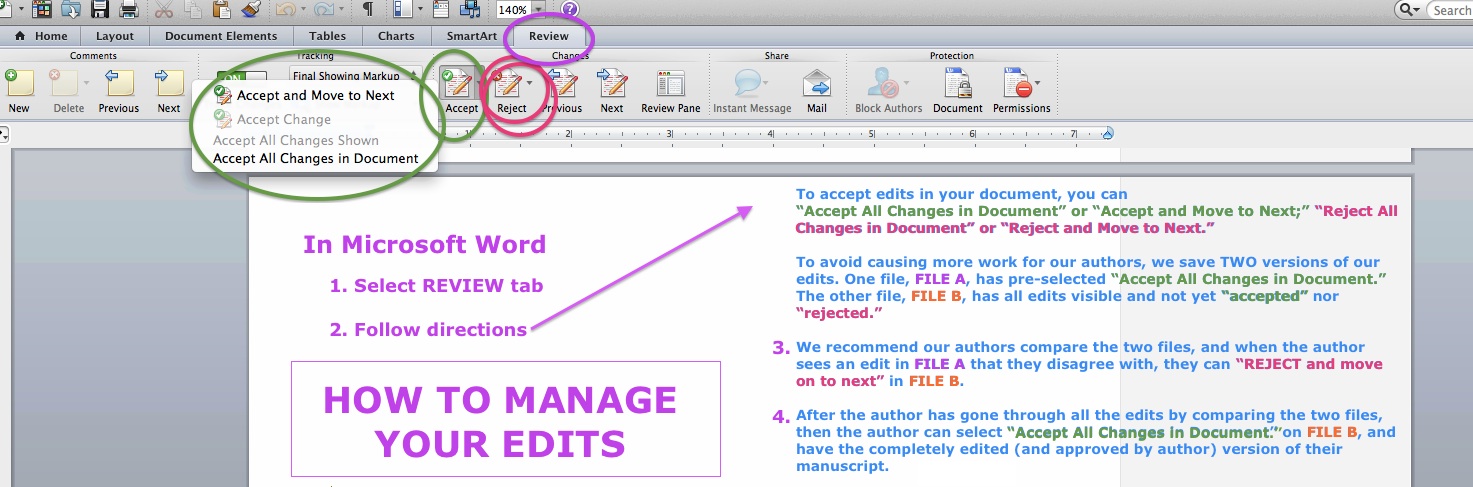
  EDITOR Sends Completed File Back to AUTHOR:

THE AUTHOR’S JOB:

1. READ through document

2. CHOOSE FROM (to accept and/or reject changes)

a. Accept All Changes in Document

b. Accept and Move to Next

c. Reject All Changes in Document

d. Reject and Move to Next

3. SHORTCUT for authors

a. Save TWO* versions of the file you received from your editor.

i. File A [edits accepted]

1. In Word Doc, under REVIEW tab [File A]

2. Select Accept All Changes in Document [File A]

ii. File B [edits visible]

1. Leave the file the way you received from the editor

b. Read through File A side-by-side with File B

i. If you find an edit you don’t want

1. In File B

a. Under REVIEW tab [File B]

b. Select Reject and Move to Next [File B]

ii. When you are finished reading File A, and correcting File B,

1. In File B

a. Under REVIEW tab [File B]

b. Select Accept All Changes in Document [File B]

c. File B is now fully edited, and author approved

*At Editing Addict, I do this beforehand for my authors, however, not all editors have the [File A & File B] policy, and expect the author to do it on their end. How To Manage Your Edits
How to Accept and/or Reject Tracked Changes in a Word Document: YouTube Video

Still have questions? Leave a comment below, or send  a message to the editor: billijoycarson@editingaddict.com. Teamwork brings success!

Fantasy? Nah, My Neighborhood

[found on terribleminds.com; by Chuck Wendig]

“ROOTED IN THE REAL

Reality is fantasy’s best friend. We, the audience, and you, the writer, all live in reality. The problems we understand are real problems. Genuine conflicts. True drama. The drama of families, of lost loves, of financial woes. Cruel neighbors and callow bullies and loved ones dead.

This is the nature of write what you know, and the fantasy writer’s version of that is, write what’s real. Which sounds like very bad advice, because last time I checked, none of us were plagued by dragons or sentient fungal cities or old gods come back to haunt us. But that’s not the point — the point is, you use the fantasy to highlight the reality.

The dragon is the callow bully. The lease on your fungal apartment is up and your financial woes puts you in tithe to the old gods who in turn make for very bad neighbors. You grab the core essence of a true problem and swaddle it in the mad glittery ribbons of fantasy — and therein you find glorious new permutations of conflict. Reality expressed in mind-boggling ways. Reach for fantasy. Find the reality.”

For more tips on writing fantasy from Chuck Wendig, click here.

[found on http://terribleminds.com/ramble/2012/06/19/25-things-you-should-know-about-writing-fantasyzzz]

Poetry Styles

To see the (more) complete list, with a further seventy-four types of poetry, click here.

[found on poetryfoundation.org]

Acrostic

A poem in which the first letter of each line spells out a word, name, or phrase when read vertically. See Lewis Carroll’s “A Boat beneath a Sunny Sky.”

Alexandrine

In English, a 12-syllable iambic line adapted from French heroic verse. The last line of each stanza in Thomas Hardy’s “The Convergence of the Twain” and Percy Bysshe Shelley’s “To a Skylark” is an alexandrine.

Anagram

A word spelled out by rearranging the letters of another word; for example, “The teacher gapes at the mounds of exam pages lying before her.”

Aubade

A love poem or song welcoming or lamenting the arrival of the dawn. The form originated in medieval France. See John Donne’s “The Sun Rising” and Louise Bogan’s “Leave-Taking.” Browse more aubade poems.”

[found on http://www.poetryfoundation.org/learning/glossary-terms?category=forms-and-types]

Fiction — The Highest Autobiography

[found on nytimes.com; by COLSON WHITEHEAD]

“Write what you know. Bellow once said, “Fiction is the higher autobiography.” In other words, fiction is payback for those who have wronged you.

When people read my books “My Gym Teacher Was an Abusive Bully” and “She Called Them Brussels Sprouts: A Survivor’s Tale,” they’re often surprised when I tell them they contain an autobiographical element.

Therein lies the art, I say. How do you make that which is your everyday into the stuff of literature? Listen to your heart. Ask your heart, Is it true? And if it is, let it be. Once the lawyers sign off, you’re good to go.”

For more excellent tips on writing from Colson Whitehead, click here.

[found on http://www.nytimes.com/2012/07/29/books/review/colson-whiteheads-rules-for-writing.html?_r=0]

How to: Nonfiction Proposal

[found on bradfordlit.com; by ]

“How To Write A Non-Fiction Proposal

Most non-fiction books are sold on the basis of a book proposal, often with one or more sample chapters rather than on a completed manuscript. While every agency and editor may have a slightly different opinion on the mechanics of writing a winning non-fiction proposal, most successful proposals have the following elements in common:

  1. Overview
    This is an introduction that summarizes the book’s contents and tells why the book should be published. In essence, this is your main selling statement. Concisely address all that is the most exciting, interesting, introspective and unique about your book. Make it clear that you are the best and most qualified person to write this wonderful and very necessary piece of non-fiction, as well as make a persuasive case for your intended market.
  2. Competition
    Understand and present how your book will fit in the marketplace. Select 4-6 of your major competing titles and compare them to your own. How is your book different and unique? The point here is not to denigrate other works (which may very well be beloved by your audience), but to highlight how your book successfully fills a gap in the market. Be honest but always keep in mind that each component of the proposal is to help you SELL your book, and showing how your project is at the head of the class is an excellent way to do so. It is not advisable to state that your book is “like no other” and decline to cite any comparative titles.
  3. Market
    Who is your intended audience? Who will relate to your book and rush to buy it? In this section, illustrate how the market for this book not only exists, but is a large, robust, book-buying section of the general public. It is unrealistic to make a statement that everyone will buy your book, so be mindful of exactly who your subject will appeal to. If there are any special markets that you can tap through any of your own personal connections this would be the place to mention it. An editor needs to see how your market translates to bottom-line sales.
  4. Biography
    This is your space for telling the editor a little more about yourself, specifically about how your experiences relate to this book. For example, if you are writing a cookbook, you’ll want to tell the editor about your experience working under the tutelage of Jacques Pepin. Be sure to mention your publishing history, if applicable. Keep this section as concise and professional as possible.
  5. Publicity
    If there are built-in publicity opportunities for your project, address them here. Any ideas for marketing or promotions you may have, especially if you have personal connections or direct access to likely prospects, should be mentioned. Make sure you let the editor know if you have any previous publicity experience.
  6. Chapter Outline
    This is one of the most critical sections of your proposal. List each chapter, with chapter title and give a brief description of the material covered. The style in which you deliver the description should be informed by the type of non-fiction book you are selling. A how-to book chapter description would necessarily be quite different from a travel narrative chapter description.
  7. Projected length and date of delivery
    Estimate the number of months you expect to take writing the book from signing to contract until completion. Give either a projected manuscript page length (use the standard of 250 words per page) or word count.
  8. Sample Chapters
    Sample chapters may or may not be necessary if you have written a complete and compelling proposal. If you have a track record of previous publications, you may not need to include sample chapters. If, however, you do elect to write a sample, you should draft the chapter that “puts your best foot forward” so to speak. Write the section that is the most interesting, the most compelling and the one that you feel most passionate about.”

For more tips on writing from Bradford Literary Agency, click here.

[found on http://www.bradfordlit.com/how-to-write-a-non-fiction-proposal]

Make Your Readers Worry, And They Will Be Loyal

[found on writersdigest.com]

“Predictability

Readers like to worry about characters in crisis. They want to tremble about what’s around the next corner (whether it’s emotional or physical). If a reader knows what’s coming, and then it does in fact come, the worry factor is blown. Your novel no longer conveys a fictive dream but a dull ride down familiar streets.

The fix is simple: Put something unexpected in every scene. Doing this one thing keeps the reader on edge.

So how do you come up with the unexpected? Try making lists. Pause and ask yourself what might happen next, and list the possibilities, centering on three primary areas: description, action and dialogue. For each one, don’t choose the first thing that comes to mind (which usually amounts to cliches). Force yourself to list at least five alternatives.

Description: Dump generic details for ones unique to the character’s perceptions. How might he see a room where someone died? What’s one surprising thing about the wallpaper? The bed? The closet?

Action: Close your eyes and watch your scene unfold. Let the characters improvise. What are some outlandish things that could result? If something looks interesting, find a way to justify it.

Dialogue: Don’t always use “on-the-nose” exchanges. How might characters say things that put other characters (and thus, readers) off balance? Consider Clarice Starling’s first conversation with Hannibal Lecter in The Silence of the Lambs. Clarice begins:

“I think you’ve been destructive. For me it’s the same thing.”

“Evil’s just destructive? Then storms are evil, if it’s just that simple. And we have fire, and then there’s hail. Underwriters lump it all under ‘Acts of God.’”

“Deliberate––”

“I collect church collapses, recreationally. Did you see the recent one in Sicily?”

You can make these lists in your planning stages, just before writing a scene, and/or when you revise. Either way, the unexpected elements that result will perceptibly elevate the quality of your story.”

For more tips on writing from , click here.

[found on http://www.writersdigest.com/online-editor/the-5-biggest-fiction-writing-mistakes-how-to-fix-them]

The New Reality of Author Platforms

[found on forbes.com; by Alan Rinzler]

“It’s still about visibility, but today’s approach has changed. The New Author Platform requires a focus on developing an unobstructed back and forth between authors and their readers, with the authors — not the publishers — controlling the flow.

Now it’s the author, not a publicist, who inspires readers to buy the book. The New Author Platform allows not only well-established authors, but unknown, first-time beginners to do an end run around the conservative gate-keepers and reach readers directly.”

To find out more from Alan Rinzler about author platforms, and how to create your own, click here.

[found on http://www.forbes.com/sites/booked/2011/07/26/the-new-author-platform-what-writers-need-to-know]