Tag: fiction

Write What You Love
[found on thecreativepenn.com; by JOANNA PENN on MAY 24, 2011]
“This is a guest post from Kate Lord Brown, author of The Beauty Chorus. I am totally in agreement with Kate on this topic. After years of being blocked by thinking I had to write literary fiction, I looked at my obsessions of religion, psychology, travel and action-adventure thrillers and finally wrote with passion!
Maybe you’ve come across the tired old line ‘write what you know’? It’s standard advice in a lot of How To Write manuals. I’d like to suggest you ignore it, and instead write what you love.
If I was going to ‘write what I know’, I could tell you about juggling work and family life. I could tell you about what I cooked for dinner last night, which film I watched. In fact, that is pretty much what I do write about for blog posts and articles. I’ve published internationally writing about parenting, travel locations, art exhibitions. For short sprint writing, drawing on your own experience is a great start. You can add to this with simple research about products, details about travel connections or opening times to package up a neat few hundred words.
However, for the endurance race of a book length manuscript I think you need more than that. If, like me, you juggle writing with all the other demands of work and running a home, it has to be a burning question that will get you running to your desk instead of putting your feet up when everyone else is asleep. If you urgently want to find the answer to something, that drive and enthusiasm will be felt by your readers.
Sometimes you’re lucky, and you stumble on the key to your new story. I came across a tiny obituary for a woman who had flown Spitfires during WW2, and that sparked months of research for my debut novel. I wanted to know why people had forgotten about these incredible women. I wanted to know everything about their lives, what it was like to be a young woman in a man’s world during the War. I knew nothing about wartime aviation – but I loved their story, and I wanted to know more.
With ‘The Beauty Chorus’ I was lucky. The story came to me. But there is no point waiting for the Muse – as Jack London said: ‘You can’t wait for inspiration. You have to go after it with a club.’
If you are searching around for a subject for your next book, or wondering why your current project has hit a wall, why not try the following:
- Take a big sheet of craft paper and some markers. Draw a circle at the centre and put your name in it. Radiating out from that centre, draw a line for each thing you love, and write it down in a smaller circle. Get really specific – not just ‘flowers’ from that write ‘roses’ or ‘tulips’. Brainstorm everything that excites you, really thrills you.
- Come back to your drawing a few days later, and see what jumps out at you. There may be two or three things, which is fine. I never need too much excuse for a new notebook, I don’t know about you, and this is time to reach for one. Write on the first page your chosen subject.
- Over the coming weeks, you’ll find you spot more and more information about this subject you love – it’s amazing how synchronicity kicks in and you will suddenly start seeing roses, or tulips, or WW2 aircraft wherever you look. Write it down. Paste up pictures and photographs in your book. Follow up tantalising leads. Tune into your story.
Within a very short time, you will find you have a resource book that can be the powerhouse of your new book. Just flicking through the pages of your notebook should excite you. From this seed a whole story can blossom – whether it’s about Crusaders bringing home roses, or the nefarious dealings of tulip traders, or the brave and beautiful young women who flew fighter planes.”
[found on http://www.thecreativepenn.com/2011/05/24/write-what-you-love]
Share this:
A Fiction-Lover’s Devotional
Deadline for this is VERY soon. Check it out.
|
|

Modern-Day Parables:
A Fiction-Lover’s Devotional
Deadline: September 1, 2013
Submissions should be sent to: Kathy Ide
“Kathy Ide is putting together a compilation of short fictional stories accompanied by Life Applications to help readers glean scriptural truths from the stories—similar to the format Jesus used when He told parables and then explained to His listeners how the stories applied to their everyday lives.
A major mainstream publisher has expressed serious interest in this book (and potential series). After seeing the proposal with some sample chapters, they have requested a complete manuscript as soon as possible. So the deadline for submissions to Kathy is September 1, 2013.
Contributing authors will receive an honorarium ($25) and a complimentary copy of the published book. Contributors should be able to purchase additional copies at author discount for sale or give-away. Bios of contributing authors will be featured at the end of each chapter. Titles of recently published works and website addresses can be included in the bio. So this devotional compilation will be an excellent opportunity for new readers to discover you and your books.
Guidelines
FORMAT
- Title: something catchy that relates to the topic
- Byline as you want it to appear
- Fiction Story: 1,500-2,000 words
- Life Application: 250-500 words giving truth, teaching, and inspiration related to the story
- Scripture verse that applies to the story (Include reference and version used)
- Author’s Bio: 50-100 words
- Plus or minus a few words is perfectly acceptable. Subject to change at publisher’s discretion.
- Double space, 12-point Times New Roman.
- In the upper-left corner of the first page, please include your name, address, phone number, and e-mail.
- In the upper-right corner of the first page, please indicate the theme/topic of your story.
- Feel free to submit multiple stories.
TIPS
- Short stories must be FICTION. No true stories (not even fictionalized true stories).
- Third person is preferable. (First person tends to have the feel of a true story.)
- Contemporary settings are preferred. Near-past or near-future will be considered.
- The publisher is very conservative, so the submission content should be too. (Think “Upper Room.”)
- Since I am a professional editor, I will most likely edit your submission. You need to be OK with that.
- If you have a fictional story with Life Application based on a Bible character, please let me know as I’m doing a project similar to this one, using biblical fiction, for a different publisher.
If you’d like to see some sample stories to get an idea of what Kathy looking for, let her know (at the email address below). She’ll be happy to e-mail a couple to you.
E-MAIL SUBMISSIONS TO Kathy Ide (Kathy@KathyIde.com)
Please write “Modern-Day Parables” in the subject line.”
Share this:

Featured Writing Addict: J.D. Scott
J.D. Scott

J.D. Scott has been the organizing member of Abba’s Writers in Phoenix, Arizona, for the past three years. She leads, organizes, and teaches both critiquing and story development to its 50+ members. She is also a participating member of West Valley Writers Group in Avondale, Arizona.
In February of 2013, J.D. Scott accepted the invitation to become part of the team at A Book’s Mind as a publishing consultant. She thoroughly enjoys working alongside writers, helping them fulfill their dreams of becoming published authors.
The Disillusionment of Anahera Daniels was released in 2013, and the second book in the Anahera Daniels series will be released in the fall of 2014.
What’s J.D. Scott’s Genre?
Fiction: Young Adult, Science Fiction
What’s J.D. Scott’s Inspiration?
“I spent nearly twenty years working with children and young adults as a nanny, mentor, camp counselor, daycare worker, and youth group leader. With a heart for today’s youth, I set out to write books that not only entertain, but also inspire today’s youth to rise above the current culture, and see their value.”
What’s J.D. Scott’s book about?
The Disillusionment of Anahera Daniels
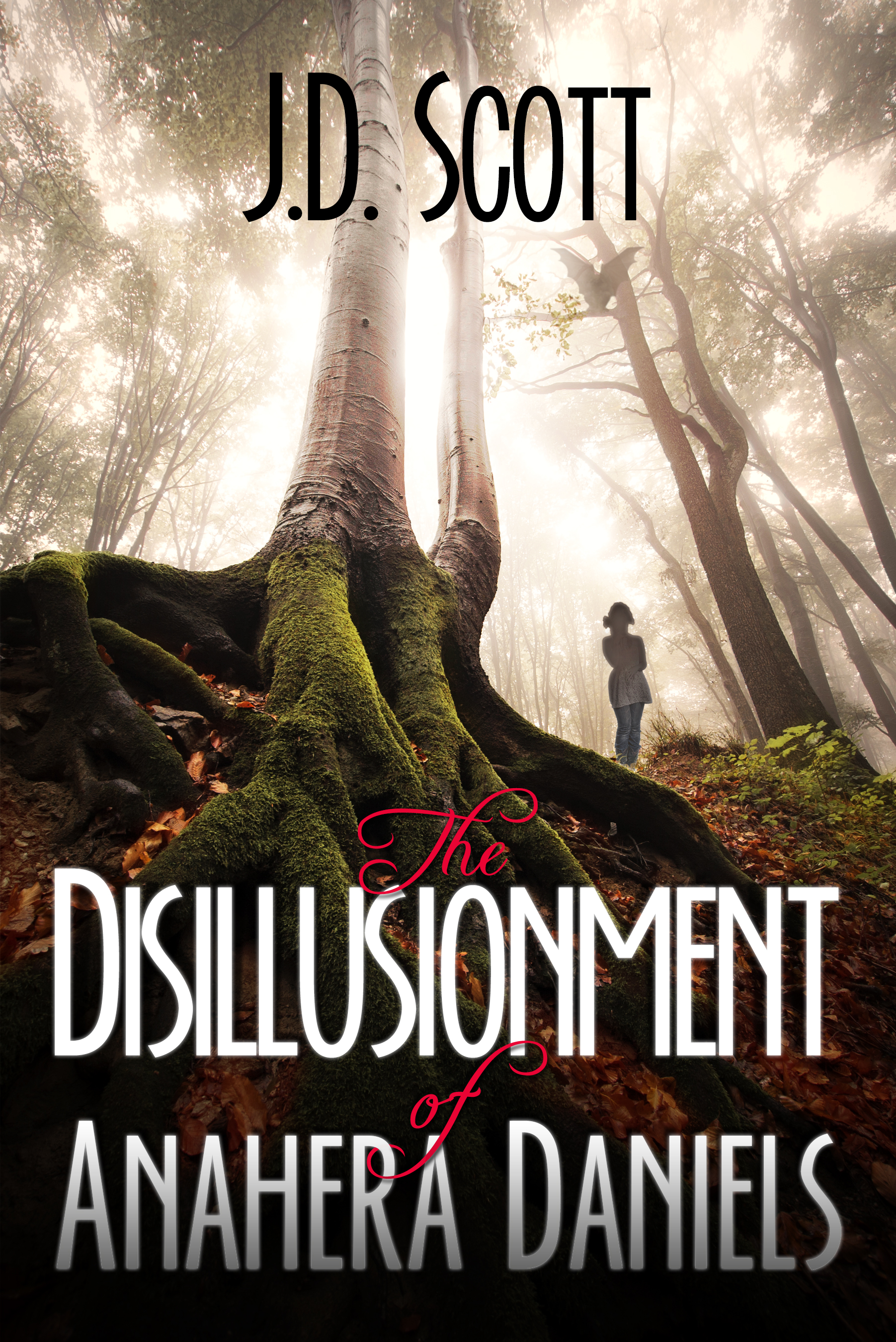
“Nothing of significance ever happened on Pleasant Avenue in the sleepy town of Prescott, Arizona. That is, nothing you’ve ever heard about…
On Anahera Daniels’ 18th birthday, she wakes from a disturbing nightmare, only to walk into another. After overhearing life-shattering news that her parents aren’t who she thought they were—she questions her place among family, friends, and in the heart of Nathan, her high school crush. Ana’s life splinters into two realities when strange dreams develop into a newfound ability to travel between Earth and the world of Posternis.
A world away, Ana finds herself wounded, and fleeing from a dark-winged creature when she collides into Adrian, an attractive Posternis native. Accepting the help of his outstretched hand, she unknowingly binds their fates together. Ana’s fierce determination drives her search to unravel the mystery of her biological parents, and their connection with the Cozen, the gargoyle-like creatures seemingly bent on her destruction.
Armed with only her sarcastic wit and a pocket knife, Ana must decipher where her loyalties lie, and choose between two worlds and two loves—before the deadly side-effects of traveling ends her life altogether.”
| Amazon | Barnes & Noble | A Book’s Mind | Blog |
| JDScottNovels.com | Facebook | Twitter | Goodreads | Email |
[See what J.D. had to say about our editor!]
Tell J.D. you heard about her on editingaddict.com!

Share this:

Principles of Fiction…?
“I gave up worrying about the principles of fiction writing when I realized that there weren’t any.”
― Teri Louise Kelly
Share this:
Invented Stories
“The vigor I lacked for physical activities became incandescent when, pen in hand, I filled those pages with invented stories. Sometimes they were intimately about me – family tales, parental exploits – sometimes they became horrific stories sprinkled with torture, death, and reunion: crazy games and tear-soaked sagas.”
― Philippe Grimbert, Memory
Share this:
A Writer’s Avalanche
“I even read aloud the part of the novel I had rewritten, which is about as low as a writer can get and much more dangerous for him than glacier skiing unroped before the full winter snowfall has set over the crevices.
When they said, ‘It’s great, Ernest. Truly, it’s great. You cannot know the thing it has,” I wagged my tail in pleasure and plunged into the fiesta concept of life to see if I could not bring some attractive stick back, instead of thinking, ‘If these bastards like it what is wrong with it?’ That was what I would think if I had been functioning as a professional although, if I had been functioning as a professional, I would never have read it to them.”
― Ernest Hemingway
Share this:
20 Writing Tips from 12 Fiction Authors
[found on iuniverse.com]
“Writing success boils down to hard work, imagination and passion—and then some more hard work…. Use these tips as an inspirational guide—or better yet, print a copy to put on your desk, home office, refrigerator door, or somewhere else noticeable so you can be constantly reminded not to let your story ideas wither away by putting off your writing.
|
|
|
|
|
|
|
|
|
|
|
|
|
|
|
|
|
|
|
|
|
|
|
|
|
|
|
|
|
|
|
|
|
|
|
|
|
|
|
Even famous authors sometimes have a tough time with writing; they also go through periods of self-doubt. Despite this, they always manage to come up with the goods. So take a lesson from them and stop putting off your writing plans and get started on your publishing journey today.”
 Editing Addict, LLC