Parallel [straight & narrow] Structure

#DailyFixEA

Laurie E. Rozakis, Ph.D. on parallel structure:

Parallel structure means putting ideas of the same rank in the same grammatical structure. Your writing and speech should have parallel words, phrases, and clauses. Parallel structure gives your writing many admirable strengths, including the following:

    • Rhythm
    • Emphasis
    • balance
    • Impact
    • Crispness
    • Conciseness

Parallel words share the same part of speech (such as nouns, adjectives, or verbs) and tense (if the parallel word are verbs).

    • My date was obnoxious, loud, and cheap; no doubt he thought I was gorgeous, personable, and witty.
    • We pleaded, begged, and prayed—to no avail.

Parallel phrases create an underlying rhythm in your speech and writing…

    • “For taking away our Charters, abolishing our laws, and altering the Forms of our Government . . . ” (Declaration of Independence)
    • “Now the trumpet summons us again—not as a call to bear arms, though arms we need—not as a call to battle, though embattled we are—but a call to bear the burden of a long twilight struggle…” (John F. Kennedy’s inauguration speech)

Parallel clauses can give your writing balance as well….

    • “Let every nation know, whether it wishes us well or ill, that we shall pay any price, bear any burden, meet any hardship, support any friend, oppose any foe to assure the survival and success of liberty.” (John F. Kennedy’s inauguration speech)
    • “Our chiefs are killed; Looking-Glass is dead; Ta-Hool-Shute is dead.” (Chief Joseph’s surrender speech, 1877)”

Rozakis‘s book, The Complete Idiot’s Guide to Grammar and Style, is an excellent resource for writers of all kinds. You can find it here.

Weird Crimes of Grammar

Is anything else needed on a Monday morning than to watch “Weird Al” Yankovic sing about Word Crimes? We think not.

“Weird Al” Yankovic – Word Crimes

Grammar crimes are a crime. We wholeheartedly agree. Do your part; read a book.

Research How-To…and Why

[found on copyblogger.com; by  ]

“I’m going to talk about research. No, research is not very fun, and it’s never glamorous, but it matters. A lot.

If you want to be able to make compelling case for something — whether it’s in a book, on a blog, or in a multi-million dollar VC pitch — you need stories that frame your arguments, rich anecdotes to compliment tangible examples, and impressive data so you can empirically crush counter arguments.

But good research doesn’t just magically appear. Stories, anecdotes and data have to be found before you can use them.

You have to hunt them down like a shark, chasing the scent of blood across the vast ocean of information. The bad news is that this is an unenviable task … but the good news is that it’s not impossible.

It’s not even that hard … once you learn what you’re doing — and I’m going to teach you those skills.

By the time I was 21, my research had been used by #1 New York Times Bestselling authors like Robert Greene, Tim Ferriss, and Tucker Max. Was I a slave to study? Did I have to become a library hermit to accomplish this? No, I did it all in my spare time–on the side, with just a few hours of work a week.

Here’s how I did it …

Step 1: Prepare long before gameday [sic]

…This is the mark you must aim for as a researcher, to not only have enough material — and to know where the rest of what you haven’t read will be located — on hand to do your work….

Step 2: Learn to search (Google) like a pro

…How do you find a needle in haystack? Get rid of the extra hay….

Step 3: Go down the rabbit hole (embrace serendipity)

…One of my rules as a reader is to read one book mentioned in or cited in every book that I read. It not only solves the problem of ‘what to read next’ but it sends you on a journey down the rabbit hole….

Step 4: When in doubt, turn to the classics

…The Classics are “classic” for a reason. They’ve survived the test of time….

Step 5: Keep a commonplace book

…a book of quotes, sentences, metaphors and  miscellany that he could use at a moment’s notice….”

To read the entire article from , click here.

[found on http://www.copyblogger.com/content-marketing-research/]

Two Words? Oops, One Word

[found on quickanddirtytips.com; by Bonnie Trenga Mills]

“Do you want to get ahead (one word) or are you cooking an esoteric dish and want to get a head (two words)? That one little space can make a big difference in meaning: Either you are moving past others in business or you are purchasing a skull…..

When it comes to pairs such as “apart” with no space and “a part” with a space, the spelling doesn’t matter when you’re talking; both sound the same. When you write the words, however, you might forget to add a space, or you might add an unnecessary one. This problem crops up with all kinds of words, but in this episode we’re focusing on words beginning with the letter “a.”

Words That Start With “A”

Here’s a short list of pairs like “ahead” and “a head”: “alight” and “a light,” “abuzz” and “a buzz,” “apart” and “a part,” and, lastly, “ahold” and “a hold.” As you can see from this list, the one-worders beginning with “a” can be various parts of speech: “ahead” is an adverb, “alight” is a verb,” and “abuzz” is an adjective. The two-worders, on the other hand, consist of an article—the word “a”—and a noun: “light,” “buzz,” “part,” and “hold.” True, these words can sometimes be verbs, but when something follows the article “a,” it’s a noun (unless something such as an adjective comes between the article and the noun, as in “a delicious cake”).

“Alight” Versus “A Light”

Let’s see these four pairs in action. The first two—“alight”/“a light” and “abuzz”/“a buzz”—are the easy ones. You could say, “That annoying bee wants to alight on my nose.” This means the bee wants to land on your nose, and there’s no space in “alight.” If you say, “He turned on a light”—with a space—that means he was no longer enveloped in darkness.

“Abuzz” Versus “A Buzz”

In keeping with the bee theme, here’s our next example: “I heard a buzz.” A quick test for those listening: Is there a space or not? Well, yes, there is! “A buzz” with a space means “a buzzing noise.” “Abuzz” with no space is an adjective that means alive with activity, as in “The room became abuzz when the grammarian entered.”

To read the entire article from Grammar Girl, click here.

[found on http://www.quickanddirtytips.com/education/grammar/a-hold-or-ahold]

Not All Is Possessive

[found on grammarphobia.com; by The Grammarphobia Blog]

 Nouns: Possessive vs Genitive

“Normally, nouns used with numbers to form adjectival phrases are singular, as in “two-inch rain,” “three-year-old boy,” “two-dollar word,” “eight-volume biography,” and “four-star restaurant.”

However, where a plural noun is used by tradition to form such a phrase, it’s generally followed by an apostrophe, as in “the Thirty Years’ War” and “the Hundred Years’ War.”

The plural followed by an apostrophe is also used in phrases like “ten dollars’ worth” or “five years’ experience” or “two days’ time.”

Apostrophe constructions like these aren’t “possessive” in the sense of ownership; strictly speaking, they’re genitive.”

To learn more from grammarphobia.com, click here.

[found on http://www.grammarphobia.com/blog/2010/08/sui-genitive.html]

Grammar Toolkit

[found on grammarist.com]

Have you ever been writing, and realized  you have no idea what words you need—nor if they are a single word, two words, or a compound word? This site, grammarist.com, is an amazing tool for just such a panic attack. Take a look at the example for workout vs. work out:

“Workout vs. work out

As a noun or an adjectiveworkout is one word. As a verb, it’s two words—work out. So, for instance, when it’s workout time, you start your workout, work out for a while, and stop.

Work out is just one of many phrasal verbs with corresponding one word forms that function as nouns and adjectives. The one-word forms are sometimes hyphenated (e.g., work-out), but more often completely compounded. These forms never catch on as verbs in edited writing, though they are often erroneously treated as verbs in more informal contexts.”

To add this site to your toolkit for writing, click here.

[found on http://grammarist.com/usage/workout-work-out]

The Least of It

“People approach writers, assuming we pull a perfect text out of our nose each time (well spelled). Spelling is the least of it.” 

― Sara Levine, Touchstone Anthology of Contemporary Creative Nonfiction: Work from 1970 to the Present

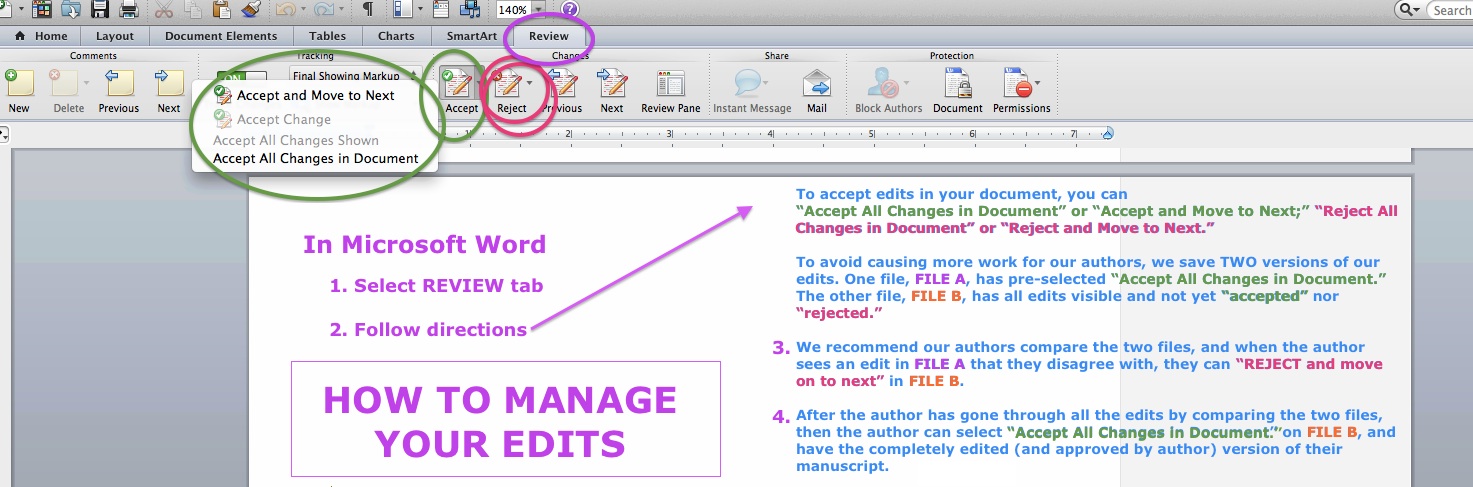
How To Manage Your Edits

“As an editor, I have heard horror stories about authors who didn’t know how to process the edits they received back from their editors. Instead of asking what to do with the Word document, [caution, you’re going to scream] some of the authors printed the full manuscript, compared item by item, then RETYPED the entire manuscript.

Don’t let this be you.

Firstly, your editor is on your TEAM. An editor wants you to succeed. And even though you may feel like we are all jackals, we don’t really bite. Ask us questions—especially when you feel overwhelmed or uncertain.”

— Billi Joy Carson / Senior Editor, Editing Addict

  EDITOR Sends Completed File Back to AUTHOR:

THE AUTHOR’S JOB:

1. READ through document

2. CHOOSE FROM (to accept and/or reject changes)

a. Accept All Changes in Document

b. Accept and Move to Next

c. Reject All Changes in Document

d. Reject and Move to Next

3. SHORTCUT for authors

a. Save TWO* versions of the file you received from your editor.

i. File A [edits accepted]

1. In Word Doc, under REVIEW tab [File A]

2. Select Accept All Changes in Document [File A]

ii. File B [edits visible]

1. Leave the file the way you received from the editor

b. Read through File A side-by-side with File B

i. If you find an edit you don’t want

1. In File B

a. Under REVIEW tab [File B]

b. Select Reject and Move to Next [File B]

ii. When you are finished reading File A, and correcting File B,

1. In File B

a. Under REVIEW tab [File B]

b. Select Accept All Changes in Document [File B]

c. File B is now fully edited, and author approved

*At Editing Addict, I do this beforehand for my authors, however, not all editors have the [File A & File B] policy, and expect the author to do it on their end. How To Manage Your Edits

How to Accept and/or Reject Tracked Changes in a Word Document: YouTube Video

Still have questions? Leave a comment below, or send  a message to the editor: billijoycarson@editingaddict.com. Teamwork brings success!

Be Passive The Writing Must Not

[found on bookcoaching.com; by Judy Cullins]

“Stop passive sentence construction.

When you write in passive voice, your writing slides along into long sentences that slow your readers down, even bore them.

Before you put your final stamp of approval on your writing, circle all the “is,” “was” and other passive verbs like: begin, start to, seems, appears, have, and could. Use your grammar check to count your passives. Aim for 2-4% only.

Instead of, ”Make sure that your name is included on all your household accounts and investments.” Passive culprits include “Make” and “is included.” Create more clarity with this revision,” Include your name on all household accounts and investments to keep your own credit alive after your divorce.”

For more tips on writing from Judy Cullins, click here.

[found on http://bookcoaching.com/wp/non-fiction-book-writing-solutions]