Tips on Capitalization in Titles

[found on grammar.about.com; by ]

“Style guides disagree on which words to capitalize in a title (of a book, article, essay, movie, song, or video game). Here’s a basic guide to the two most common methods: sentence case and title case….

There’s not a single set of rules for capitalizing words in a title. For most of us, it’s a matter of selecting one convention and sticking to it. The big decision is whether to go with sentence case (simple) or title case (a little less simple).

Sentence case (also known as Down style)

Capitalize only the first word of the title and any proper nouns: “Rules for capitalizing the words in a title.” This form, recommended by the Publication Manual of the American Psychological Association for titles in reference lists, is popular with many online and print publications. In fact it’s now the standard form for titles and headlines in most countries–but not (yet) in the United States.

Title Case (also known as Headline Style or Up Style)

Capitalize the first and last words of the title and all nounspronounsadjectivesverbsadverbs, and subordinating conjunctions (if, because, as, that, and so on): “Rules for Capitalizing the Words in a Title.”

It’s the little words that style guides disagree on. The Chicago Manual of Style, for instance, notes that “articles (a, an, the), coordinating conjunctions (and, but, or, for, nor), and prepositions, regardless of length, are lowercased unless they are the first or last word of the title.”

But The Associated Press Stylebook is fussier:

  • Capitalize the principal words, including prepositions and conjunctions of four or more letters.
  • Capitalize an article—the, a, an—or words of fewer than four letters if it is the first or last word in a title.

Other guides say that prepositions and conjunctions of fewer than five letters should be in lowercase—except at the beginning or end of a title. (For additional guidelines, see the glossary entry for title case.)

So pick a form—any form. And then try to be consistent.”

[found on http://grammar.about.com/od/grammarfaq/f/capitalstitle.htm]

Punctuation Is Your Friend . . .

[found on thepunctuationguide.com]

 . . .

“An ellipsis is a set of three periods ( . . . ) indicating an omission. Each period should have a single space on either side, except when adjacent to a quotation mark, in which case there should be no space.”

“The em dash is perhaps the most versatile punctuation mark. Depending on the context, the em dash can take the place of commasparentheses, or colons—in each case to slightly different effect.

Notwithstanding its versatility, the em dash is best limited to two appearances per sentence. Otherwise, confusion rather than clarity is likely to result.

Do not mistake the em dash (—) for the slightly narrower en dash (–) or the even narrower hyphen (-). Those marks serve different purposes and are further explained in other sections.”

!

The most flagrant way a writer demonstrates contempt for his readers is by ignoring punctuation altogether. A close second is the abundant use of the exclamation point. Some writers even use three or more exclamation points, lest the reader not fully grasp the significance of what is being said.  To be effective, the exclamation point should be used in moderation.”

[ found on http://www.thepunctuationguide.com/index.html ]

Grammar Toolkit

[found on grammarist.com]

Have you ever been writing, and realized  you have no idea what words you need—nor if they are a single word, two words, or a compound word? This site, grammarist.com, is an amazing tool for just such a panic attack. Take a look at the example for workout vs. work out:

“Workout vs. work out

As a noun or an adjectiveworkout is one word. As a verb, it’s two words—work out. So, for instance, when it’s workout time, you start your workout, work out for a while, and stop.

Work out is just one of many phrasal verbs with corresponding one word forms that function as nouns and adjectives. The one-word forms are sometimes hyphenated (e.g., work-out), but more often completely compounded. These forms never catch on as verbs in edited writing, though they are often erroneously treated as verbs in more informal contexts.”

To add this site to your toolkit for writing, click here.

[found on http://grammarist.com/usage/workout-work-out]

Grand Opening—Or Nothing At All

[found on hatrack.com; by Orson Scott Card]

“If you mess up the opening, nothing you do later in the story will fix it. And because mistakes in the opening will reverberate through the rest of the story, when you finally do fix the opening you usually have to throw out and redo everything that you wrote after it. With rare exceptions, you simply have to get the opening right before you can go on.

But what is the “opening”? The first sentence? Having a good first sentence is nice, but it’s not the opening. By definition, the first sentence is in the first paragraph, and the first paragraph is free. That is, the first paragraph of a story does not have to be in the same voice or mood or tone as the rest of the work. The first paragraph is important for setting the scene, for giving vital information that allows what follows to make sense. But the real opening is after that first paragraph — when the story starts in earnest.”

For more amazing tips on writing from Uncle Orson’s Writing Class, click here.

[found on http://hatrack.com/writingclass/lessons/1998-10-29.shtml]

Repeat Not, Repeat Not — R E P E A T — N O T

[found on holtuncensored.com; by Pat Holt]

Just about every writer unconsciously leans on a “crutch” word. Hillary Clinton’s repeated word is “eager” (can you believe it? the committee that wrote Living History should be ashamed). Cosmopolitan magazine editor Kate White uses “quickly” over a dozen times in A Body To Die For. Jack Kerouac’s crutch word in On the Road is “sad,” sometimes doubly so – “sad, sad.” Ann Packer’s in The Dive from Clausen’s Pier is “weird.”

Crutch words are usually unremarkable. That’s why they slip under editorial radar – they’re not even worth repeating, but there you have it, pop, pop, pop, up they come. Readers, however, notice them, get irked by them and are eventually distracted by them, and down goes your book, never to be opened again.

But even if the word is unusual, and even if you use it differently when you repeat it, don’t: Set a higher standard for yourself even if readers
won’t notice. In Jennifer Egan’s Look at me, the core word – a good word, but because it’s good, you get *one* per book – is “abraded.”

Here’s the problem:

“Victoria’s blue gaze abraded me with the texture of ground glass.” page 202
“…(metal trucks abrading the concrete)…” page 217
“…he relished the abrasion of her skepticism…” page 256
“…since his abrasion with Z …” page 272

The same goes for repeats of several words together – a phrase or sentence that may seem fresh at first, but, restated many times, draws attention from the author’s strengths. Sheldon Siegel nearly bludgeons us in his otherwise witty and articulate courtroom thriller, Final Verdict, with a sentence construction that’s repeated throughout the book:

“His tone oozes self-righteousness when he says…” page 188
“His voice is barely audible when he says…” page 193
“His tone is unapologetic when he says…” page 199
“Rosie keeps her tone even when she says…” page 200
“His tone is even when he says…” page 205
“I switch to my lawyer voice when I say …” page 211
“He sounds like Grace when he says…” page 211

What a tragedy. I’m not saying all forms of this sentence should be lopped off. Lawyers find their rhythm in the courtroom by phrasing
questions in the same or similar way. It’s just that you can’t do it too often on the page. After the third or fourth or 16th time, readers exclaim silently, “Where was the editor who shoulda caught this?” or “What was the author thinking?

So if you are the author, don’t wait for the agent or house or even editorial consultant to catch this stuff *for* you. Attune your eye now. Vow to yourself, NO REPEATS.

And by the way, even deliberate repeats should always be questioned: “Here are the documents.” says one character. “If these are the documents, I’ll oppose you,” says another. A repeat like that just keeps us on the surface. Figure out a different word; or rewrite the exchange. Repeats rarely allow you to probe deeper.”

For more excellent tips on writing from Pat Holt, click HERE.

[found on http://www.holtuncensored.com/hu/the-ten-mistakes]

Tips For New Writers

[found on karenkingsbury.com; by Karen Kingsbury]

“4. Read Other Books Similar to Yours

If you want to write a mystery, read mysteries. If you want to write a Christian romance, read Christian romances. If you want to write a Christian general fiction, such as Karen Kingsbury’s works—read Karen Kingsbury’s books. You get the idea. You must be well versed in the type of genre you wish to write. Editors and agents will expect this.

5. Get a Copy of Writer’s Market

This is an informational book that releases new every year and has a list of editors and agents who are acquiring new material.

6. Write a Brief Synopsis for Your Book

Once you’ve finished your book, and you’re happy with it, write a very brief one-sentence or two-sentence synopsis. This will go a long way in helping you convey the story to an editor or agent. Example: Gideon’s Gift is about a sick little girl, an angry homeless man, and the gift that changes both of their lives forever. You need something like this for your book.”

For more tips on writing from Karen Kingsbury, click HERE.

[found on http://www.karenkingsbury.com/about-karen/writing-tips]

Build Screenwriting Characters

[found on thescriptlab.com]

“For a truly effective screenplay, you must know your characters backwards and forward. In screenwriting, the moment you begin to imagine character relationships – how your character deals with his parents, his siblings, his coworkers, and all that – you start to explore the world of your story, and suddenly scenes begin to emerge.

As you research your character (context, culture, occupation), creating details (attitudes, values, emotions), developing backstory (physiology, sociology, psychology), and establishing personality and behavior, you start putting the character in different situations in your mind, and you begin to imagine him or her in the most mundane and most exciting moments of his life.

The courage to deal with the trivial and banalities is something you should develop. Because often the best stories in screenwriting, are made from the most commonplace material, and if you don’t know how your character cooks dinner, does laundry, brushes his teeth, or what his little vexations are, his petty likes and dislikes, a dynamic, a full story will never happen.

Frank Daniel, the former chair of the Film Division at Columbia University and past dean of the School of Cinema-Television at USC, echos the point in five simple words: “A story starts with character.”

So if character is the key, and stories are only as good as the characters within them, you better create some damn, fine, outstanding characters.”

For more tips on writing screenplays from , click HERE.

[found on http://thescriptlab.com/screenwriting]

How To Write A Travel Guide

[found on writersworkshop.co.uk; by Robin Lloyd-Jones]
  • Do your research – pre-travel research enriches the whole experience; post-travel research adds depth and accuracy to what you write. While travelling keep notes or you will forget; and take photographs to illustrate your words.
  • Be curious – about everything and everybody. What makes many travel books enjoyable is the people encountered along the way. Talk to everyone and never stop asking questions. Listen with a sympathetic ear. Look behind the glossy façade, delve beneath the surface.
  • Have a sense of wonder – Colours seemed so much brighter when we were children. Try to see the world with that same freshness of vision.
  • Use all your senses – sight, sound, smell, taste and touch. Develop a feeling for the culture and history of a place. And a sense of humour allied to keen observation can make the most ordinary of experiences entertaining.
  • Don’t neglect your inner journey – Many of the most successful travel books are as much about the emotional journey the author makes as they are about the physical journey. The resolution of a personal issue or a change in attitude adds interest and brings the reader closer to the author.
  • Write with passion – To fully engage the reader (or indeed, a literary agent) your book must have something in it that you care about strongly –  an issue, a cause, the pursuit of a lifelong ambition. Without this your writing is in danger of seeming flat.
  • Be an open door, be receptive –  Travel with open eyes, ears, mind and heart.

For more tips on writing from Robin Lloyd-Jones, click here.

[found on http://www.writersworkshop.co.uk/Travel.html]

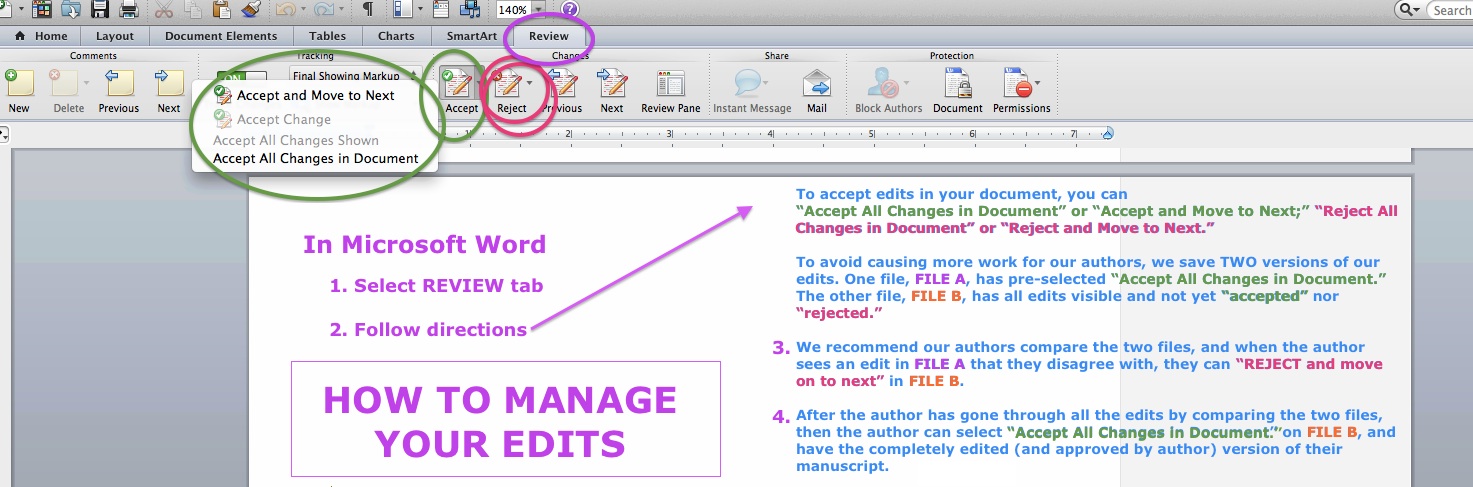
How To Manage Your Edits

“As an editor, I have heard horror stories about authors who didn’t know how to process the edits they received back from their editors. Instead of asking what to do with the Word document, [caution, you’re going to scream] some of the authors printed the full manuscript, compared item by item, then RETYPED the entire manuscript.

Don’t let this be you.

Firstly, your editor is on your TEAM. An editor wants you to succeed. And even though you may feel like we are all jackals, we don’t really bite. Ask us questions—especially when you feel overwhelmed or uncertain.”

— Billi Joy Carson / Senior Editor, Editing Addict

  EDITOR Sends Completed File Back to AUTHOR:

THE AUTHOR’S JOB:

1. READ through document

2. CHOOSE FROM (to accept and/or reject changes)

a. Accept All Changes in Document

b. Accept and Move to Next

c. Reject All Changes in Document

d. Reject and Move to Next

3. SHORTCUT for authors

a. Save TWO* versions of the file you received from your editor.

i. File A [edits accepted]

1. In Word Doc, under REVIEW tab [File A]

2. Select Accept All Changes in Document [File A]

ii. File B [edits visible]

1. Leave the file the way you received from the editor

b. Read through File A side-by-side with File B

i. If you find an edit you don’t want

1. In File B

a. Under REVIEW tab [File B]

b. Select Reject and Move to Next [File B]

ii. When you are finished reading File A, and correcting File B,

1. In File B

a. Under REVIEW tab [File B]

b. Select Accept All Changes in Document [File B]

c. File B is now fully edited, and author approved

*At Editing Addict, I do this beforehand for my authors, however, not all editors have the [File A & File B] policy, and expect the author to do it on their end. How To Manage Your Edits

How to Accept and/or Reject Tracked Changes in a Word Document: YouTube Video

Still have questions? Leave a comment below, or send  a message to the editor: billijoycarson@editingaddict.com. Teamwork brings success!

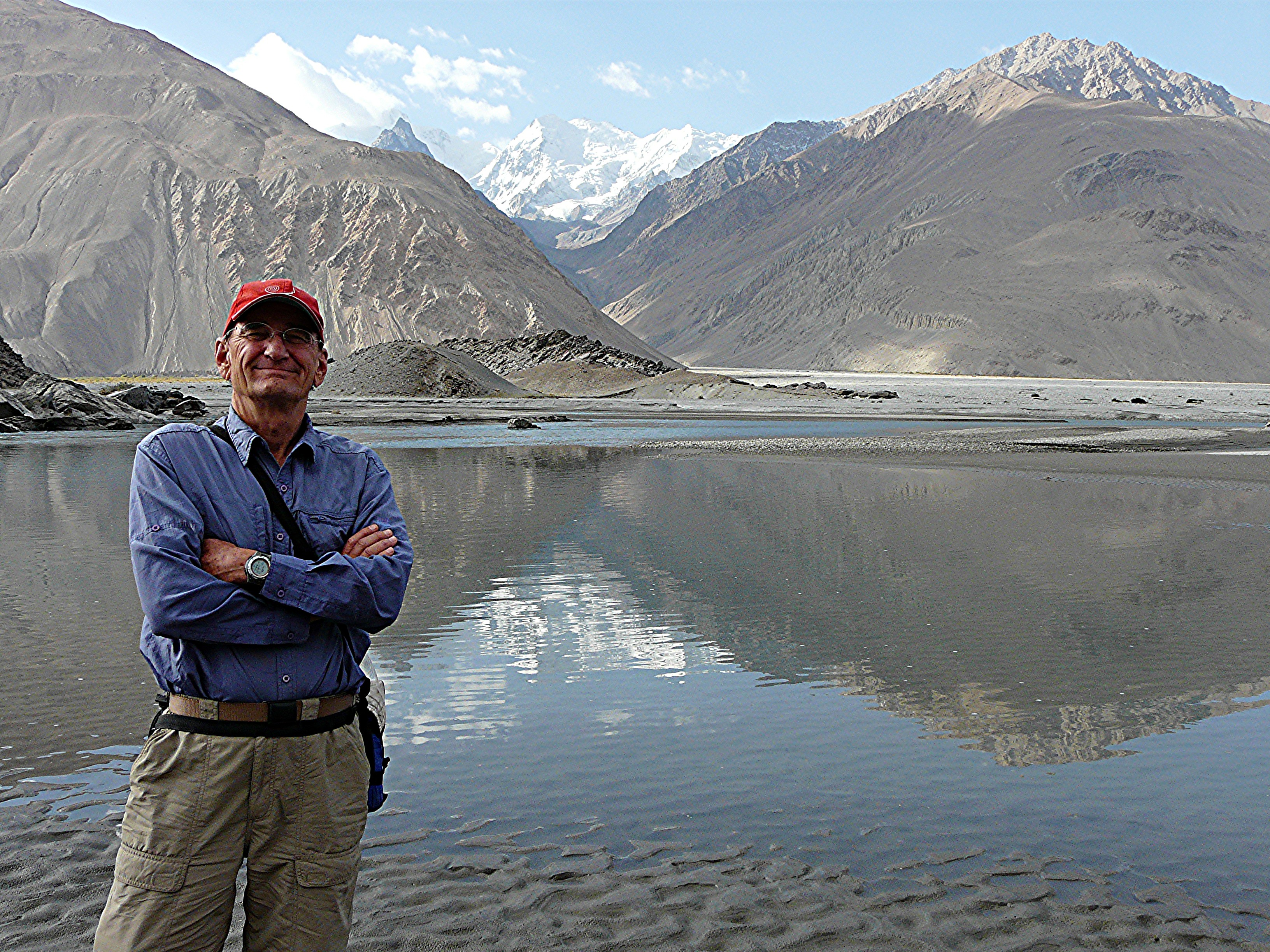
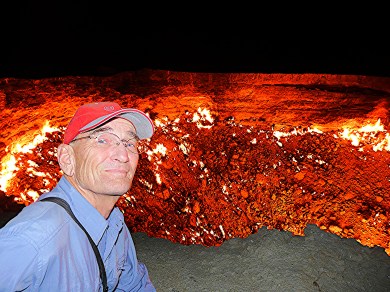
Featured Writing Addict: David Rich

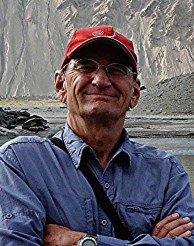
David Rich

David Rich is a most intrepid writer—braving blizzards, monsoons, desert heat, and State Department travel advisories—to visit the world’s most out-of-the-way places, primarily by RV, from the Karakoram Mountains in Pakistan to the wilds of Borneo.

David retired in his forties to become a full-time international traveler, an occupation he found preferable to former professions of law professor and trial lawyer with the Arizona Attorney General’s Office (from which he says he’s now mostly recovered). He pursued freelance travel writing and exotic full-time international travel for eighteen years, living in almost every country on the planet. Until buying a home near Deer Valley Airport, AZ in 2009 (where he later obtained his private pilot’s license in 2011), he and his wife Mary had sold everything and were classically homeless.

Travel highlights include: climbing Kilimanjaro in Tanzania and Roraima Tepui—where Brazil, Guyana and Venezuela intersect; the Annapurna and Everest Base Camp treks in Nepal; the Karakorum’s in NW Pakistan, hosting six of the world’s 14 highest peaks; the exotic Stans (particularly Tajikistan and Uzbekistan); Mali and Ethiopia; the national parks of Patagonia, and Petra in Jordan. The highlights comprise hundreds of incredible sights and far-reaching adventures, including a minor hostage situation in Serbia.

David and Mary RVed Europe, Scandinavia, Northern Africa, and the Middle East for three years; they RVed Australia for over a year, New Zealand during two visits totaling a year, and South America for two years. Along with the extensive RV and other independent travel throughout Africa and Asia, they interspersed sailing trips all over the globe from Malaysia, Thailand, and the Philippines to Venezuela, Panama and Columbia.

What’s David’s Genre?

Travel, philosophy, economics, government, religion, and ethics

What’s  David’s Passion For Writing?

“An addiction to travel has taken me around the world many times. I inherited the passion from my parents, who traveled every available moment. My travels have ranged from sailboats and Cessnas to RVs and backpacks—all over the world. We understand that you can’t know a place, country, people, or culture until you go experience them firsthand. My curiosity and thirst for knowledge of other places, peoples, and cultures have—with a few exceptions—found me living in every country on the planet. I love to travel, a passion reflected in my books, stories, and photos. I also write books on philosophy, specifically economics, government, ethics, and religion and have two works in process for completion by the end of 2014.”

What are David’s books about?

RV the World
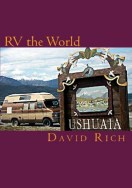
“Traveling the world by RV is the least expensive, most interesting and convenient means to see the world in its entirety, up close and cosy. Anyone can do it. RV the World explains how, and takes the reader on a three-year RV trip through Europe, North Africa, Scandinavia, and the Middle East.”

Amazon.com Book Description:

“The easiest, most comfortable, safest and least expensive way to see the entire world is by RV, which the author has done on every continent save Antarctica. When people learn the author and his wife have traveled the world continuously for 18 years, living in 147 countries, everyone is curious. The questions are always the same: Does it cost a lot to travel full time all over the world? How much? How are you able to navigate all those foreign countries? What’s the best way to do it? Then comes, I wish I could do that, to which the author always says, Anyone can do it if they really want to. It’s easy and inexpensive.

The book answers all these questions and takes the reader on a tour of Europe, Scandinavia, North Africa and the Middle East, further answering where to go, what to do and exactly how to do it. The sights include all the Seven Wonders and much more, from fantastic cities, national parks, sprawling antiquities and incredible mountains to exotic shopping, fine dining and pristine beaches. Here’s how to ship your own RV all over the world or go wherever you’d like and buy an RV there, obtain insurance, deal with foreign languages, the requirements of the proper RV and how to sell it locally before moving onto the next continent. Full-time international travel is easy when you know how to deal with the necessary details from mail, inoculations, documents, weather, costs, airfare, investments and healthcare.

 
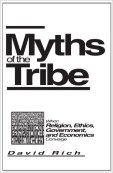
Myths of the Tribe

“The relationships among government, economics, ethics, and religion are explored in Myths of the Tribe: When Religion, Ethics, Government and Economics Converge. The relationships are many, recognition of which, would improve the efficacy of all four.”

Amazon.com Book Description:

“David Rich examines the pervasive influence of organized religion on three vital areas of human behavior — ethics, government, and economics — and argues that the belief systems of all major religions have become a detriment to clear thinking, rational conduct, and wise public policy.

Despite the fact that modern society is an outgrowth of the Enlightenment, most of our “tribe” continues to operate on the basis of assumptions and attitudes that have their origin in ancient myths. These myths, still propagated by organized religion, not only hamper efforts to apply reason to our problems, but they can foster violent conflicts that threaten global security, as witnessed today in the former Yugoslavia, the Middle East, Northern Ireland, and many regions of Africa and Asia.”
_____________________________________________
  

To reach David Rich, buy his books, or schedule a book-signing event:

Tell him you heard about him on editingaddict.com!