Grand Opening—Or Nothing At All

[found on hatrack.com; by Orson Scott Card]

“If you mess up the opening, nothing you do later in the story will fix it. And because mistakes in the opening will reverberate through the rest of the story, when you finally do fix the opening you usually have to throw out and redo everything that you wrote after it. With rare exceptions, you simply have to get the opening right before you can go on.

But what is the “opening”? The first sentence? Having a good first sentence is nice, but it’s not the opening. By definition, the first sentence is in the first paragraph, and the first paragraph is free. That is, the first paragraph of a story does not have to be in the same voice or mood or tone as the rest of the work. The first paragraph is important for setting the scene, for giving vital information that allows what follows to make sense. But the real opening is after that first paragraph — when the story starts in earnest.”

For more amazing tips on writing from Uncle Orson’s Writing Class, click here.

[found on http://hatrack.com/writingclass/lessons/1998-10-29.shtml]

Tips For New Writers

[found on karenkingsbury.com; by Karen Kingsbury]

“4. Read Other Books Similar to Yours

If you want to write a mystery, read mysteries. If you want to write a Christian romance, read Christian romances. If you want to write a Christian general fiction, such as Karen Kingsbury’s works—read Karen Kingsbury’s books. You get the idea. You must be well versed in the type of genre you wish to write. Editors and agents will expect this.

5. Get a Copy of Writer’s Market

This is an informational book that releases new every year and has a list of editors and agents who are acquiring new material.

6. Write a Brief Synopsis for Your Book

Once you’ve finished your book, and you’re happy with it, write a very brief one-sentence or two-sentence synopsis. This will go a long way in helping you convey the story to an editor or agent. Example: Gideon’s Gift is about a sick little girl, an angry homeless man, and the gift that changes both of their lives forever. You need something like this for your book.”

For more tips on writing from Karen Kingsbury, click HERE.

[found on http://www.karenkingsbury.com/about-karen/writing-tips]

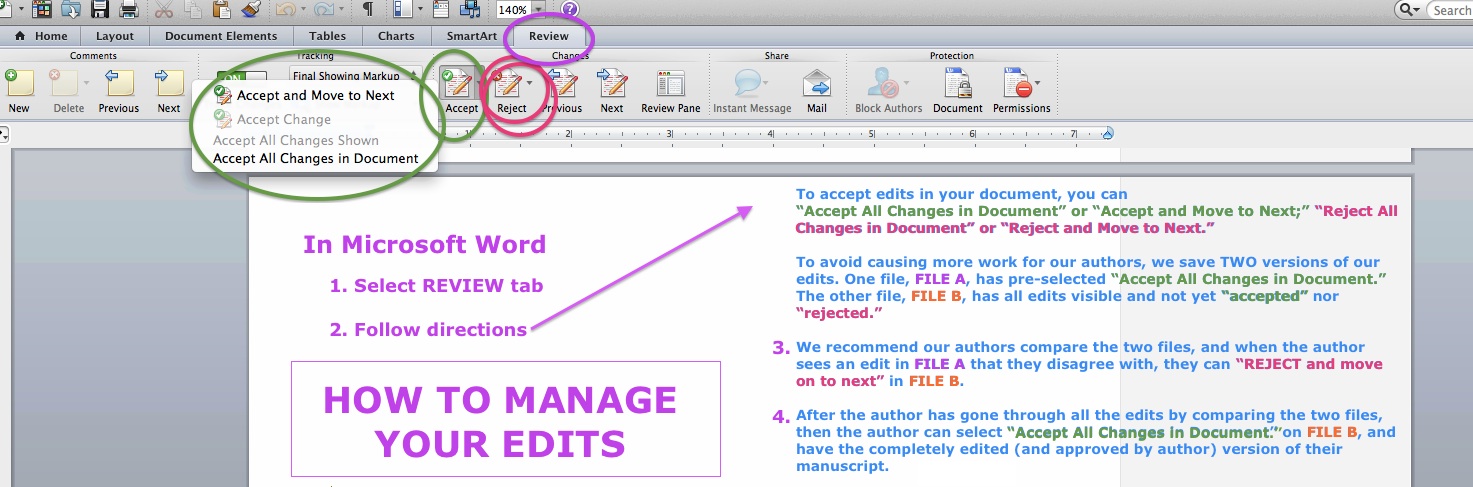
How To Manage Your Edits

“As an editor, I have heard horror stories about authors who didn’t know how to process the edits they received back from their editors. Instead of asking what to do with the Word document, [caution, you’re going to scream] some of the authors printed the full manuscript, compared item by item, then RETYPED the entire manuscript.

Don’t let this be you.

Firstly, your editor is on your TEAM. An editor wants you to succeed. And even though you may feel like we are all jackals, we don’t really bite. Ask us questions—especially when you feel overwhelmed or uncertain.”

— Billi Joy Carson / Senior Editor, Editing Addict

  EDITOR Sends Completed File Back to AUTHOR:

THE AUTHOR’S JOB:

1. READ through document

2. CHOOSE FROM (to accept and/or reject changes)

a. Accept All Changes in Document

b. Accept and Move to Next

c. Reject All Changes in Document

d. Reject and Move to Next

3. SHORTCUT for authors

a. Save TWO* versions of the file you received from your editor.

i. File A [edits accepted]

1. In Word Doc, under REVIEW tab [File A]

2. Select Accept All Changes in Document [File A]

ii. File B [edits visible]

1. Leave the file the way you received from the editor

b. Read through File A side-by-side with File B

i. If you find an edit you don’t want

1. In File B

a. Under REVIEW tab [File B]

b. Select Reject and Move to Next [File B]

ii. When you are finished reading File A, and correcting File B,

1. In File B

a. Under REVIEW tab [File B]

b. Select Accept All Changes in Document [File B]

c. File B is now fully edited, and author approved

*At Editing Addict, I do this beforehand for my authors, however, not all editors have the [File A & File B] policy, and expect the author to do it on their end. How To Manage Your Edits

How to Accept and/or Reject Tracked Changes in a Word Document: YouTube Video

Still have questions? Leave a comment below, or send  a message to the editor: billijoycarson@editingaddict.com. Teamwork brings success!

Children’s Book, Here You Come

[found on wvculture.org; by Mary Rodd Furbee]

“Consider why you want to write children’s books.
If you want to write books for children, it helps to be a little crazy. I developed a passion to write nonfiction biographies for middle-school children about four years ago. My daughter’s experiences made me realize that there were hardly any children’s books on America’s founding mothers. It hit me, hard: This was what I had to write. There was a need. The subject was fascinating. I knew I could do it, and found the prospect exciting. If you have a similar passion, perfect. If not, perhaps you are meant to do something else. It’s hard to write books, harder still to write books for children. It’s difficult to get published, and you’ll face a lot of rejection.

Don’t expect to make big money or make it quickly.
Writing books for children is like starting a business. You must invest both time and money. I hoped to make money writing my first books, but I didn’t. Four years and six published books later, I still haven’t made as much money as I could have in most professional writing or editing positions. It’s the rare children’s book that hits the bestseller list or wins a Newbery Award, and the rare full-time children’s writer who makes a living.

Read children’s books.
When I decided to write biographies of women in American history, I read biographies, histories, books about writing biographies, and lots of middle-grade fiction and nonfiction. It’s amazing what you can learn by reading the books you want to write – be they board books for infants and toddlers, picture books, early readers, middle-grade novels or young adult nonfiction. Read the best authors – over and over. If you can, take a class in children’s literature or writing for children.”

For more tips on writing children’s books from Mary Rodd Furbee, click here.

[found on http://www.wvculture.org/arts/Artworks/Fall01/childrens.html]

Poetry Styles

To see the (more) complete list, with a further seventy-four types of poetry, click here.

[found on poetryfoundation.org]

Acrostic

A poem in which the first letter of each line spells out a word, name, or phrase when read vertically. See Lewis Carroll’s “A Boat beneath a Sunny Sky.”

Alexandrine

In English, a 12-syllable iambic line adapted from French heroic verse. The last line of each stanza in Thomas Hardy’s “The Convergence of the Twain” and Percy Bysshe Shelley’s “To a Skylark” is an alexandrine.

Anagram

A word spelled out by rearranging the letters of another word; for example, “The teacher gapes at the mounds of exam pages lying before her.”

Aubade

A love poem or song welcoming or lamenting the arrival of the dawn. The form originated in medieval France. See John Donne’s “The Sun Rising” and Louise Bogan’s “Leave-Taking.” Browse more aubade poems.”

[found on http://www.poetryfoundation.org/learning/glossary-terms?category=forms-and-types]

The New Reality of Author Platforms

[found on forbes.com; by Alan Rinzler]

“It’s still about visibility, but today’s approach has changed. The New Author Platform requires a focus on developing an unobstructed back and forth between authors and their readers, with the authors — not the publishers — controlling the flow.

Now it’s the author, not a publicist, who inspires readers to buy the book. The New Author Platform allows not only well-established authors, but unknown, first-time beginners to do an end run around the conservative gate-keepers and reach readers directly.”

To find out more from Alan Rinzler about author platforms, and how to create your own, click here.

[found on http://www.forbes.com/sites/booked/2011/07/26/the-new-author-platform-what-writers-need-to-know]

Painting Poetic Pictures

[found on writing.ie; by Maggie Smith Hurt]

“Beginning to write poetry is about beginning to think about moments, stories, memories as their complete selves and then finding the right way to make those things lean, to amp up the right words to convey the tension, ambiguity and softness.

It’s a task a bit like painting a horse on a grain of rice….all the right things in the right place but the space is smaller and so the subject, all the more significant in its purest form, becomes the whole thing, the little nugget of art- the whole picture.”

For more great tips on poetry from Maggie Smith Hurt, click here.

[found on http://www.writing.ie/resources/writing-poetry-where-to-start]

Who Are You Talking About?

[found on tylerlehmann.wordpress.com; by Tyler Lehmann]

“The test of any good fiction is that you should care something for the characters; the good to succeed, the bad to fail. The trouble with most fiction is that you want them all to land in hell, together, as quickly as possible.” — Mark Twain

“A good writer knows his characters better than he does his closest friends. Oh, that sounds nuts, you say? Yep, probably.

But the reality is, no one will give a rip about your characters if you don’t make them come alive, as good ol’ Twain points out above. Humans are infinitely complex, and if your characters don’t mimic that complexity, the illusion that is reading is lost.

    1. Gender
    2. Age
    3. Ethnicity
    4. Body type
    5. Hair color and style
    6. Eyewear
    7. Facial hair
    8. Clothing style
    9. Tattoos and piercings
    10. Scars and birthmarks…”

For more tips on writing, and the complete list of traits from Tyler Lehmann, click here.

[found on http://tylerlehmann.wordpress.com/2013/01/09/80-powerful-questions-you-need-to-make-a-character-traits-for-creative-writing]

Be Passive The Writing Must Not

[found on bookcoaching.com; by Judy Cullins]

“Stop passive sentence construction.

When you write in passive voice, your writing slides along into long sentences that slow your readers down, even bore them.

Before you put your final stamp of approval on your writing, circle all the “is,” “was” and other passive verbs like: begin, start to, seems, appears, have, and could. Use your grammar check to count your passives. Aim for 2-4% only.

Instead of, ”Make sure that your name is included on all your household accounts and investments.” Passive culprits include “Make” and “is included.” Create more clarity with this revision,” Include your name on all household accounts and investments to keep your own credit alive after your divorce.”

For more tips on writing from Judy Cullins, click here.

[found on http://bookcoaching.com/wp/non-fiction-book-writing-solutions]