Be Passive The Writing Must Not

[found on bookcoaching.com; by Judy Cullins]

“Stop passive sentence construction.

When you write in passive voice, your writing slides along into long sentences that slow your readers down, even bore them.

Before you put your final stamp of approval on your writing, circle all the “is,” “was” and other passive verbs like: begin, start to, seems, appears, have, and could. Use your grammar check to count your passives. Aim for 2-4% only.

Instead of, ”Make sure that your name is included on all your household accounts and investments.” Passive culprits include “Make” and “is included.” Create more clarity with this revision,” Include your name on all household accounts and investments to keep your own credit alive after your divorce.”

For more tips on writing from Judy Cullins, click here.

[found on http://bookcoaching.com/wp/non-fiction-book-writing-solutions]

The Value of a Book

“In the end, what makes a book valuable is not the paper it’s printed on, but the thousands of hours of work by dozens of people who are dedicated to creating the best possible reading experience for you.” 

― John Green

Feel Not Alone, Dear Writer

[found on quentinschultze.com; by Quentin J. Schultze]

“Discuss Your Writing with Writers (and Authors)
Authors need one another.  Writing is personal, but learning about writing is communal.  Every author depends on the work of earlier writers.  This is true for style and content.  We all need feedback from other writers as well as from readers.  Discussing our ideas and manuscripts with other writers helps us to discover what works and what doesn’t—and why.  Join a local writers group (e.g., through a bookstore), read one another’s drafts, and offer kind but honest feedback.  If possible, invite some published (but humble) authors into the group.  Eventually, sitting at your keyboard or staring at a notebook will not seem so lonely, intimidating, and baffling.”

[found on http://quentinschultze.com/tips-1-5-for-book-writers]

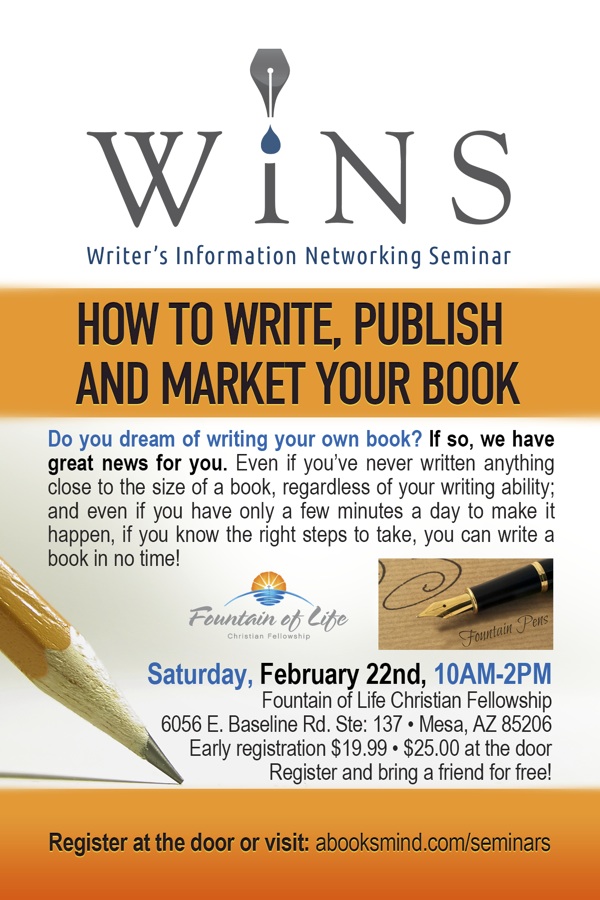
Win FREE Proofreading at WiNS Conference

Feb-22-WINS copy

Win a FREE Proofreading Prize for 20,000 words!

HOW THE CONTEST WORKS:

To enter into the contest, share both Editing Addict and A Book’s Mind on Facebook (see details below).

The winner of the contest will be the person with the MOST  registered referrals who ATTEND the WiNS Conference (minimum of nine referrals required).

PROOFREADING PRIZE can be used toward your publishing package with A Book’s Mind, or by independent editing on your own, through Editing Addict.

HOW TO ENTER:

1) Share both EDITING ADDICT and A BOOK’S MIND

a) Share Editing Addict’s Facebook Page, (remember to tag Editing Addict in the share, so you are registered in the contest).

b) Share the A Book’s Mind poster of the WiNS Conference (remember to tag A Book’s Mind, so you are registered in the contest).

2) Register YOURSELF and FRIENDS for the WiNS Conference

a) Early register yourself for the WINS conference (see poster for details)

b) Have the MOST early registered referrals who attended the WINS Conference (minimum of nine referrals required)

c) If you have already registered for the contest, let us know, and do STEP 1!

CONTEST ENDS AT THE DOOR ON FEBRUARY 22!

Strong Words Where Stand Ye?

[found on writershelper.com]

“Writing Tip #5: Use strong verbs and nouns

The verbs are the action words. They put things in motion. Make yours as strong as possible.

The verb to be (am, is, are, was, were) puddles on the floor. Eliminate it wherever possible. I spent a year in Ukraine and experienced Russian, where the verb to be exists, but almost never appears. People simply leave it out and I found the effect powerful. In English we can’t leave verbs out of our sentences, but we can make those we use work hard for us.

Nouns name the people, places, and things in our world. English has multiple words for almost everything. A male parent can be father, dad, pop, daddy, the old man, pater, progenitor, sire, begetter, conceiver, governor, abba, papa, pa, pap, pappy, pops, daddums, patriarch, paterfamilias, stepfather, foster father, and other family nicknames. Choose the noun that does the best work for you.

Short words are usually best. They have more punch. They hit the gut hard.

The paragraph above has only one word with more than one syllable.”

For more exciting tips on writing from Writer’s Helper, click here.

[found on http://www.writershelper.com/writingtips.html]

Authors on Authoring

“Never open a book with weather. If it’s only to create atmosphere, and not a charac­ter’s reaction to the weather, you don’t want to go on too long. The reader is apt to leaf ahead look­ing for people. There are exceptions. If you happen to be Barry Lopez, who has more ways than an Eskimo to describe ice and snow in his book Arctic Dreams, you can do all the weather reporting you want.”

Elmore Leonard

“You can never read your own book with the innocent anticipation that comes with that first delicious page of a new book, because you wrote the thing. You’ve been backstage. You’ve seen how the rabbits were smuggled into the hat. Therefore ask a reading friend or two to look at it before you give it to anyone in the publishing business. This friend should not be someone with whom you have a ­romantic relationship, unless you want to break up.”

Margaret Atwood 

“Do it every day. Make a habit of putting your observations into words and gradually this will become instinct. This is the most important rule of all and, naturally, I don’t follow it.”

Geoff Dyer


Writer’s Block Begone

Here are some ideas to fight writer’s block. Tell us if you have any to add!

David Alm on writer’s block:

“Writer’s block is as much a part of being a writer as banging your head against the wall in frustration when publisher’s don’t return your calls. I jest, but seriously — it doesn’t matter how successful you are or what kind of writing you do; if you’re a writer, you’ve been stuck.

Not anymore, if the makers of Write or Die have anything to say about it. The app, now available for $9.99, aims to keep you on task by threatening you with some pretty dire consequences if you stop churning out copy. Set it to “kamikaze” mode, and it will begin deleting words you’ve already written after 45 seconds of no activity.”

—David Alm / Contrary Blog

13 authors views on Writer’s Block from FlavorWire:

    • “Suggestions? Put it aside for a few days, or longer, do other things, try not to think about it. Then sit down and read it (printouts are best I find, but that’s just me) as if you’ve never seen it before. Start at the beginning. Scribble on the manuscript as you go if you see anything you want to change. And often, when you get to the end you’ll be both enthusiastic about it and know what the next few words are. And you do it all one word at a time.” – Neil Gaiman

Click to view the other 12.

Strategies for overcoming writer’s block:

“Taking notes

Jot down ideas and phrases as they occur to you. Free yourself from paragraphs and sentences for the moment–use flow charts, arrows, boxes, outlines, even pictures. Right now, you are worried about getting things down before you forget them.

Freewriting/Brainstorming

When you’re not just blocked, when you’re stonewalled, try freewriting. Sit down for ten minutes and write down everything you can think of about your topic. The object is to write without stopping for the whole ten minutes. If you can’t think of anything to say, write “blah, blah, blah” over and over. If other things occur to you as you write, go ahead and record them, even if they are not directly related to your topic. These distractions may be part of what is keeping you blocked.

Freewriting is good for uncovering ideas–it’s a good way to nudge “inspiration.” But the main purpose of freewriting is to get you moving! Most of what you write in those ten minutes will go in the recycling bin, but you’ll be warmed up and your serious writing should go more smoothly.

Brainstorming resembles freewriting but is more goal-directed. You start not only with a topic, say PROFS, but also with a goal: What do new users need to know about this system? Then allow yourself to jot down ideas for a set amount of time without censoring any possibilities and without striving for perfect prose. When the “storm” has passed, you can rearrange ideas, put thoughts into complete sentences, edit, and polish.

Piecework

Sometimes, starting at the beginning induces Perfect Draft Syndrome. It may be easier to get started if you approach the task sideways. If you’ve got a plan for the article or manual, choose a section from the middle or a point you know well and start there. Then do another section. After you’ve gained some confidence, you can work on the opening and smooth out the transitions.

What I Really Mean Is (WIRMI)

When you’re stuck in a quagmire trying to find the perfect phrase, switch to What I Really Mean Is and just say it the way you think it. Once you know what you mean, it is easier to refine the phrasing.

Satisficing (satisfy + suffice)

You “satisfice” when you take the first reasonable solution instead of searching endlessly for just the right word or sentence. If you’re unhappy with the choice, you can bracket it and promise yourself you’ll fix it later.”

—Writer’s Tips from css.illinois.edu

Query Letter Help

[found on maxbarry.com; by Max Barry]

“The Query Letter

The idea of a query letter is to take this book you’ve written, this incomparable masterpiece that took five years and destroyed your marriage, and summarize it on a single piece of paper while still leaving enough room in the margins for a publisher or agent to scribble, “Sorry, not for us.” You have to try to pitch your book in such an intriguing way that the publisher immediately writes back to you, demanding to see sample chapters (or the entire manuscript). This may sound tough to do, but in truth it’s even harder. Your query needs to stand out from the other 80 the editor is going to read that day, but avoid amateurish gimmicks, like $50 bills.

There are plenty of good web sites on how to write a query letter and approach agents/editors. Some of them are:

One thing you must do is say what sort of book you’ve written. This is what agents/editors will be scanning for when they read your letter: is it a thriller, a comedy, a rural human drama? Most writers, including me, find this very difficult to do, and tend to produce descriptions like, “It’s kind of a futuristic science-fiction comedy-come-romance set in Medieval France with a strong anti-war message.” This is why authors should be banned from describing their own novels.

So I suggest enlisting help: have your friends read your book and ask them what novels they think it’s similar to. Then at least you’ll have a rough genre to start from. Also, for practice, try to describe your book in a single, short sentence. Ask people if it sounds interesting, and rework it until it does.

This is very much personal opinion, but I think a good description often combines something common (“It’s a detective story”) with something original (“where the PI has a terminal illness”). The common part grounds the story, letting us know what ballpark it’s in. The original part shows it’s something special.

Update (May-07): If you’re interested, I’ve posted my old query letter, which I sent out while agent-hunting in 1998. It’s kinda cringe-worthy reading it now, definitely over the top, but since it worked…”

For more great info from MaxBarry, click here.

[found on http://maxbarry.com/writing/help.html]

Write With Passion

[found on fuelyourwriting.com; by Kim Phillips]

“Passion in writing becomes even more important in print or online, where the reader can’t be influenced by your tone, eye contact, or body language.

Michael Stelzner, who writes for the online magazine Social Media Examiner, is flat-out crazy about social media.  It’s not just his business; he’s in love with it, and it shows.  Contrast the corporate blog of Michael Hyatt, CEO of Thomas Nelson Publishers, with that of Bill Marriott of the eponymous hotel chain and decide who loves his job more.

Some tips for writing with passion…

Write about something you understand. It’s not likely you’re going to have strong feelings about something you’re not familiar with.

Know who you’re writing for. This should always be the case, but it will be helpful if you know what you have in common with the reader.  If you’re a 55-year-old man writing for mommies about toys, you’re going to have to think about what experiences you share.

Don’t load up your writing with facts and stats. Unless you’re writing a blog for engineers, most people would rather know the meaning of the data and how it can help them.  If you’re writing about homelessness, describe one homeless family’s experience and leave out the chart.

Find your indignation. There’s nothing like a little righteous anger to get the juices flowing.

Tell a story. Relate not only what happened, but how you felt about it.  Be vulnerable:  people will consider it brave, and they will come with you.

Admit that you don’t have a clue. That happens so rarely that the reader will be intrigued.

Be yourself. You have a unique point of view and a voice that is not exactly like anyone else; that’s interesting.  Are you edgy?  Self-deprecating?  Thoughtful?  Irreverently funny?  The local curmudgeon?  Then be that.

If you want to engage people, get them on your side.  If you don’t care, why should they?”

For more tips on writing from FuelYourWriting, click here.

[found on http://www.fuelyourwriting.com/writers-embrace-your-passion]