How To Write A Travel Guide

[found on writersworkshop.co.uk; by Robin Lloyd-Jones]
  • Do your research – pre-travel research enriches the whole experience; post-travel research adds depth and accuracy to what you write. While travelling keep notes or you will forget; and take photographs to illustrate your words.
  • Be curious – about everything and everybody. What makes many travel books enjoyable is the people encountered along the way. Talk to everyone and never stop asking questions. Listen with a sympathetic ear. Look behind the glossy façade, delve beneath the surface.
  • Have a sense of wonder – Colours seemed so much brighter when we were children. Try to see the world with that same freshness of vision.
  • Use all your senses – sight, sound, smell, taste and touch. Develop a feeling for the culture and history of a place. And a sense of humour allied to keen observation can make the most ordinary of experiences entertaining.
  • Don’t neglect your inner journey – Many of the most successful travel books are as much about the emotional journey the author makes as they are about the physical journey. The resolution of a personal issue or a change in attitude adds interest and brings the reader closer to the author.
  • Write with passion – To fully engage the reader (or indeed, a literary agent) your book must have something in it that you care about strongly –  an issue, a cause, the pursuit of a lifelong ambition. Without this your writing is in danger of seeming flat.
  • Be an open door, be receptive –  Travel with open eyes, ears, mind and heart.

For more tips on writing from Robin Lloyd-Jones, click here.

[found on http://www.writersworkshop.co.uk/Travel.html]

How To Manage Your Edits

“As an editor, I have heard horror stories about authors who didn’t know how to process the edits they received back from their editors. Instead of asking what to do with the Word document, [caution, you’re going to scream] some of the authors printed the full manuscript, compared item by item, then RETYPED the entire manuscript.

Don’t let this be you.

Firstly, your editor is on your TEAM. An editor wants you to succeed. And even though you may feel like we are all jackals, we don’t really bite. Ask us questions—especially when you feel overwhelmed or uncertain.”

— Billi Joy Carson / Senior Editor, Editing Addict

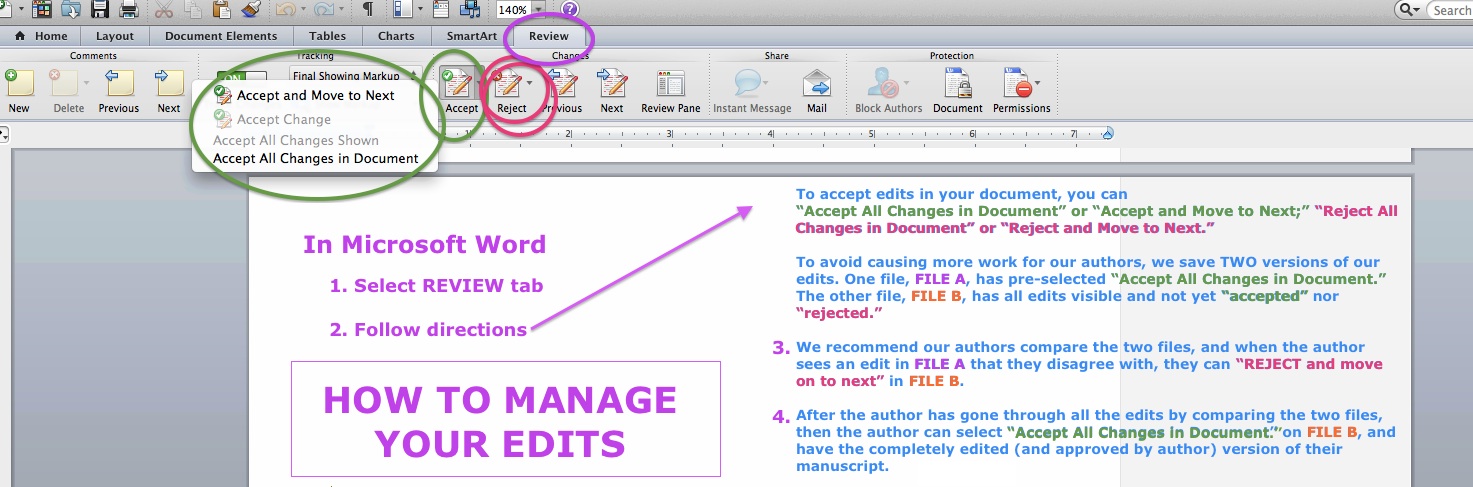
  EDITOR Sends Completed File Back to AUTHOR:

THE AUTHOR’S JOB:

1. READ through document

2. CHOOSE FROM (to accept and/or reject changes)

a. Accept All Changes in Document

b. Accept and Move to Next

c. Reject All Changes in Document

d. Reject and Move to Next

3. SHORTCUT for authors

a. Save TWO* versions of the file you received from your editor.

i. File A [edits accepted]

1. In Word Doc, under REVIEW tab [File A]

2. Select Accept All Changes in Document [File A]

ii. File B [edits visible]

1. Leave the file the way you received from the editor

b. Read through File A side-by-side with File B

i. If you find an edit you don’t want

1. In File B

a. Under REVIEW tab [File B]

b. Select Reject and Move to Next [File B]

ii. When you are finished reading File A, and correcting File B,

1. In File B

a. Under REVIEW tab [File B]

b. Select Accept All Changes in Document [File B]

c. File B is now fully edited, and author approved

*At Editing Addict, I do this beforehand for my authors, however, not all editors have the [File A & File B] policy, and expect the author to do it on their end. How To Manage Your Edits

How to Accept and/or Reject Tracked Changes in a Word Document: YouTube Video

Still have questions? Leave a comment below, or send  a message to the editor: billijoycarson@editingaddict.com. Teamwork brings success!

Featured Writing Addict: David Rich

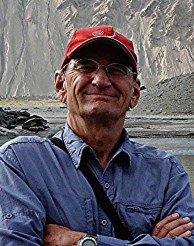
David Rich

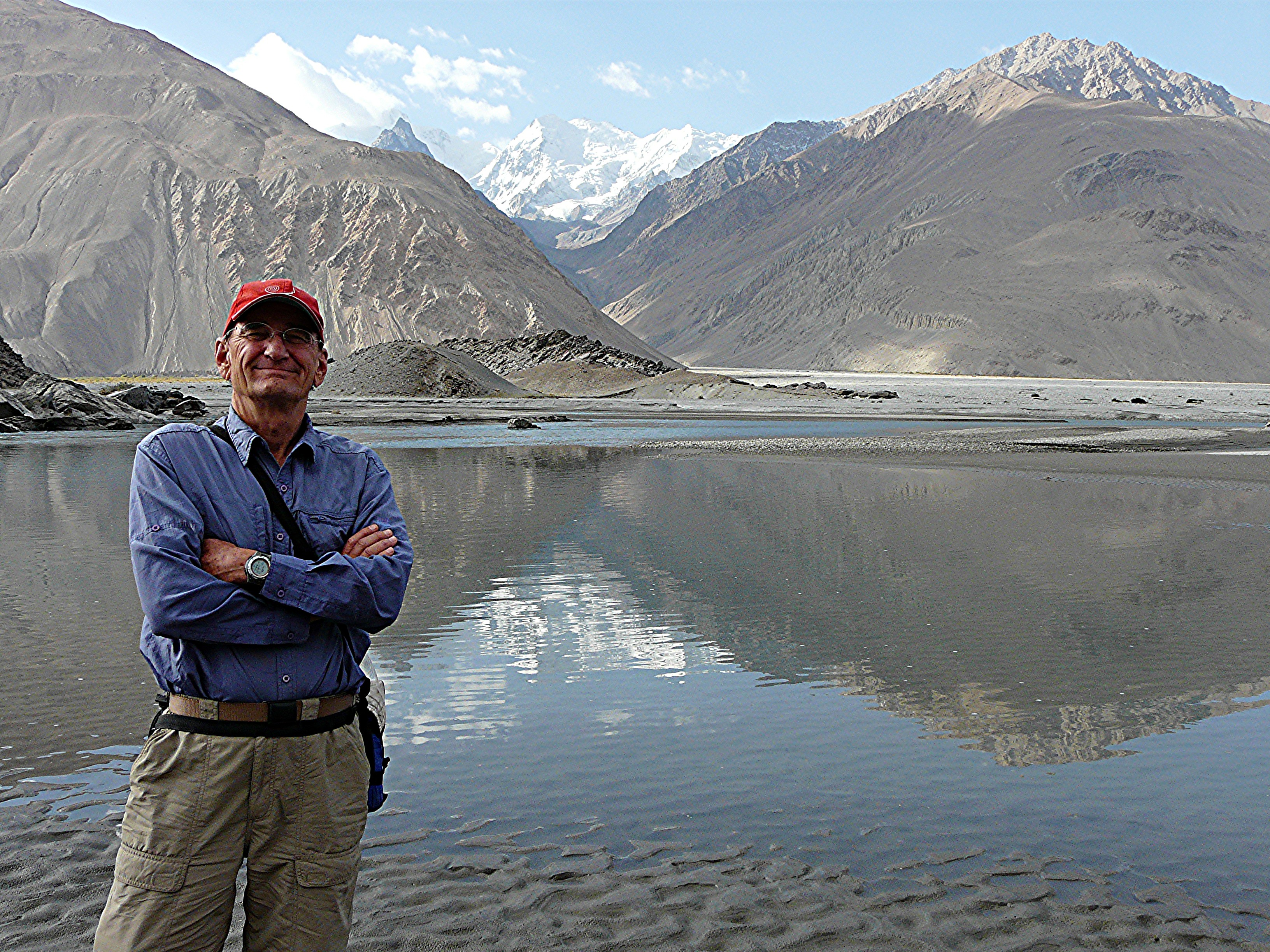
David Rich is a most intrepid writer—braving blizzards, monsoons, desert heat, and State Department travel advisories—to visit the world’s most out-of-the-way places, primarily by RV, from the Karakoram Mountains in Pakistan to the wilds of Borneo.

David retired in his forties to become a full-time international traveler, an occupation he found preferable to former professions of law professor and trial lawyer with the Arizona Attorney General’s Office (from which he says he’s now mostly recovered). He pursued freelance travel writing and exotic full-time international travel for eighteen years, living in almost every country on the planet. Until buying a home near Deer Valley Airport, AZ in 2009 (where he later obtained his private pilot’s license in 2011), he and his wife Mary had sold everything and were classically homeless.

Travel highlights include: climbing Kilimanjaro in Tanzania and Roraima Tepui—where Brazil, Guyana and Venezuela intersect; the Annapurna and Everest Base Camp treks in Nepal; the Karakorum’s in NW Pakistan, hosting six of the world’s 14 highest peaks; the exotic Stans (particularly Tajikistan and Uzbekistan); Mali and Ethiopia; the national parks of Patagonia, and Petra in Jordan. The highlights comprise hundreds of incredible sights and far-reaching adventures, including a minor hostage situation in Serbia.

David and Mary RVed Europe, Scandinavia, Northern Africa, and the Middle East for three years; they RVed Australia for over a year, New Zealand during two visits totaling a year, and South America for two years. Along with the extensive RV and other independent travel throughout Africa and Asia, they interspersed sailing trips all over the globe from Malaysia, Thailand, and the Philippines to Venezuela, Panama and Columbia.

What’s David’s Genre?

Travel, philosophy, economics, government, religion, and ethics

What’s  David’s Passion For Writing?

“An addiction to travel has taken me around the world many times. I inherited the passion from my parents, who traveled every available moment. My travels have ranged from sailboats and Cessnas to RVs and backpacks—all over the world. We understand that you can’t know a place, country, people, or culture until you go experience them firsthand. My curiosity and thirst for knowledge of other places, peoples, and cultures have—with a few exceptions—found me living in every country on the planet. I love to travel, a passion reflected in my books, stories, and photos. I also write books on philosophy, specifically economics, government, ethics, and religion and have two works in process for completion by the end of 2014.”

What are David’s books about?

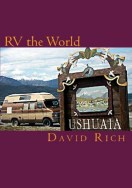
RV the World

“Traveling the world by RV is the least expensive, most interesting and convenient means to see the world in its entirety, up close and cosy. Anyone can do it. RV the World explains how, and takes the reader on a three-year RV trip through Europe, North Africa, Scandinavia, and the Middle East.”

Amazon.com Book Description:

“The easiest, most comfortable, safest and least expensive way to see the entire world is by RV, which the author has done on every continent save Antarctica. When people learn the author and his wife have traveled the world continuously for 18 years, living in 147 countries, everyone is curious. The questions are always the same: Does it cost a lot to travel full time all over the world? How much? How are you able to navigate all those foreign countries? What’s the best way to do it? Then comes, I wish I could do that, to which the author always says, Anyone can do it if they really want to. It’s easy and inexpensive.

The book answers all these questions and takes the reader on a tour of Europe, Scandinavia, North Africa and the Middle East, further answering where to go, what to do and exactly how to do it. The sights include all the Seven Wonders and much more, from fantastic cities, national parks, sprawling antiquities and incredible mountains to exotic shopping, fine dining and pristine beaches. Here’s how to ship your own RV all over the world or go wherever you’d like and buy an RV there, obtain insurance, deal with foreign languages, the requirements of the proper RV and how to sell it locally before moving onto the next continent. Full-time international travel is easy when you know how to deal with the necessary details from mail, inoculations, documents, weather, costs, airfare, investments and healthcare.

 
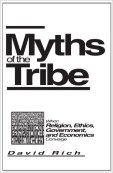
Myths of the Tribe

“The relationships among government, economics, ethics, and religion are explored in Myths of the Tribe: When Religion, Ethics, Government and Economics Converge. The relationships are many, recognition of which, would improve the efficacy of all four.”

Amazon.com Book Description:

“David Rich examines the pervasive influence of organized religion on three vital areas of human behavior — ethics, government, and economics — and argues that the belief systems of all major religions have become a detriment to clear thinking, rational conduct, and wise public policy.

Despite the fact that modern society is an outgrowth of the Enlightenment, most of our “tribe” continues to operate on the basis of assumptions and attitudes that have their origin in ancient myths. These myths, still propagated by organized religion, not only hamper efforts to apply reason to our problems, but they can foster violent conflicts that threaten global security, as witnessed today in the former Yugoslavia, the Middle East, Northern Ireland, and many regions of Africa and Asia.”
_____________________________________________
  

To reach David Rich, buy his books, or schedule a book-signing event:

Tell him you heard about him on editingaddict.com!

Game of Thrones Writing Tips

[found on lifehacker.com.au; by ]

“Choose your point-of-view characters to broaden the narrative’s scope

My story is essentially about a world at war. It begins very small with everybody apart from Daenerys in the castle of Winterfell. It’s a very tight focus, and then as the characters split apart, each character encounters more people and additional POVs come into focus.

It’s like if you were trying to do World War 2 as a novel: do you just take one average GI? Well that would only cover the European theatre, not the Pacific. Do you make Hitler a point-of-view character to show the other side? What about the Japanese or Italy? Roosevelt, Mussolini, Eisenhower — all these characters have a unique viewpoint that presents something huge in Word War 2.

So you either need an omnificent viewpoint structure where you’re telling it from the point of view of God, which is a pretty outdated literary technique, or you have a mosaic of people who are seeing one small part of the story and through that you get the entire picture. That’s the path I chose to take.

It’s okay to “borrow” from history

Although my story is fantasy, it is strongly grounded in actual Medieval history. The War of the Roses was one of the major influences, which had the Yorks and the Lancasters instead of the Starks and the Lannisters. But I like to mix and match and move things around. As the famous saying goes; stealing from one source is plagiarism but stealing from lots of sources is research!”

For more tips from Chris Jager on writing, click here.

[found on http://www.lifehacker.com.au/2013/11/ten-tips-on-writing-a-fantasy-saga-from-game-of-thrones-author-george-r-r-martin]

Keep Your Story Fresh, Or Be Lost

[found on matthewdunnbooks.com; by Matthew Dunn]

“Make Sure Your Story is Fresh in 5 Years Time.

If you choose to set your story at a point in history, then your book won’t age for obvious reasons. But, most thriller readers like their stories to be contemporary which on the one hand is great for writers because it doesn’t mean we have to do painful extra research on e.g. what clothes a man would have worn in 1934.

On the other hand, there are pitfalls. Your book can take over a year to be written and edited, many years to get an agent and a publishing deal, and another year or two to become a finished published novel. Want to write a spy novel featuring the rogue state of Iran? If so, you need to be confident that Iran is still a rogue state in at least 5 years’ time.

The Western world applauded the collapse of communism but I guarantee you there were a large number of spy writers who tore up their draft manuscripts in disgust when the USSR fragmented, because their stories were supposed to be contemporary yet featured the Cold War and the Soviet Union.”

For more tips on writing from Matthew Dunn, click here.

[found on http://www.matthewdunnbooks.com/writing-a-thriller-novel-10-tips]

Dialogue Your Characters

[found on theguardian.com]

“It’s never too soon to start thinking about what your characters will say and how they’ll say it. Giving each of your characters a distinct voice is key to writing great fiction.

The goal of Worksheet 9 is to encourage you to think about your characters’ individual speech patterns and specific word choices. Your characters will probably reveal these distinctions as your story progresses, but thinking about it early will make you more receptive to such revelations.

For each of your major characters, record information about individual speech patterns and any catchphrases they may use.

With this information in place on a dialogue sheet, you’ll know exactly what a given character will say and how he/she will say it. You can also use this worksheet during the final edit and polish of the manuscript to double-check speech patterns.”

[found on http://www.theguardian.com/books/2012/oct/19/researching-your-novel]

Want a Great Book?

[found on helpingwritersbecomeauthors.com; by K.M. Weiland]

“Twenty-five ways to write an awesome book:

1. Hook readers with a strong first chapter that doesn’t waste time.

2. Create a sympathetic and/or entertaining character.

3. Give the character a strong goal.

4. Obstruct the character’s goal with equally strong opposition.

5. Create a theme that arises from the character’s inner conflict.

6. Craft a strong plot with proper structure.

7. Do your research and get your facts straight.

8. Expunge unnecessary scenes, settings, and characters.

9. Balance action and character with properly structured scene/sequel pairings.

10. Write realistic, entertaining dialogue.

11. Maintain a consistent POV.

12. Create original and entertaining voices for narrating characters.

13. Tighten descriptions with more strong verbs and nouns and fewer modifiers.

14. Show more than you tell.

15. Dig deep for original ideas and turns of phrase.

16. Properly foreshadow your climax—without giving away any big reveals.

17. Build realistic and engaging settings.

18. Add only meaningful subplots.

19. When you build tension—always fulfill it.

20. Create a dynamic arc of growth for your character.

21. Add interesting minor characters who can power the plot forward.

22. Choose the right tone to enhance your plot and theme.

23. Rock readers with a climax that fulfills all their desires for the story.

24. Don’t tie off all the loose ends in your story’s ending.

25. Proofread, proofread, proofread.”

For more excellent tips from K.M. Weiland, click here.

[found on http://www.helpingwritersbecomeauthors.com/2013/11/top-25-ways-write-awesome-book.html]

Book Your Research

[found on dailyfinance.com; by J.T. Ellison]

“If you’re planning to embark on a career as a writer, there’s something you need to know: When it comes to research, you’ll be paying your own way. Authors are faced with many economic challenges, but one of the hardest is that they often have to use their own cash to get the wheels spinning.

  • Go to the library: This is an obvious solution, but one that we sometimes overlook, especially since we can go online and find the answers we need. But a good library, and librarian, can help you find little details you would have missed otherwise. I like to read old newspapers to get a sense of what’s happening in my character’s past, and microfiche is the best way to do that. Plus, libraries often have experts in for talks.
  • Meet your fellow writers: Almost every professional writer’s association has an online listserve full of scribes who are experts in their own fields. I can’t tell you how many times I’ve reached out to a doctor, a lawyer, a weapons expert or former police officer through these groups. And almost all the organizations accept associate members. International Thriller Writers, Romance Writers of America, Mystery Writers of America and Sisters in Crime are all excellent groups that even have “writer’s universities,” in which they offer classes on writing and various research methods. Best of all, you get to rub elbows with your favorite writers!
  • Go online. . .but be careful: You can find out anything online, but be sure you double- and triple-source your information. Just because it’s on Wikipedia doesn’t mean it’s accurate. When I started doing research on Scotland, the first thing I did was add Scotland’s major newspapers to my RSS feeds. It allowed me a snapshot of the country, and the political undercurrents soon made their way into my story. You can become an expert pretty quickly by putting in the effort.
  • Go back to school: Through a writer’s organization or your own diligence, you can find tons of online classes that are relatively inexpensive and will give you a fuller understanding of your topic. From writing to guns to romance, anything and everything is offered.
  • Talk to the experts: Regardless of what you’re writing about, there’s nothing better than finding someone who’s lived it. Weapons experts, cops, FBI agents, SWAT team members, doctors and lawyers all have one thing in common: They want you to get it right. Just don’t forget to say thank you in the acknowledgments.
  • Reach out to readers: Blogs are a great way to get information, with the caveat that you need to double-source, just like with Wikipedia and Google. Most blogs are subjective, so you can’t use them as gospel. While you’re getting to know private experts, don’t forget to talk to people at your local bookstore. Most folks who work in bookstores do so because they love to read. Which means they’ll be a font of information for you to mine. Check your local independent bookstores as well as the chains to find people who are fascinated by your topic and can point you to the best books to use for research.
  • Explore local resources: There are innumerable ways to do research in person in your city. Big and small towns have access to the FBI Citizens’ Academy, your local Citizens’ Police Academy and multitudes of other offerings. Don’t forget to attend author signings as well — your favorite author might have a tip or two for you to find the perfect research tool.
  • Meet some strangers. . .and some old friends: Even though many groups have moved online, there are still plenty who meet and mingle in person. The members tell stories. Lots of stories. They have professional speakers. They have archives. And they want to share this information with you. For that matter, don’t discount the ones around you when you’re looking to do research. I always check with my parents when I have a question. Send up a flare within your intimate circle, and see who knows what. This is especially good for places, because if you’re anything like me, your friends and family live or have traveled all over the world.”

To read more tips from DailyFinance, click here.

[found on http://www.dailyfinance.com/2011/01/17/eight-ways-to-do-book-research-without-breaking-the-bank]

Learning To Write

[found on nicholassparks.com]

On Learning The Craft of Writing:

“Research

First, there are entire books written on this subject, and it’s important to realize that any information provided here will be in greatly abbreviated form. With that in mind, the first step would be to read a variety of books on the craft of writing. On Writing by Stephen King, The Elements of Style by William Strunk and E.B. White, Creating Fiction edited by Julie Checkoway, and A Dangerous Profession by Frederick Busch, are but a few that I would recommend.  I also like Screenplay by Sid Field, which isn’t about novel writing, but has a lot of useful information. These titles are enough to get you started and there are countless other books on the topic that will help as well, for everything from creating characters to coming up with plots.

Read

Second, you must read, and read a lot. Did I say A LOT? I read over a hundred books a year and have done so since I was fifteen years old, and every book I’ve read has taught me something. I’ve learned that some authors are incredible at building suspense (see The Firm by John Grisham), I’ve read others that scare the jeepers out of me (see The Shining by Stephen King). Some authors can weave an incredible number of story lines into a single, coherent novel, with all parts coming together at the end that makes it impossible to stop turning the pages (see The Sum of all Fears by Tom Clancy), while other authors make me laugh out loud (seeBloodsucking Fiends by Christopher Moore). I’ve also learned that many, many authors fail when attempting to do these things. By reading a lot of novels in a variety of genres, and asking questions, it’s possible to learn how things are done—the mechanics of writing, so to speak—and which genres and authors excel in various areas.

Next, focus in on the genre you want to write, and read books in that genre. A LOT of books by a variety of authors. And read with questions in your mind. In a thriller, for instance, you might ask: how many characters were there? Too many or too few? How long was the novel? How many chapters were there? Was that too few, too many or just right? How did the author build suspense? Did the author come out of nowhere with a surprise? Or did the author drop hints earlier? If so, how many hints? Where in the novel did he put them? Was the suspenseful scene primarily narrative or dialogue? Or a combination of both? Did that work? Would it have been better another way? Where did the bad guys come in? In the beginning? The middle? When did they first meet the good guy? What happened? Did the reader know they were bad? Did they do something bad right off, or was it something that seemed good at the time?

Then, read another thriller and ask yourself those questions again. Then read another and another and another and ask those same questions. And keep reading your entire life and asking questions.

Little by little, you’ll learn the process.

Write

The final step is to write. You can’t be a writer if you don’t write, it’s just that simple. I wrote two complete novels and another book before I even attempted to write The Notebook. Those two novels are unpublished, but they taught me that I not only liked to write, but that I had it in me to finish a novel once I’d started it. Those lessons were important when I sat down to write The Notebook.

I write five or six days a week, usually a minimum of 2000 words, sometimes more. This section of the website, for instance, which took about four days to write, is about 20,000 words. When it’s finished, I’ll start writing something else. All people who regard writing as a profession write consistently. Those who regard it as a hobby usually don’t.

2000 words can take anywhere from three to eight hours. (I love those three-hour days, by the way, but my average is probably closer to five hours.) The actual time spent writing depends on a number of factors, including what I’m writing, whether the scene is difficult or easy, etc. No matter what, I try to maintain consistency in my work habits. And I’m always trying to improve, to try new things, to write a new story that is better than anything else I’ve written.”

To read more from Nicholas Sparks (including how to write query letters, and how to find agents, click HERE.

[found on http://nicholassparks.com/for-writers]