Enter, and Resolve Thyself

[found on iuniverse.com]
“Introduce your main characters and themes in the first third of your novel. If you are writing a plot-driven genre novel make sure all your major themes/plot elements are introduced in the first third, which you can call the introduction. Develop your themes and characters in your second third, the development. Resolve your themes, mysteries and so on in the final third, the resolution.”
— Michael Moorcock

To see the rest of the tips from iUniverse, click here.

[found on http://www.iuniverse.com/ExpertAdvice/20WritingTipsfrom12FictionAuthors.aspx]

Win FREE Proofreading at WiNS Conference

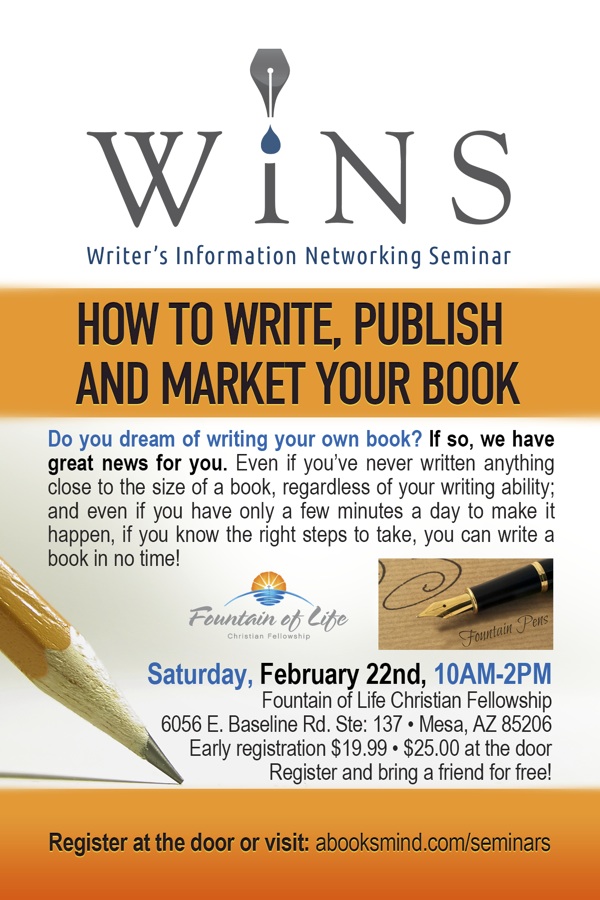
Feb-22-WINS copy

Win a FREE Proofreading Prize for 20,000 words!

HOW THE CONTEST WORKS:

To enter into the contest, share both Editing Addict and A Book’s Mind on Facebook (see details below).

The winner of the contest will be the person with the MOST  registered referrals who ATTEND the WiNS Conference (minimum of nine referrals required).

PROOFREADING PRIZE can be used toward your publishing package with A Book’s Mind, or by independent editing on your own, through Editing Addict.

HOW TO ENTER:

1) Share both EDITING ADDICT and A BOOK’S MIND

a) Share Editing Addict’s Facebook Page, (remember to tag Editing Addict in the share, so you are registered in the contest).

b) Share the A Book’s Mind poster of the WiNS Conference (remember to tag A Book’s Mind, so you are registered in the contest).

2) Register YOURSELF and FRIENDS for the WiNS Conference

a) Early register yourself for the WINS conference (see poster for details)

b) Have the MOST early registered referrals who attended the WINS Conference (minimum of nine referrals required)

c) If you have already registered for the contest, let us know, and do STEP 1!

CONTEST ENDS AT THE DOOR ON FEBRUARY 22!

Rehearse Your Writing

[found on dailywritingtips.com; by Mark Nichol]

“Rehearse your writing by explaining the feel of a room, a street, or a park. Is it expansive, or economical? Friendly, or foreboding? Clean, or chaotic? What do your other senses tell you? What is the noise level? How does it smell? What are the textures like? Is it easy to walk through or along, or to otherwise navigate, or do obstacles interfere?

If your story takes place in a natural landscape, describe the terrain and what associations it has based on whether it conjures a sense of grace, harmony, and peace or whether it is full of bleak, harsh, jagged features. How does the presence of vegetation, or bodies of water, contribute to the feel of the terrain? What effect does the weather produce?

Place your characters in the context of their locations by showing, without telling, whether they are at home in their setting or whether the environment is alien to them, and how they respond to their feelings.”

For more great tips from Mark Nichol, click here.

[found on http://www.dailywritingtips.com/physical-descriptions-put-readers-in-your-place]

Prompt Your Way

[found on writingforward.com; by Melissa Donovan]

“Creative Writing Prompts

  1. You’re digging in your garden and find a fist-sized nugget of gold.
  2. Write about something ugly–war, fear, hate, or cruelty–but find the beauty (silver lining) in it.
  3. The asteroid was hurtling straight for Earth…
  4. A kid comes out of the bathroom with toilet paper dangling from his or her waistband.
  5. Write about your early memories of faith, religion, or spirituality; yours or someone else’s.
  6. There’s a guy sitting on a park bench reading a newspaper…
  7. Write a poem about a first romantic (dare I say: sexual) experience or encounter.
  8. He turned the key in the lock and opened the door. To his horror, he saw…
  9. Silvery flakes drifted down, glittering in the bright light of the harvest moon. The blackbird swooped down…
  10. The detective saw his opportunity. He grabbed the waitress’s arm and said…”
[found on http://www.writingforward.com/writing-prompts/creative-writing-prompts/25-creative-writing-prompts]

Strong Words Where Stand Ye?

[found on writershelper.com]

“Writing Tip #5: Use strong verbs and nouns

The verbs are the action words. They put things in motion. Make yours as strong as possible.

The verb to be (am, is, are, was, were) puddles on the floor. Eliminate it wherever possible. I spent a year in Ukraine and experienced Russian, where the verb to be exists, but almost never appears. People simply leave it out and I found the effect powerful. In English we can’t leave verbs out of our sentences, but we can make those we use work hard for us.

Nouns name the people, places, and things in our world. English has multiple words for almost everything. A male parent can be father, dad, pop, daddy, the old man, pater, progenitor, sire, begetter, conceiver, governor, abba, papa, pa, pap, pappy, pops, daddums, patriarch, paterfamilias, stepfather, foster father, and other family nicknames. Choose the noun that does the best work for you.

Short words are usually best. They have more punch. They hit the gut hard.

The paragraph above has only one word with more than one syllable.”

For more exciting tips on writing from Writer’s Helper, click here.

[found on http://www.writershelper.com/writingtips.html]

Which or That?

[found on writetothepoint.com; by Gary Kinder]

“The difference between “that” and “which” might be the most confounding piece of grammar in the English language, but it doesn’t have to be. Here’s what you need to know: Grammarians call the words following a “that” or a “which” a “relative clause.” That relative clause either “restricts” (I like the word “distinguishes” better, but grammar texts have long called the word “that” “restrictive”) what it modifies, or it “does not restrict” what it modifies. The writer tells us which it is by the word he chooses to introduce the clause.

“That” at the beginning restricts; it means that the writer wants the relative clause to distinguish one thing from a universe of like things. “Which” at the beginning means the writer addresses only one thing, and he simply wants to add information.”

[found on http://writetothepoint.com]

Killing Your Characters

[found on writersrelief.com; by Writers Relief Staff]

“If you’re considering killing off your main character, keep the following tips in mind:

  1. Be somewhat realistic. It may be hard to swallow if your main character survives what no one should be able to. When a jumbo jet crashes in the desert but your hero, Jack, walks away unscathed thanks to his skill with a nail file and a soda can, you can practically hear your readers groan.
  2. Plot problems. Don’t kill the protagonist if you are having problems with the storyline and simply don’t know what to do next: The heroine finds herself between an enraged grizzly and a cliff—if you can’t figure out a plausible way to extricate her, this shouldn’t be the only reason to kill her off.
  3. Beware morality statements. Perhaps your main character’s death is a natural consequence of his fatal flaw. He is a functioning alcoholic and sometimes drinks and drives. Be very careful not to make this into a morality statement by waving it over your readers’ heads: This is what happens to drunk drivers! You want the story to be powerful, not your personal statement on drunk driving.
  4. Don’t kill the MC off in a trivial or anticlimactic way. In other words, unless it’s tied to the theme or plot in some significant way, Hattie Heroine should not die from an infected paper cut. If we’ve invested in her character, we need some tension building up to her death.
  5. Avoid resurrections. Please don’t be tempted to miraculously bring a main character back to life unless it’s an integral part of your plot or theme (like a medical thriller centered around a miraculous new drug that reverses death). What? It was actually Hattie Heroine’s twin sister who died of infection? Like an ending where the MC wakes up and realizes everything was just a dream, a miraculous resurrection can be a little cheesy—or an easy out.”
[found on http://writersrelief.com/blog/2013/11/main-characters-how-to-kill-your-protagonist-without-killing-your-fanbase]