Tag: writers

How To Manage Your Edits
“As an editor, I have heard horror stories about authors who didn’t know how to process the edits they received back from their editors. Instead of asking what to do with the Word document, [caution, you’re going to scream] some of the authors printed the full manuscript, compared item by item, then RETYPED the entire manuscript.
Don’t let this be you.
Firstly, your editor is on your TEAM. An editor wants you to succeed. And even though you may feel like we are all jackals, we don’t really bite. Ask us questions—especially when you feel overwhelmed or uncertain.”
— Billi Joy Carson / Senior Editor, Editing AddictEDITOR Sends Completed File Back to AUTHOR:
THE AUTHOR’S JOB:
1. READ through document
2. CHOOSE FROM (to accept and/or reject changes)
a. Accept All Changes in Document
b. Accept and Move to Next
c. Reject All Changes in Document
d. Reject and Move to Next
3. SHORTCUT for authors
a. Save TWO* versions of the file you received from your editor.
i. File A [edits accepted]
1. In Word Doc, under REVIEW tab [File A]
2. Select Accept All Changes in Document [File A]
ii. File B [edits visible]
1. Leave the file the way you received from the editor
b. Read through File A side-by-side with File B
i. If you find an edit you don’t want
1. In File B
a. Under REVIEW tab [File B]
b. Select Reject and Move to Next [File B]
ii. When you are finished reading File A, and correcting File B,
1. In File B
a. Under REVIEW tab [File B]
b. Select Accept All Changes in Document [File B]
c. File B is now fully edited, and author approved
*At Editing Addict, I do this beforehand for my authors, however, not all editors have the [File A & File B] policy, and expect the author to do it on their end. 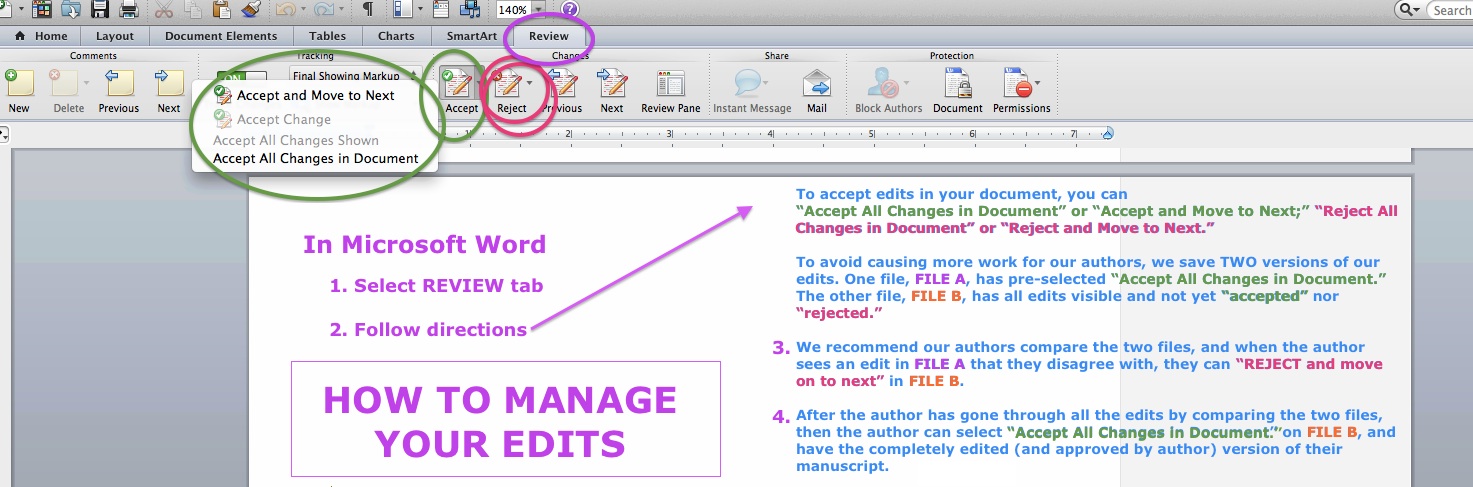
How to Accept and/or Reject Tracked Changes in a Word Document: YouTube Video
Still have questions? Leave a comment below, or send a message to the editor: billijoycarson@editingaddict.com. Teamwork brings success!
Share this:

Jealous, Your Writing Is
“Authors always carry a means for scribbling and an excuse for pausing, often inopportunely, to record those fleeting sparks of creative fancy that might otherwise vanish like a wisp in the wind if ignored. Writing is a jealous and needy lover.”
― Richelle E. Goodrich
Share this:
Fantasy? Nah, My Neighborhood
[found on terribleminds.com; by Chuck Wendig]
“ROOTED IN THE REAL
Reality is fantasy’s best friend. We, the audience, and you, the writer, all live in reality. The problems we understand are real problems. Genuine conflicts. True drama. The drama of families, of lost loves, of financial woes. Cruel neighbors and callow bullies and loved ones dead.
This is the nature of write what you know, and the fantasy writer’s version of that is, write what’s real. Which sounds like very bad advice, because last time I checked, none of us were plagued by dragons or sentient fungal cities or old gods come back to haunt us. But that’s not the point — the point is, you use the fantasy to highlight the reality.
The dragon is the callow bully. The lease on your fungal apartment is up and your financial woes puts you in tithe to the old gods who in turn make for very bad neighbors. You grab the core essence of a true problem and swaddle it in the mad glittery ribbons of fantasy — and therein you find glorious new permutations of conflict. Reality expressed in mind-boggling ways. Reach for fantasy. Find the reality.”
For more tips on writing fantasy from Chuck Wendig, click here.
[found on http://terribleminds.com/ramble/2012/06/19/25-things-you-should-know-about-writing-fantasyzzz]
Share this:
Authors Must Write
“The pen to a writer is like a cigarette to a smoker; they need it to take the edge off.”
― Kellie Elmore
Share this:
Learn You Must
“Not all marketing people are writers, but all writers must learn to be marketers.”
― Joanne Kraft
Share this:
The New Reality of Author Platforms
[found on forbes.com; by Alan Rinzler]
“It’s still about visibility, but today’s approach has changed. The New Author Platform requires a focus on developing an unobstructed back and forth between authors and their readers, with the authors — not the publishers — controlling the flow.
Now it’s the author, not a publicist, who inspires readers to buy the book. The New Author Platform allows not only well-established authors, but unknown, first-time beginners to do an end run around the conservative gate-keepers and reach readers directly.”
To find out more from Alan Rinzler about author platforms, and how to create your own, click here.
[found on http://www.forbes.com/sites/booked/2011/07/26/the-new-author-platform-what-writers-need-to-know]
Share this:
Make Stuff Up
“I’m an author. We don’t want to lead. We don’t need to follow. We stay home and make stuff up and write it down and send it out into the world, and get inside people’s heads. Perhaps we change the world and perhaps we don’t. We never know. We just make stuff up.”
― Neil Gaiman
Share this:
Characters Develop Your Romance
[found on writing-world.com; by Karen Wiesner]
“Let your characters decide the level of intimacy, not publisher guidelines.
I used to base everything I wrote on what the publishers might buy. I suppose it makes some sense to do that when you’re not published. Target your publisher, then tailor what you write to that set of guidelines. Sounds logical, right? I’m not so sure. A part of me really believes that the reason I didn’t sell all those years was because I was trying to write for everyone else except myself and what fit my characters. If you’re writing for someone else, you’re not writing what’s in your heart… and it’s going to show.
The same is true for love scenes. In every one of my books, the level of intimacy is a little different, depending on what that particular hero and heroine dictate. Restless as Rain and Forever Man are strongly what I dub “romantic erotica” because the emotions are as hot as the physical lovemaking. The characters in these books are very extreme, larger than life and they demand a sexuality that suits their personalities. In First Love, the sexual tension is definitely there from start to finish and the love scenes are satisfying without being overtly erotic.
However, the hero and heroine in this book are in need of emotional healing, more so than sexual healing. Their lovemaking is part of that healing process, and it suited them to have emotionally sensual loves scenes rather than down-and-dirty, deep ones. Leather & Lace, my first published book, was completely different. The heroine in the book was very innocent and naive. When she thought of lovemaking, it was always in a more “romantic” sense and, because she was so private, having more low-key love scenes were appropriate. The sexual tension remained throughout, however.”
For more tips on writing from Karen Wiesner, click here.
 Editing Addict, LLC