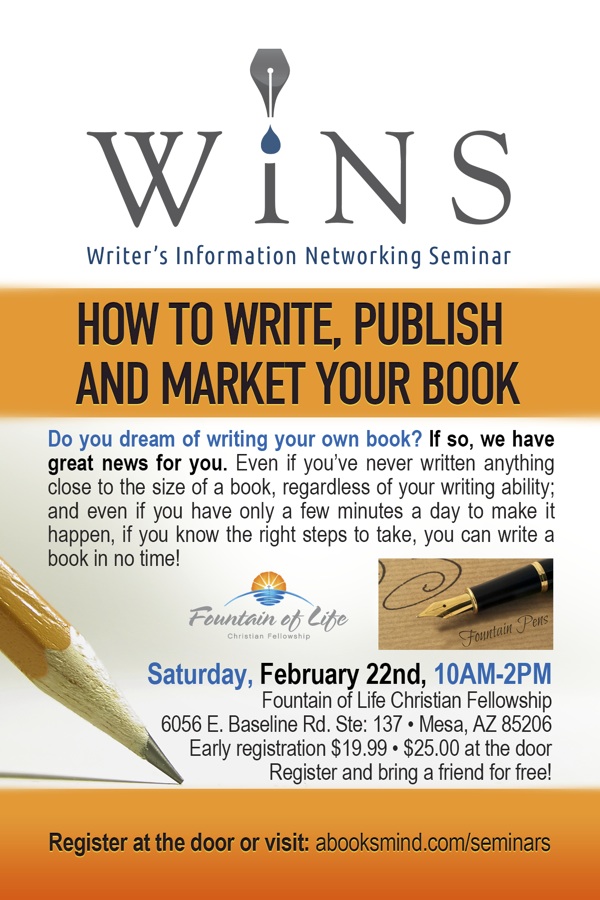
Win FREE Proofreading at WiNS Conference

Feb-22-WINS copy

Win a FREE Proofreading Prize for 20,000 words!

HOW THE CONTEST WORKS:

To enter into the contest, share both Editing Addict and A Book’s Mind on Facebook (see details below).

The winner of the contest will be the person with the MOST  registered referrals who ATTEND the WiNS Conference (minimum of nine referrals required).

PROOFREADING PRIZE can be used toward your publishing package with A Book’s Mind, or by independent editing on your own, through Editing Addict.

HOW TO ENTER:

1) Share both EDITING ADDICT and A BOOK’S MIND

a) Share Editing Addict’s Facebook Page, (remember to tag Editing Addict in the share, so you are registered in the contest).

b) Share the A Book’s Mind poster of the WiNS Conference (remember to tag A Book’s Mind, so you are registered in the contest).

2) Register YOURSELF and FRIENDS for the WiNS Conference

a) Early register yourself for the WINS conference (see poster for details)

b) Have the MOST early registered referrals who attended the WINS Conference (minimum of nine referrals required)

c) If you have already registered for the contest, let us know, and do STEP 1!

CONTEST ENDS AT THE DOOR ON FEBRUARY 22!

The Perfect Scene

[found on advancedfictionwriting.com; by Randy Ingermanson]

“Writing the perfect scene:

    1. Goal: A Goal is what your POV character wants at the beginning of the Scene. The Goal must be specific and it must be clearly definable. The reason your POV character must have a Goal is that it makes your character proactive. Your character is not passively waiting for the universe to deal him Great Good. Your character is going after what he wants, just as your reader wishes he could do. It’s a simple fact that any character who wants something desperately is an interesting character. Even if he’s not nice, he’s interesting. And your reader will identify with him. That’s what you want as a writer.
    2. Conflict: Conflict is the series of obstacles your POV character faces on the way to reaching his Goal. You must have Conflict in your Scene! If your POV character reaches his Goal with no Conflict, then the reader is bored. Your reader wants to struggle! No victory has any value if it comes too easy. So make your POV character struggle and your reader will live out that struggle too.
    3. Disaster: A Disaster is a failure to let your POV character reach his Goal. Don’t give him the Goal! Winning is boring! When a Scene ends in victory, your reader feels no reason to turn the page. If things are going well, your reader might as well go to bed. No! Make something awful happen. Hang your POV character off a cliff and your reader will turn the page to see what happens next.

For more tips on writing from AdvancedFictionWriting, click here.

[found on http://www.advancedfictionwriting.com/articles/writing-the-perfect-scene]

The Art of Conflict

[found on huffingtonpost.com; by Writer’s Relief Staff]

“Learn the art of conflict. Creating a powerful conflict and weaving it tightly throughout the story is a tricky thing to master, and can take years of practice. The catharsis that a reader will experience at the resolution, however, is worth the struggle. Conflict is what makes us interested in outcome. And your conflict must affect your characters in a way that forces them to act and grow as a result. A story with a weak conflict that leaves the characters exactly as they were at the start won’t be satisfying; your story won’t make a lasting impression.

Here’s a tip: The best way to learn how to write conflict is by reading it. The next time you’re reading a short story or novel, take note of how the author presents the main conflict and the specific ways in which the characters react to it.”

[found on http://www.huffingtonpost.com/2012/06/27/writing-tips-advice-fiction-authors_n_1628537.html]

Rehearse Your Writing

[found on dailywritingtips.com; by Mark Nichol]

“Rehearse your writing by explaining the feel of a room, a street, or a park. Is it expansive, or economical? Friendly, or foreboding? Clean, or chaotic? What do your other senses tell you? What is the noise level? How does it smell? What are the textures like? Is it easy to walk through or along, or to otherwise navigate, or do obstacles interfere?

If your story takes place in a natural landscape, describe the terrain and what associations it has based on whether it conjures a sense of grace, harmony, and peace or whether it is full of bleak, harsh, jagged features. How does the presence of vegetation, or bodies of water, contribute to the feel of the terrain? What effect does the weather produce?

Place your characters in the context of their locations by showing, without telling, whether they are at home in their setting or whether the environment is alien to them, and how they respond to their feelings.”

For more great tips from Mark Nichol, click here.

[found on http://www.dailywritingtips.com/physical-descriptions-put-readers-in-your-place]

How to Make a Who-Dun-It

[found on blog.karenwoodward.org; by Karen Woodward]

“1. Know who your murderer is and why they did it.

– What was their goal?
– What are the stakes?
– What motivates the killer?

By the end of the story make sure you’ve answered these questions in your manuscript.

2. Leave clues

The clues “do not have to be obvious or even fully explained. You’ll want to leave some “mystery in your mystery.”

3. After you finish the first draft add in clues where needed

Price’s tip: Red herrings are much easier to add in after the book is written as long as you don’t write yourself into a corner with your characters, such as explaining everything they do and why.

4. Don’t fully explain everything

Price writes: “Let your characters retain some mystery.”

People aren’t fully explained any more than they are wholly good or bad, your characters should reflect this.

5. Your protagonist doesn’t have to know everything, at least not right away

Like you and me, it’s okay if your sleuth doesn’t have all the answers and is unsure about what happened … as long as she gets there in the end.”

[found on http://blog.karenwoodward.org/2013/04/5-rules-for-writing-murder-mystery.html]

Name That Face

[found on writersdigest.com; by Elizabeth Sims]

There are many different styles of naming your characters, one is the ironic choice.

“Ironic Names

Large chunks of Alexander McCall Smith’s bestselling 44 Scotland Street series concern the difficult life of Bertie Pollock, an Edinburgh schoolboy. Two of his schoolmates are lads named Larch and Tofu. Though minor characters, they’re there for a distinct purpose.

The names interact with a savory irony. Tofu and Larch’s names obviously have been bestowed by parents with finely tuned ideals. Political correctness abounds: One boy’s name is a legume paste, the other a tree. Yet the characters, we learn from their actions and words, are as shallow and phony-hearted as their names are sophisticated.

Smith gives us, by contrast, the simple, direct, honest Bertie. He is worth more than both Tofu and Larch put together. His is an ordinary, unpretentious name; his surname, Pollock, is a common fish. Bertie, then, is the humble everyman who must endure everybody else’s idiotic, self-serving vanities.

But for pure triumphal irony, can anything top the Veneering family, of Dickens’ classic Our Mutual Friend? Such a vaguely grand-seeming name for a vaguely grand family. Simultaneously, of course, their name clues us in that they are nothing but surface. And we enjoy watching them try—and fail—to live up to their banal aspirations.

Ironic names are easy to create: Just think of your character’s opposite qualities and brainstorm liberally. Let’s say you’ve got a clumsy guy who lives with his parents and aspires merely to avoid work and download porn. You could give him an ironic name like Thor or Victor or Christian or even Pilgrim. Or you could give him a first name that’s a family surname, like Powers or Strong.

Authors who want to use ironic character names should strictly limit themselves to one per story or novel.”

To see other options of name choice from Writer’s Digest, click here.

[found on http://www.writersdigest.com/writing-articles/by-writing-goal/improve-my-writing/namedropping-finding-solid-names-for-your-unique-characters]

Plot Now, It’s Time

[found on fictionwriting.about.com; by ]

“Give Some Thought to Plot.

Writing a novel can be a messy undertaking. The editing process will go easier if you devote time to plot in the beginning. For some writers, this means an outline; others work with index cards, putting a different scene on each one. Still others only have a conflict and a general idea of where they plan to end up before diving in. If you’ve been writing for a while, you already know how your brain works and what kind of structure it needs in order to complete big projects. If you’re just starting out, then this may be something you’ll learn about your writing process as you revise your first novel.”

To read more tips from Ginny Wiehardt, click here.

[found on http://fictionwriting.about.com/od/novelwriting/tp/noveladvice.htm]

Grammar Up, It’s Important

[found on writerstreasure.com; by  ]

“Read up on Grammar, Spelling and Punctuation

Before you get offended for me saying such a suggestion, let me elaborate. There are some common misspellings found on the internet; two such lists are found here and here. “It’s and its”, “there and their”, “loose and lose” and so on. So if you make such a common mistake, people will see you as an amateur.

Grammar mistakes are as common as spelling mistakes. Some new school people say go ahead and break the grammar rules. That may be good advice for a few of them (for example, you should break the no sentence ending with a preposition rule and you’re perfectly free to begin a sentence with ‘and’ and ‘but’ if it appeals to you).

But not all grammar rules were made by stodgy people, and most make sense. If it appeals to you to break them, go ahead, but you must know the reason why you broke it in the first place, and why it wasn’t appropriate. If you don’t know that you broke a rule or why, your credibility goes out of the window.

In the same way, people make punctuation mistakes often without realizing that they did it. The confusion between “me, myself and I”, the improper and incorrect use of the apostrophe (some people have campaigned for its being banned since it causes so much confusion among people) etc has become rapidly larger and larger.

So that is why, if you really want to become a credible writer who is not governed by the rules, go read up on grammar, spelling and punctuation. A single book or two will clear confusions, enable to break rules knowing why you broke them, consciously following sensible rules and more.

Tip: – Don’t rely on Microsoft Word’s Grammar Checker. Its spell check is all right, but the grammar tool is atrocious. Many has been the time that it shows up its infamous green line under my words and calls out for incorrect and so called grammatically correct changes. Have you ever seen a “Fragment (consider revising)” call to change? It’s perfectly all right to ignore that, because you’re not writing a textbook, you’re a creative writer.”

For more excellent tips on writing from Writers’ Treasure, click here.

[found on http://www.writerstreasure.com/how-to-improve-your-creative-writing]

Prompt Your Way

[found on writingforward.com; by Melissa Donovan]

“Creative Writing Prompts

  1. You’re digging in your garden and find a fist-sized nugget of gold.
  2. Write about something ugly–war, fear, hate, or cruelty–but find the beauty (silver lining) in it.
  3. The asteroid was hurtling straight for Earth…
  4. A kid comes out of the bathroom with toilet paper dangling from his or her waistband.
  5. Write about your early memories of faith, religion, or spirituality; yours or someone else’s.
  6. There’s a guy sitting on a park bench reading a newspaper…
  7. Write a poem about a first romantic (dare I say: sexual) experience or encounter.
  8. He turned the key in the lock and opened the door. To his horror, he saw…
  9. Silvery flakes drifted down, glittering in the bright light of the harvest moon. The blackbird swooped down…
  10. The detective saw his opportunity. He grabbed the waitress’s arm and said…”
[found on http://www.writingforward.com/writing-prompts/creative-writing-prompts/25-creative-writing-prompts]