Tag: books

Feel Not Alone, Dear Writer
[found on quentinschultze.com; by Quentin J. Schultze]
“Discuss Your Writing with Writers (and Authors)
Authors need one another. Writing is personal, but learning about writing is communal. Every author depends on the work of earlier writers. This is true for style and content. We all need feedback from other writers as well as from readers. Discussing our ideas and manuscripts with other writers helps us to discover what works and what doesn’t—and why. Join a local writers group (e.g., through a bookstore), read one another’s drafts, and offer kind but honest feedback. If possible, invite some published (but humble) authors into the group. Eventually, sitting at your keyboard or staring at a notebook will not seem so lonely, intimidating, and baffling.”
[found on http://quentinschultze.com/tips-1-5-for-book-writers]
Share this:
Enter, and Resolve Thyself
[found on iuniverse.com]
“Introduce your main characters and themes in the first third of your novel. If you are writing a plot-driven genre novel make sure all your major themes/plot elements are introduced in the first third, which you can call the introduction. Develop your themes and characters in your second third, the development. Resolve your themes, mysteries and so on in the final third, the resolution.” — Michael MoorcockTo see the rest of the tips from iUniverse, click here.
[found on http://www.iuniverse.com/ExpertAdvice/20WritingTipsfrom12FictionAuthors.aspx]
Share this:
Cease Being Lost
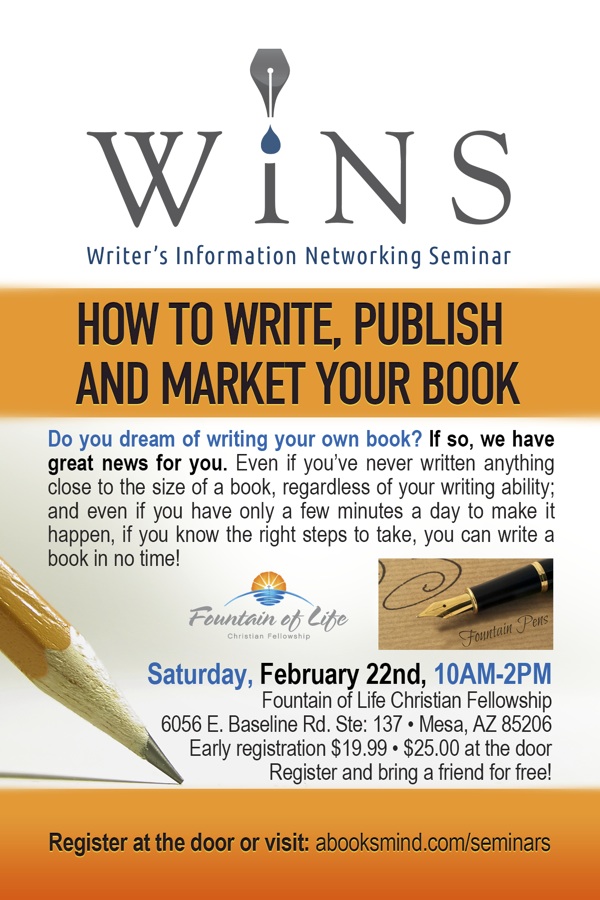
Win FREE Proofreading at WiNS Conference
Win a FREE Proofreading Prize for 20,000 words!
HOW THE CONTEST WORKS:
To enter into the contest, share both Editing Addict and A Book’s Mind on Facebook (see details below).
The winner of the contest will be the person with the MOST registered referrals who ATTEND the WiNS Conference (minimum of nine referrals required).
PROOFREADING PRIZE can be used toward your publishing package with A Book’s Mind, or by independent editing on your own, through Editing Addict.
HOW TO ENTER:
1) Share both EDITING ADDICT and A BOOK’S MIND
a) Share Editing Addict’s Facebook Page, (remember to tag Editing Addict in the share, so you are registered in the contest).
b) Share the A Book’s Mind poster of the WiNS Conference (remember to tag A Book’s Mind, so you are registered in the contest).
2) Register YOURSELF and FRIENDS for the WiNS Conference
a) Early register yourself for the WINS conference (see poster for details)
b) Have the MOST early registered referrals who attended the WINS Conference (minimum of nine referrals required)
c) If you have already registered for the contest, let us know, and do STEP 1!
CONTEST ENDS AT THE DOOR ON FEBRUARY 22!
Share this:

The Perfect Scene
[found on advancedfictionwriting.com; by Randy Ingermanson]
“Writing the perfect scene:
- Goal: A Goal is what your POV character wants at the beginning of the Scene. The Goal must be specific and it must be clearly definable. The reason your POV character must have a Goal is that it makes your character proactive. Your character is not passively waiting for the universe to deal him Great Good. Your character is going after what he wants, just as your reader wishes he could do. It’s a simple fact that any character who wants something desperately is an interesting character. Even if he’s not nice, he’s interesting. And your reader will identify with him. That’s what you want as a writer.
- Conflict: Conflict is the series of obstacles your POV character faces on the way to reaching his Goal. You must have Conflict in your Scene! If your POV character reaches his Goal with no Conflict, then the reader is bored. Your reader wants to struggle! No victory has any value if it comes too easy. So make your POV character struggle and your reader will live out that struggle too.
- Disaster: A Disaster is a failure to let your POV character reach his Goal. Don’t give him the Goal! Winning is boring! When a Scene ends in victory, your reader feels no reason to turn the page. If things are going well, your reader might as well go to bed. No! Make something awful happen. Hang your POV character off a cliff and your reader will turn the page to see what happens next.
For more tips on writing from AdvancedFictionWriting, click here.
[found on http://www.advancedfictionwriting.com/articles/writing-the-perfect-scene]
Share this:
Breathe, and Write
The Art of Conflict
[found on huffingtonpost.com; by Writer’s Relief Staff]
“Learn the art of conflict. Creating a powerful conflict and weaving it tightly throughout the story is a tricky thing to master, and can take years of practice. The catharsis that a reader will experience at the resolution, however, is worth the struggle. Conflict is what makes us interested in outcome. And your conflict must affect your characters in a way that forces them to act and grow as a result. A story with a weak conflict that leaves the characters exactly as they were at the start won’t be satisfying; your story won’t make a lasting impression.
Here’s a tip: The best way to learn how to write conflict is by reading it. The next time you’re reading a short story or novel, take note of how the author presents the main conflict and the specific ways in which the characters react to it.”
[found on http://www.huffingtonpost.com/2012/06/27/writing-tips-advice-fiction-authors_n_1628537.html]
Share this:
Pulse of a Book
“Write from the heart. A book without a pulse is like a person without a spirit.”
— Linda Radke, President of Five Star Publications
Share this:
Rehearse Your Writing
[found on dailywritingtips.com; by Mark Nichol]
“Rehearse your writing by explaining the feel of a room, a street, or a park. Is it expansive, or economical? Friendly, or foreboding? Clean, or chaotic? What do your other senses tell you? What is the noise level? How does it smell? What are the textures like? Is it easy to walk through or along, or to otherwise navigate, or do obstacles interfere?
If your story takes place in a natural landscape, describe the terrain and what associations it has based on whether it conjures a sense of grace, harmony, and peace or whether it is full of bleak, harsh, jagged features. How does the presence of vegetation, or bodies of water, contribute to the feel of the terrain? What effect does the weather produce?
Place your characters in the context of their locations by showing, without telling, whether they are at home in their setting or whether the environment is alien to them, and how they respond to their feelings.”
For more great tips from Mark Nichol, click here.
 Editing Addict, LLC